
Smallpox - Page 3
The New World
As bad as smallpox was in the Old World, the devastation that ensued upon its introduction to the Americas was of apocalyptic proportions. It was brought by the first European explorers in the late 1490s. It found in the native peoples of the New World a population entirely naive to the disease. The death rates were higher as well, approaching 90 to 95 percent case fatalities among some populations. Smallpox in these populations had a greater tendency to be the more lethal hemorrhagic type. Of all the diseases to have impacted the course of history, few can argue that this was the most significant. Two ancient and populous cultures, the Incas and the Aztecs, were all but wiped from the face of the Earth.
Smallpox Links
Smallpox Eradication Campaign
WHO recommendations on smallpox research and destruction of virus (requires Adobe Acrobat reader)
Smallpox History
Amherst and the Native Americans
The Edward Jenner Museum Homepage
Timeline of the disease
Site with Good Smallpox photos
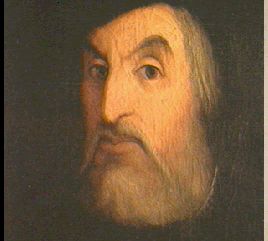
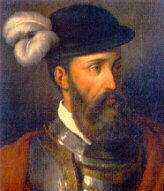
The Conquistadors Hernando Cortez (left) and Francisco Pizzaro (right) managed to subdue massive and relatively advanced civilizations in the New World with a small number of men and a few weapons. How did they manage this? Smallpox.
Hernando Cortez began his invasion of Mexico in 1519. Smallpox arrived there the same year, either carried by Cortez's men or spread from other bands of smallpox carrying explorers. Many of the Spaniards had been exposed as children and were immune to the disease, so how did smallpox make the long voyage to the Americas?. In his book Armies of Pestilence, Bray contends that the disease was first carried over by African slaved brought by the Spaniards to work the plantations of the West Indies. From there it was a matter of a few short leaps to reach the mainland. Almost simultaneous with the death of the Aztec ruler Montezuma, smallpox began to ravage the native population. The Aztecs fought well at first, but soon were dropping like flies from the smallpox epidemic. Through all this they witnessed the already immune Spaniards go practically untouched by the disease. To this highly religious and superstitious population this must have seemed like a divine curse on their people. The will to resist of those that survived was crushed. The Spaniards took the opposite view and felt that smallpox was God's way of clearing the land of savages to make way for the Faithful. 10 years after Cortez mad his initial forays, the population of Mexico had fallen from 25 million to 6.5 million and a once powerful empire ceased to exist. Pizzaro was no less aided by smallpox during his invasion of Peru against the Inca empire. Prior to Pizzaro's arrival, smallpox had already killed the Inca ruler and his heir, leading to a civil war. Pizzaro's forces were able to step in and easily subdue this weakened and war torn empire with only 180 men.
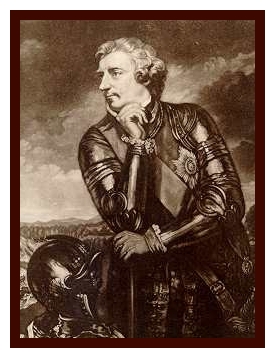
Smallpox arrived a little later in what is now the US and Canada. The effect was no less severe. Again, a population with no immunity was infected. Case fatality rates were high here as well. The Native Americans were not organized into large empires like the Aztecs, an dno clear estimates of populations exist for some tribes, but it is clear that many tribes were wiped out almost completely by smallpox epidemics. The first use of directed biological warfare on this continent was carried out by Lord Jeffrey Amherst in 1763. Amherst was an officer with the British Army during the French and Indian War. In an attempt to spread smallpox to attacking indian forces, Amherst sent blankets taken from smallpox patient's sickbeds to the Ottawa tribe under Chief Pontiac. How effective this attack was cannot be known with certainty, but smallpox was known to be prevalent in this tribe shortly thereafter. The story of this incident is detailed well at this site. As in Mexico and South America, smallpox traveled in advance of the invading Europeans, wiping out large numbers of natives and paving the way for the conquest. 2/3 of the Native American population were killed by disease in the 18th and 19th centuries, with smallpox responsible for the lion's share. This was the last major impact that smallpox would have on history, though it did continue to kill or scar millions worldwide until the mid 20th century.

Eradication ! or ?
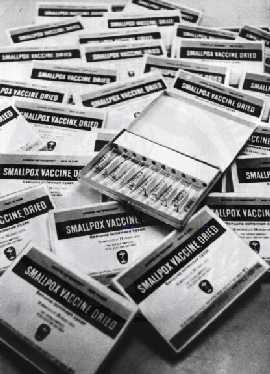
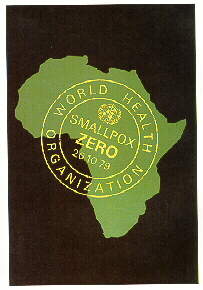
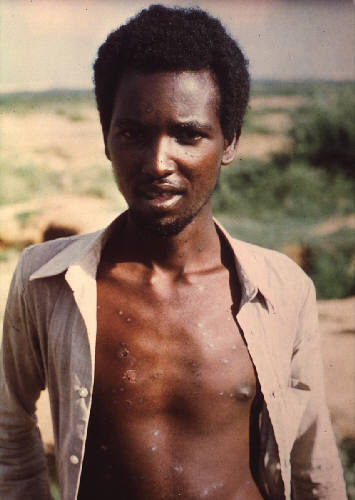
In 1958, the World Health Organization (WHO) embarged on a grand plan to eradicate smallpox from the globe in what still ranks as mankind's greatest victory over an infectious disease. Smallpox was an ideal candidate. An effective vaccine was available, smallpox cases were easily recognized, the disease occured only in humans, and there were no asymptomatic carriers. The story of this is told here. In 1977 Ali Maalin of Somalia became the last case of smallpox to occur naturally. (2 lab workers were infected accidentally in 1978 but it spread no further.) In 1980, smallpox was declared eradicated. Today, the fate of the last remaining stocks of viable Variola virus in the US and Russia is being debated. Whether or not these are the only stocks of Variola left is debated as well. (see section on biological warfare.) At any rate, to see a case of smallpox today would constitute a public health emergency of immense proportions.
References
Hopkins DR. Princes and Peasants: Smallpox in History. Chicago: Univ of Chicago Pr; 1983.
Nicolau Barquet, MD, and Pere Domingo, MD. "Smallpox: The Triumph over the Most Terrible of the Ministers of Death." Annals of Internal Medicine 15 October 1997. 127:635-642.
Bray, RS. Armies of Pestilence - The Impact of Disease on History. New York: Barnes and Noble Books, 2000.