
Plague

Links
The Black Death is perhaps the most legendary disease to have afflicted mankind. It has a history dating back to at least the Roman Empire. Its effects over the course of pandemics between the 1300's and 1600's were devastating. 1/3 to 1/2 of the population of Europe died from 1346 - 1350 in the first great plague outbreak. The population of Europe took nearly 200 years to fully recover, as continued outbreaks of the plague kept the death rates high.. It persisted for over three centuries in Europe before practically vanishing in the late 17th and early 18th century. Plague continues to be a problem today, as recent outbreaks in India will attest. The disease is also endemic in the southwestern United States rodent populations with occasional human cases to remind us that The Plague is still around.
Plague, known in early times as the Black death, is caused by the bacterium Yersinia pestis. Y. pestis is a Gram negative rod (bacillus) commonly found in rodents such as rats and prairie dogs. It is a "vector borne" disease, meaning that the bite of some intermediate host, such as a rat flea in this case, transmits the disease from one animal to another.
Y. pestis causes three distinct forms of disease in man - bubonic, pneumonic, and septicemic plague. In the bubonic form, the bacterium invades the lymph nodes, causing large swellings, or buboes, to develop. These later rupture and hemorrhage forming red/black blotches under the skin. Death usually follows in untreated cases on the 6th or 7th day of symptoms.
In the pneumonic form, the plague bacilli move to the lungs causing a severe pneumonia. The organisms are then coughed up by the patient, allowing efficient person to person transmission to take place. This process bypasses the rat and rat flea cycle and afflicts only close contacts of those that fall ill.

CDC Plague Pages
Nice Discovery Channel site on the Black Death of Europe
Effects of the Black Death on Art - Geocities web page
Firsthand accounts of the plague
Good history of The Plague in Europe
Wayson stain of Yersinia pestis. Taken from CDC plague site, click image for larger picture
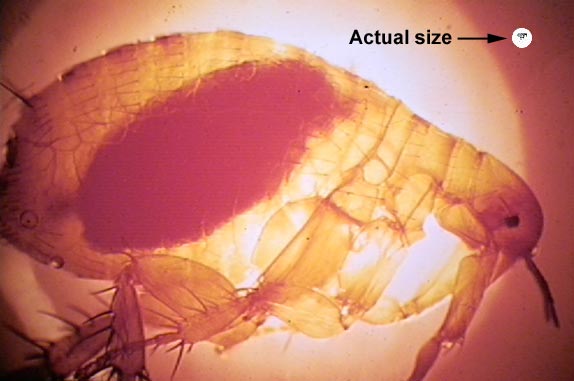
Xenopsylla cheopis, the Oriental rat flea vector of the plague (click image for larger view)
Justinian's Plague
email: [email protected]
Justinian's plague struck Egypt and the Eastern Roman Empire in the mid 6th century AD. Though less chronicled and hence less well known than the 14th century plague of Europe, this pandemic perhaps had a more profound impact on the history of Western Civilization than its successor. The plague is named for Justinian, the Emperor of what remained of the Roman Empire at that point in history. The effects of the plague are recorded by Procopius, who was secretary to one of Justinian's generals. He describes a disease characterized by fever, "bubonic" (below the abdomen) swelling and "swelling under the armpit" quickly followed by death in most cases. He records that Constantinople suffered 5000 deaths per day at one point in the epidemic, which tarried in the city for four months. An estimated 25 percent of the population of the Eastern Roman Empire was killed in the initial attack of plague, and some claim a total 50% loss over subsequent visitations. This contributed to the further collapse of the Roman Empire by denying Justinian sufficient numbers of citizens with which to fight a war. Arab nations were relatively spared the effects of the plague and proceeded to occupy the depopulated lands of the present-day Persian Gulf and North Africa. Before at last dying out for a time, this plague pandemic raged well into the 8th century and contributed to the lapse of Europe and the Wesrerm Mediterranean.

Visitor Number
The 14th Century Plague
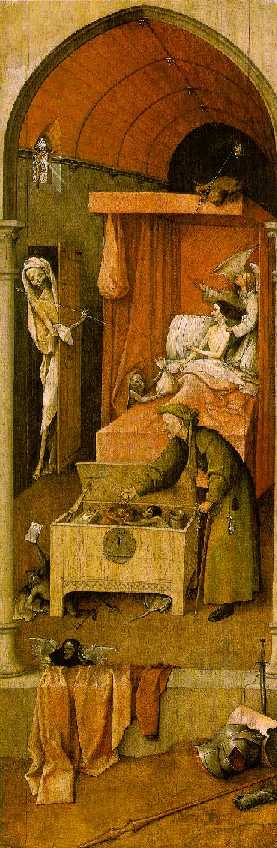
Ring Around the Rosie
Pocket Full of Posies
Ashes, Ashes
We All Fall Down
The Black Death, as it is known, fell upon the feudal Europe of Arthurian legend. It is an event that widely ingrained in our popular culture. From the Monty Python cries of "Bring out yer dead!" to the playground song of "Ring around the rosie" this event colors our lives to this day. Popular movies and books (and even this web page) play upon mankinds fear of "The Plague." In more subtle ways it colors our views of science, government, the Church, and death. It is hard to find someone who is unaware of the Black Death.
The plague pandemic of the 14th century gained its foothold in Europe at the port city of Caffa on the Black Sea. At the time this was a hub of East-West trading. In 1346 the plague epidemic struck this city, perhaps coming from Asian countries to the east. A scuffle broke out between the Tartars and the Genoese traders in the city, resulting in the Genoese retreating behind the city walls. In an attempt to drive out the Genoese, the bodies of plague victims were lobbed over the city walls in catapults. This was perhaps the earliest recorded instance of biological warfare. Because of the horrific conditions in this plague infested city the Genoese were forced to flee Caffa. They carried the plague with them to Sicily and later to the mainland of Europe. Over the following years the plague would disseminate to the major population centers of Europe.
Cities of that time were overcrowded, filthy affairs packed with the poor, destitute, and landless. The overcrowded conditions provided tinder to the fire that was about to burst upon the scene. The plague was carried from one city to the next by traders, pilgrims, or people fleeing the disease. Once established in a city, the terrible effects of the plague caused a collapse in the social structure. In his work The Decameron, written between 1350 and 1352, Giovanni Boccaccio records the effects of the plague on the citizens of Florence:
"...it showed its first signs in men and women alike by means of swellings either in the groin or under the armpits, some of which grew to the size of an ordinary apple and others to the size of an egg, and people called them gavoccioli ("bubboni" in modern Italian and "buboes" in English) And from the two parts of the body already mentioned, in very little time, the said deadly gavoccioli began to spreadindiscriminately over every part of the body; then, after this, the symptoms of the illness changed to black and livid spots appearing on the arms and thighs, and on every part of the body... ...And just as the gavoccioli were originally, and still are, a very definite indication of impending death, in like manner these spots came to men the same thing... ...almost all died by the third day of the appearance of the previously detailed symptoms.."
-The Decameron, Introduction - G. Boccaccio
This description, and others like it, clearly point to the bubonic form of Y. pestis as cause of the Black Death. Other descriptions consistent with the pneumonic or rapidly lethal septicemic form of the plague are found as well, indicating that the disease attacked people through all available mechanisms during this epidemic. Certainly the unsanitary cities provided an adequate breeding ground for rats and their fleas, giving the bubonic form its host and vector in large numbers. The overcrowding also contributed to the efficient person to person transmission of pneumonic plague. (septicemic plague can result from either mode of infection in a susceptible host.)
The plague did not spare rural Europe, however, and left vast expanses of countryside depopulated. There was a mass migration of people from city to country and country to city in a vain effort to flee the plague. A general collapse of the social order was to follow, and will be detailed in the next section.