Biological Warfare
Contents
Introduction
Biological Weapons History
Modern Biological Weapons
The Terrorist Threat
Specific Biological Warfare Agents
Biological warfare (BW) is the use of any living organism or its toxin to inflict disease or death on an enemy, his agriculture, or his equipment. Disease causing germs can be deployed with lethal intent, such as with smallpox or anthrax; or can be used to incapacitate, such as with tularemia or glanders. Agents that cause disease in plants can be employed against an enemy's crops, depriving him of food. There are also agents with corrosive properties that can be effective against equipment. All such uses have been forbidden by the Biological and Toxin Weapons Convention of 1972, though many states continue to maintain offensive BW capability.
Regulating the production of BW agents is hindeered by several factors. One is the dual use nature of much of the technology and equipment needed to produce BW materials. One example is botulinum toxin, produced from the bacterium Clostridium botulinum. It is the most potent toxin known, but has legitimate uses in the fields of plastic surgery and neurology. Approximately 90,000 Americans recieve BoTox, as it is informally known, each year in the US for medical purposes. The downside is that the same number could be killed with as little as 6 grams of weaponized toxin. Foe the metrically challenged, 1 pound could kill the entire population of New York City. The equipment needed to produce these agents often has legitimate medical uses as well. Virologic and bacteriologic culture apparatus is used by the vaccine and pharmaceutical industry and dissemination equipment is available from agricultural supply stores.
BW agents are thought of as "The poor man's nuke" by some because of the relatively low cost and ease of production. Unlike nuclear weapons, the raw materials for BW production are readily available and largely unregulated. The knowledge needed to produce these agents can be obtained with a university degree in microbiology. For this reason, biological weapons have become the primary weapon of mass destruction for many nations and terrorist organizations.

Links
Department of Defense Site
New Yorker article on modern biological weapons makers
Scientific American article on Bio-War
United States Army Medical Research Institute of Infectious Disease
Center for Nonproliferation Studies
Federation of American Scientists Biological Weapons Division
Center for Disease Control Bioterrorism Preparedness Site
Ancient History through World War II
The history of biological warfare (BW) dates back to the Black Death of 1346. The Tartars were at war with Genoese traders at the city of Caffa in the Crimea. In an attempt to transmit the plague to defenders behing the walls they lobbed bodies of plague victims over the walls. Gabriele De Mussi recorded the event as follows in 1346:
Oh God! See how the heathen races, pouring together from all sides, suddenly infested the city of Caffa and besieged the trapped Christians. They ordered corpses to be placed in catapults and lobbed into the city in hope that the intolerable stench wiould kill everyone inside.
At this time in history, diseases were thought to be spread miasmas, or foul air rising from some contaminated source. This view of disease spread was to persist until almost the 20th century in the minds of some. Possibly the besieging Tartars thought the foul air arising from plague corpses would afflict the Genoese. At any rate, the plague soon began to infect the Genoese, forcing them to abandon the city. They carried the plague with them to Constantinople, spreading the plague there as well.
Disease has been an ever present factor in warfare for as long as there have been armies. Disease and non-battle injuries (DNBI) has killed more soldiers through history than have the opposing armies. Smallpox, plague, typhus, dysentery, influenza, malaria, and cholera are but a few of the diseases that have had profound impacts on military campaigns. The directed use of microbes in warfare, however, has been of limited effectiveness to date. Smallpox played a major role in the Spanish Conquest but was spread "naturally" rather than intentionally. Lord Jeffrey Amherst, a British oficer in the French and Indian War, attempted to use contaminated blankets to transmit smallpox to the indian tribes with which he was doing battle. How effective this crude attack was is not known, though smallpox did eventually spread to the indian tribes in the area and killed many.
In the latter half of the 19th century, the work of Louis Pasteur, Robert Koch, John Snow, and others led to the acceptance of the microbial theory of disease. Not long thereafter, directed research into using microbes as agents of warfare comenced throughout the world. As early as World War I, German agents attempted to spread anthrax to allied forces using contaminated animals. There are also reports of German use of glanders against the Romanians. Neither of these attempts met with success. Though Germany maintained BW research through WWII, there are no reports of its use, perhaps out of concern about chemical retaliation by the Allies.
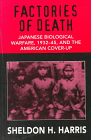
During the interwar years, the Japanese commissioned the larges BW effort of the time, the infamous Unit 731. There work was carried out on the use of anthrax, plague, cholera, and dysentery. The test subjects for these ghastly experiments were captured Chinese and later American soldiers. The activities of the murderous scientists in this unit is well detailed in the book Factories of Death by Sheldon Harris. The weapons developed here were deployed against the Chinese forces in Manchuria. In one instance billions of plague infected fleas were dropped onto Chinese villages, infecting thousands. These attacks were primarily terroristic in nature, and had no impact on the outcome of the war.
The British commenced their BW program in 1940 but never used biologicals in combat, perhaps out of fear of provoking a German nerve gas attack. The Russians began developing BW agents in 1928 with the goal of weaponizing typhus. Their work continued in earnest during World War II. Outbreaks of tularemia and Q Fever among German troops are felt to have been from Soviet attacks. The United States began development of BW agents in 1943 at Fort Detrick in Maryland and succeded in weaponizing anthrax prior to the end of WWII, though none was used. At the conclusion of hostilities in 1945 the US, Britain, and USSR possessed large stockpiles of BW agents, a massive research apparatus, and piles of information captured from the Japanese Unit 731 researchers.