 |
|
|
|
|
|
|
|
|
|
|
|
|
|
|
|
|
|
|
|
|
|
|
|
|
|
|
|
|
|
|
|
|
|
|
Influenza |
|
|
|
I had a little bird
And her name was Enza
I opened up the window
And In-flu-enza |
|
|
Influenza Links |
|
|
|
|
|
|
The most lethal pandemic of recent history came about not as the result of smallpox, the plague, or choler; but as a result of a chance mutation in the common influenza virus. Influenza is a virus that undergoes constant change. Each winter the flu season brings a slightly altered virus, just enough different from the previous year that our immune system does not recognize it well enough to prevent a new infection. This is known as antigenic drift. That is why we can catch the flu every year but rarely twice in the same year. Localized epidemics spring up during these years but there are many people with enough resistance to the new, slightly different bug to prevent major outbreaks. Every 20 years, on average, the influenza virus makes a more dramatic change, resulting in a virus that is so different that our immune system is practically helpless to prevent the infection. This is known as antigenic shift and can result in major pandemics that sweep the globe.
Influenza is a disease of swine and poultry as well as man, and novel strains can evolve over time within these animal reservoirs completely invisible to our immune systems. Eventually, these strains become radically altered from the viruses circulating in the human population. If they make the leap to human infection they catch our immune systems completely off gaurd. Both contagiousness and mortality are increased under these circumstances. This series of events occured during the winter of 1918-1919 resulting in more deaths in four months than AIDS has caused over the past 16 years (year 2000 data). |
|
|
|
|
 |
|
|
|
|
|
CDC flu information
Flu Virus sequenca database from Los Alamos National Labs
Great flu site with lots of basic science and clinical flu information
Web site to accompany PBS special on the 1918 flu pandemic
Time Magazine article on the flu |
|
|
|
|
|
|
|
|
|
Story of the 1918 influenza pandemic |
|
|
|
|
|
|
|
Back to main Epidemics page |
|
|
|
|
|
|
 |
|
|
|
The 1918 Pandemic |
|
|
|
|
|
 |
|
|
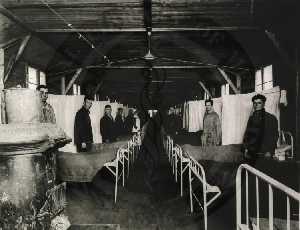
US Army flu ward during the 1918 pandemic. The sheets between the beds were placed there in an attempt to prevent person to person tansmission of germs. Image from the archives of the National Library of Medicine - Images from the History of Medicine division. For other historical flu images from this site, click here |
|
|
|
email me |
|
|
|
|
|
|
|
|
|
|
The influenza pandemic of 1918 ranks as one of the most lethal disease outbreaks in history. Caused by an antigenic shift in the influenza virus, the epidemic swept the globe killing between 20 and 50 million people. A large number of people caught the flu that year, almost 25 percent of the US population. The disease was especially lethal that year as well. Normally, influenza kills 1 in 1000 of the people it infects. In 1918 it killed 1 in 40. This combination led to the incredibly high mortality seen with that year's flu.
Another aspect of the 1918 pandemic was the high mortality rates among young adults. Infectious diseases tend to kill primarily the very young and the elderly. This flu killen an inordinate number of previously healthy adults in their 20's. The reasons behind this are not especialy clear, though some have postulated that an overwhelming inflammatory reaction brought on by the immune system was to blame. As can be seen in the picture above, the US military was hit especially hard. The pandemic hit during the latter stages of World War I, when large numbers of people were assembled in close quarters for training and deployment overseas. Military training camps and troop ships proved to be ideal breeding grounds for the flu. A physician at a military camp in Massachusetts wrote to a colleague and remarked: |
|
|
|
"One can stand it to see one, two or twenty men die, but to see these poor devils dropping like flies sort of gets on your nerves. We have been averaging about 100 deaths per day, and still keeping it up."
- Complete Text on PBS website about the 1918 flu |
|
|
|
Conditions were similarly atrocious at other US military camps, both here and abroad. A ride on a troop transport could spell a death sentence for those aboard. Troops would arive in Europe so weakened by the flu that they were barely able to march off the boat, much less fight. Training camps were closed because of the high numbers of sick soldiers crowding the camps. In some units, the flu killed far more troops than the Germans. In her book on the 1918 flu, Gina Kolata describes one unit that lost 90 men to combat during the last few months of the war. 444 died of .influenza during that same time period.
Civilian populations were not spared the wrath of the Spanish Lady, as the 1918 flu came to be known. Inuit villages were nearly wiped out, and 20 percent of the population of Western Samoa were killed in the pandemic (Garrett). Almost no place on the planet was protected from the ravages of the flu. The remains of Proctor, a small lumber town nestled in the mountains of North Carolina, lie deep within the Great Smoky Mountains National Park. A graveyard there bears witness to the devastation inflicted on even isolated rural outposts during the 1918 flu. A graveyard holds the bodies of two dozen victims of the flu of 1918-1919, this from a town of only 1000 inhabitants. |
|
|
|
Where Did It Come From? |
|
|
|
|
|
