|
Moon Point Origins, "Moon's
Point":
Jacob Moon was born
in 1781 in Berkeley County, Va. (now West Va.). He married Leah Reese
in 1806 and moved to Fayetteville County, Ohio in 1808. He served
in the War of 1812, after the war he returned to Fayetteville County and
farmed there until he and his family (wife Leah, sons Rees, Albert,
and Thomas and daughter Margaret) emigrated to Reading Twp. sometime around
1830 to 1833-- I have found several accounts giving differing dates for
the Moon's arrival, including the following on page 11 in The History
of Livingston County, 1878:
"During
the year 1830, Andrew McMillan and Garret M. Blue located on Rook's Creek,
and their descendants are numerous. Blue's name and those of his sons frequently
appear in the political annals of the county.
Jacob Moon came to
Moon's Point in the same year, and his progeny are among the most wealthy
and respected in the county."
| History does not occur in a
vacuum. About the same time Jacob and Leah were setting up housekeeping
at Moon's Point, the Town of Chicago (pop. 183) was incorporated
at the swampy mouth of an otherwise unremarkable river 100 miles to the
northwest. The town grew explosively, in 1837 it incorporated as
a city with a population of 4,000. |
Reading Twp. was
almost entirely prairie with the exception of the area along the Vermillion
River in the NE section of the township:
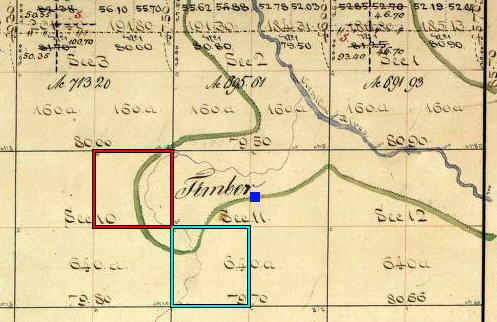
extracted and adapted from the plat found at
http://www.cyberdriveillinois.com/departments/archives/databases.html
In the early 1800s that finger of wooded
land (marked
Timber
and outlined in green by the surveyor) extending
a mile or so from the river along the course of the tributary now known
as Moon Creek would've been an extremely prominent feature of the landscape.
It's no wonder that this is where farmer Jacob chose to homestead.
On Feb. 1st, 1836, Jacob's son Albert
bought the SW quarter of Section 11 (outlined in light blue, above) from
the government for $1.25/acre. [NOTE: I had originally identified
Albert as being Jacob's brother.]
On May 18th of the same year, Jacob
bought the NE quarter of Section 10 (outlined in red, above), for the same
price. Two years later, Albert bought an additional 80 acres immediately
to the east of his first purchase (referred to in documents as "Sec. 11,
W2SE", it isn't highlighted). The blue square approximates the location
of Moon Point Cemetery.
From The History of Livingston
County, 1878:
"[The Moons] were the original and first settlers of what
is now Reading Township. They were from the State of Ohio, and, like all
early emigrants from wooded countries, were attracted by the timber and
water features of the country, and hence settled in the immediate vicinity
of the river, and near the little stream of water which now bears their
name. The point of timber, still known as Moon's Point, is one of the most
beautiful spots in this part of the country, and no wonder is expressed
that they should have been pleased with the fine scenery as well as satisfied
with the more material prospects."
The Moons and their offspring acquired
other parcels of land in Livingston and LaSalle counties over the next
20 years or so, but I haven't yet determined when or if Jacob Moon bought
the land that is now Moon Point Cemetery. According to page 154 of
The
History of Livingston County, 1878:
"The mode of making a claim in those
days was by "blazing" it out in the timber or staking it off on
the prairie. The land was not surveyed until 1833, and
every man squatted where it suited his inclination, providing no one else
had preceded him.
The federal government was offering land
as a pension benefit for the War of 1812 veterans, It's probable that Jacob
simply claimed the point of timber as his own. After the land was
surveyed he added to his holdings by purchasing the quarter-section highlighted
on the map
above.
Received from the Streatorland Historical Society, originally
dated Oct. 24, 1939:
History Crowded Into Epitaphs
in Moon's Point Cemetery Lying
Southwest of City of Streator
--------
Could the tombstones speak in little Moon Point cemetery,
a plot of ground of three acres which lies in the northeast part of Reading
Township, they could relate much concerning the lives and early history
of the pioneers who came to that section of the state even before the city
of Streator was even thought of.
A visit to this small but beautiful spot
is well worth the time and effort expended. The second turn to the
left after crossing the Vermillion river on S. Bloomington street and a
drive of about a mile and a half west brings one opposite the cemetery.
[1]
A sharp turn there forms a lane to the north through a corn field which
brings one to a set of ornamental wrought iron gates which swing from tall
red
brick pillars on each side of which are smaller gates for the admission
of pedestrians. Carved in the white stone trimmings are the words "Moon's
Point cemetery, 1921". In was in that year that a body of directors
was selected from a group of interested descendants to clear the thicket,
repair the grounds and lay the land out in lots to be offered for sale
to those desiring this spot for a burial ground. Until that time
it was quite customary to make use of the cemetery without charge or obligation.
Jacob Moon Donor.
The small tract was given by Jacob Moon,
earliest settler of the township to the community for a burial ground.
For many years George Armstrong, son of George Armstrong who came to this
community following the Moons, had the power of attorney vested in him
for disposal of the burial lots.[2]
This power passed from him to the board in 1921, which is composed of Mr.
Armstrong, George Koontz, George Baldwin, Edward Evans, and Ellsworth Allen.
Robert Arnold, whose death occurred early this year, was also a director.
No director has as yet been appointed to succeed him.
Crushed Rock Road.
The road of crushed rock that leads from the
highway to the cemetery continues through the grounds. A gentle slope
to the east and north adds picturesqueness to the setting. Protected
as it is from the highway by intervening farmland, the place becomes a
sanctum for quiet reverie and meditation.
Many of the Moons are buried there among
them the patriarch or founder of the community who passed on in 1852 at
the age of 70 years. Leah Moon, his wife, died in 1847, five years
before her husband. The stones on their graves, erected so many years
ago are still in an excellent state of preservation.[3]
Close by is the grave of Thomas Moon who died in 1844 and Albert in 1865.
Jacob Moon and his family, consisting of
his wife and children, Rees, Albert, Thomas, and Margaret came west from
Ohio in 1832.
Barickmans-Defenbaughs.
Daniel Barickman, or "Bergman" as the name was
spelled in the German language came from Ohio shortly after Jacob Moon
and it was but a short time that the township platted that year soon became
thickly settled with the two families. Daniel bringing his wife and
seven children with him- James, Upton, Jacob, Benjamin, Daniel Jr., Harriet
and Mary Ann. Practically all of them with many of their offspring
are buried in Moon's Point as the headstones indicate.
The Barackman and Moon families spread themselves
along the whole north side of the township in the wooded section, which
resembled the country from which they came.
Between 1848 and 1853 other settlers began
to appear in the township, among whom were the Defenbaughs, Bussards, Mathises,
and Mills, almost all of whom were from the old neighborhood in the east.
The original Defenbaughs were Samuel, Andrew and John. In those days
every second person one met was a Defenbaugh.
On the authority of Milton Defenbaugh, a
son of Elijah, a class of 27 students in 1874 in the village school were
all Defenbaughs but one who was Frank Teegarden. Even the teacher
was a Defenbaugh, Otis by name.
Elijah Defenbaugh was the head of that family
which consisted of his wife who was Miss Catherine Defenbaugh and children,
Ammon, Alfred, Harvey, Lucretia, Slauterbach, Milton, and Ephron.
Ammon, Milton, and their sister still reside in Reading. The others
are buried in the Defenbaugh cemetery, south of Moon Point. Elijah
Defenbaugh, at his death, left 953 acres to be divided among his children.
Zacharriah Walter, who came west on horseback in 1850 married Malinda Defenbaugh
in 1853 and he with many of his descendants are buried in Moon Point.
Many of the other Defenbaughs however are buried in the Defenbaugh cemetery
south of that place.
Other Familiar Names.
Other familiar names found in the little burying
ground were Silas Jones, whose death occurred in 1854; Hugh Grant, 1868;
Jeremiah and Mary Hoskinson, both in 1864; Wealthy Norton, 1849; James
Mason, 1859; Josiah Wolford, 1866; Sam Turk, 1883; Hetty Allen, 1867.
Then there were the Baldwins, Burtons, Mallorys, McGoverns, Arnolds, Longs,
Redferns and Koontz.
Mr. and Mrs. George Armstrong stated that
there were many, many graves there without markers, time having obliterated
all trace of mound and marble. The earliest burial, according to
stones still legible was that of Wealthy Norton in 1849.[4]
Many of the slabs have become so defaced by the hand of time that the inscription
appears as mere tracery on the corroded surface.
[1] They may have been accurate
when this was originally published, but these directions make no sense
to me. Up until 1981 there was a sweeping S curve on S. Bloomington
(Rt. 23) just south of the river. From there it was a half mile south,
then turn west (right) a half mile to the cemetery's access road.
[2] George Armstrong quoted in
the above is buried in Streator's Riverview Cemetery with his wife's family
(Plowman). His parents, George D. and Roseanne Julian Armstrong are
buried in Moon Point.
[3] Apparently there was more reverence
for the dead and respect for the surviving families back then. Since
at least the mid-1960's vandalism has been an ongoing problem in the cemetery
with many historic and irreplaceable tombstones, including Jacob and Leah
Moon's, senselessly damaged or destroyed.
[4] I'm puzzled how the author
came to this conclusion when older tombstones are mentioned earlier in
the text. |
 |
There is probably no documentation concerning the
creation of the cemetery, things like that were pretty informal back then,
but I am fairly confident that the first burial was Jacob's grandson Thomas
Moon, who died on Oct. 20, 1843 (left, full sized image available in the
Moon family listing). It simply makes sense that Jacob would've created
the cemetery upon the death of a family member. |
Moon Point, Moon's Point, Moon, Moon Creek Cemetery...
So what's in a name?
I've visited family graves there since
the 1950s and my family has been involved with Moon Point since at least
1864 (to us it was simply The Cemetery). It wasn't until I started
researching this website that I came across references to Moon Creek
Cemetery. I should point out that none of these references appear
to have been made by anyone with family buried there or having any other
affiliation with it.
The cemetery gates installed in 1921
clearly said Moon Point, but the name goes back a lot farther than
that. The History of Livingston County, 1878 makes no
mention of the cemetery itself but it does state that the area Jacob Moon
homesteaded was called Moon's Point. Even more telling, it
said that it is still referred to as Moon's Point, indicating that
the term goes back well before 1878.
More direct evidence that it was never
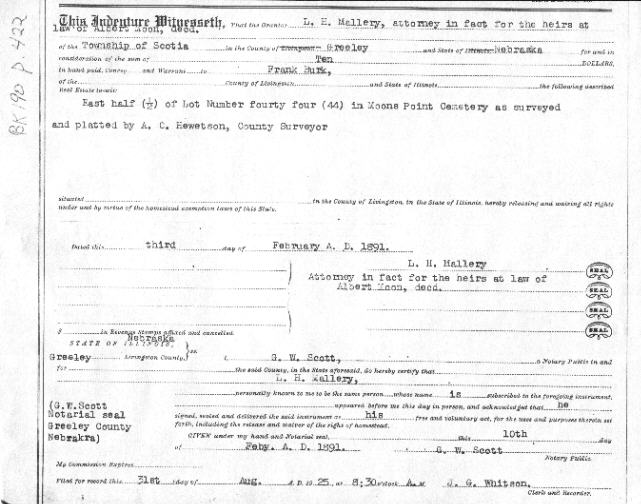
Moon Creek Cemetery may be found in a deed
dated Feb. 18th, 1891 transferring ownership of the "east half of lot fourty
four in Moon's Point Cemetery" to Frank Burk. This real estate deal
was handled by L.H. Mallery acting as "attorney in fact for the heirs at
law of Albert Moon, decd.", the heirs apparently had moved to Greeley County,
Nebraska.
Albert Moon came to Illinois from Ohio
in 1833 and settled in LaSalle county near the present town of Tonica.
In the winter of 1833 he married David and Rachel Boyle's 15 year old daughter
Elizabeth. In 1836 they moved to the land indicated in blue on the
map above. It was there, within a few hundred yards of what is now
the cemetery, that their children were born and raised.
They would've been intimately familiar
with the land even before their young cousin Thomas was buried and they
probably attended the funeral. They undoubtedly attended the funerals
of their sister Emily
J. in 1845 and their brother Thomas
J. in 1846, as well as
those of uncle Thomas
in 1844, grandmother Leah
in 1847, grandfather Jacob
in 1852, and father Albert
in 1865 (their mother Elizabeth
died three years after the mentioned transaction). They also have
Barrackman cousins buried there and they may be related to Mills and possibly
others buried in the cemetery. That they referred to it as
Moon's Point Cemetery is all the proof I need. So please-- Moon
Point, Moon's Point and Moon Cemetery are all acceptable,
Moon
Creek
Cemetery is not. |
Lawren H. Mallery, mentioned above, has
popped up many times in my research. Though he acted as "attorney
in fact" for the Moon family as far as I can determine he was not a lawyer,
although he did serve as a Justice of the Peace in Reading Twp. for a time.
He would've been a neighbor of the Moons and apparently well enough known
by them to be entrusted with the cemetery's affairs. At some point
between 1891 and Mr. Mallery's passing in 1912, George Armstrong took over
that role.
George's son Geo. Arlie related to the
author many years ago that prior to the creation of the cemetery board
in 1921 a large portion of the cemetery was considered a "potter's field"--
that is, anyone could be buried there without charge. The only stipulation
being that if the gravediggers discovered a previous burial they had to
dig elsewhere. The northeastern portion of the cemetery was surreptitiously
used by the miners that worked Streator's coalmines. Largely immigrants
and poor, they led a hard life with little or no medical care.
Infant mortality was universally high at the time,
but among the miners it was appalling. If they were marked at all
many of these 19th century graves probably had simple wooden markers which
have long since disappeared. There are so many unmarked and unknown
graves in that part of the cemetery that the cemetery board will not sell
plots
there. |