by Mike Demana (article courtesy of HMGS Great Lakes' "The Herald")
Okay, I knew my project was obscure: The Congo during the early years of its independence. However, I had no idea how difficult it would be to obtain information on the uniforms the various forces wore . This was in the 1960s, after all, when they had these amazing things called TV cameras, newspapers and magazines!
Much to my surprise, it took a lot of effort to unearth any publication of value, or rather, to conclude there WASN'T a single publication of value! Osprey's book covering UN Forces in The Congo has pages of text but no pictures or uniform information. Searches on the web or queries on The Miniature Page came up similarly empty handed. The only book that I found with actual color photos was one I referred to in Part One of this series -- "War in Peace," edited by Robert Thompson. There are half a dozen or so photos of troops in its chapter on The Congo. In one of these, five soldiers man a mortar post. One is a white mercenary in khakis, while another appears to be a mercenary in a camouflage shirt with olive drab pants. The other three are African troops. One wears olive drab shirt and pants, another olive drab shirt but camouflage pants, while the third wears civilian pants but a camouflage shirt.
This photo was basically to be my blueprint for painting this project. I figured that Congolese troops would have to scrounge for their uniforms or replacement items, resulting in various types being mixed together. My guess was that the official Congolese army, the Force Publique -- later renamed the Armee Nationale Congolaise (ANC) -- would early on be equipped in mostly olive drab. However, after a rainy season or battle or two, they'd mix in whatever khaki, camo or civilian bits they could round up.
I've always felt that fielding an irregular force like this calls upon the painter to be more organized than normal. So, I decide beforehand what colors I'm using for each figure in the batch. Since, after cleaning and flashing the figures, I glue them onto squares of cardboard for ease of handling, these temporary bases become my painting script. I literally write down onto each cardboard square something like: "Shirt = khaki; Pants = dark olive; Hat = Lt. olive." This ensures I use a variety of colors and gives different looks for the individual figures. It also enables me to organize my painting -- at a glance knowing which figs need khaki, which need a light olive, etc.
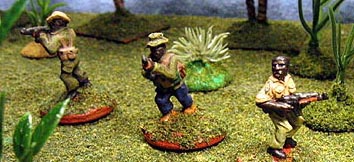 My choice for
the overall look of figures in this project was that the olive drab uniform
would predominate, what with surplus U.S. uniforms from Korea and WW II
available on the world market. Khaki would also abound, and a sprinkling
of the new-fangled (for the early 60s) camouflage uniforms would be in evidence,
too, I guessed. I even established a rough method of visually differentiating
between Militia, Regular and Professional troops -- the three types in my
Heroscape/AK-47 rules. With Professionals, I decided to paint the uniform
completely in camouflage, or olive with berets. Regulars would use a mix
of various uniform colors, as detailed above. Militia would mix in the odd
piece here and there of military color, but would be in civilian clothes
for the most part.
My choice for
the overall look of figures in this project was that the olive drab uniform
would predominate, what with surplus U.S. uniforms from Korea and WW II
available on the world market. Khaki would also abound, and a sprinkling
of the new-fangled (for the early 60s) camouflage uniforms would be in evidence,
too, I guessed. I even established a rough method of visually differentiating
between Militia, Regular and Professional troops -- the three types in my
Heroscape/AK-47 rules. With Professionals, I decided to paint the uniform
completely in camouflage, or olive with berets. Regulars would use a mix
of various uniform colors, as detailed above. Militia would mix in the odd
piece here and there of military color, but would be in civilian clothes
for the most part.
So, of course, that set off a humorous round of Google searches under "1960s Fashion" and like topics! I found that it is VERY difficult to paint a pattern to resemble a standard Western style dress shirt (which were popular in Africa in the 60s), and gave up in favor of solid colors (white or light gray looks good). More casual shirts with one or two horizontal stripes proved do-able, but even with those, I found that the more understated, the better. Tennis shoes or leather colored boots provided a good contrast for Militia from the black or dark brown military boots of the regular troops.
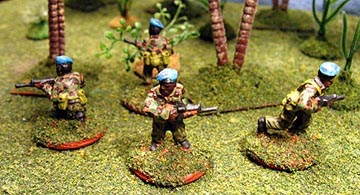
When it came time to paint my UN Forces, I decided they would be in identical uniforms, though. Their leaders of their countries knew these troops would be representing their nation and that the eyes of the world would be upon them. The light blue helmets stand out nicely, by the way, and I was even able to paint a tiny shoulder patch in the green/yellow/red colors of the Ghanaian flag. I also found that painting the letters UN on the helmet was actually very easy. All you do is paint four vertical lines. Then connect the first pair with a horizontal line at the bottom, and the last pair with a diagonal.
Another tip I found was to use more than one shade of olive drab. I have a dark Polly Scale U.S. Olive Drab acrylic paint that I used as a basecoat for the uniform, and then dry brush the much lighter Games Workshop Camo Green over. That would be my "dark olive." For the more field worn and faded "light olive," I used the above GW Camo Green as a basecoat and dry brushed a light gray over top. This gives it a nice faded look, and enabled me to do, for example, figures with dark olive pants and light olive top. The web belts, canteens, ammo pouches, etc., were painted contrasting colors from the uniform. I used a mix of khaki, olive drab, and even a Ral Partha "Elven Green" for that fresh-from-the-box look.
The figures are based and flocked individually on 3/4" fender washers. This enables them to stand upright on sloped terrain on the tabletop, and with strips of magnetic material in the figure boxes, keeps them in place during transport. One idea I had to enable the player (and his opponent) to distinguish at a glance LMG armed troops from small arms, was to make their bases different. To do this, I cut up tiny pieces of brass wire and glued them to the flocking as a final step (represents that cascade of brass from the full auto shooting!).
And perhaps the most pleasant surprise of painting my 20mm Liberation Miniatures African troops was how quickly they are finished. It takes less time to paint one of these than it does to do one of my 15mm Ancients. Honestly. It's not that Liberation Miniatures don't have much detail (they do), it's simply a modern soldier wears or carries less differently colored equipment than his Ancient predecessor. No shields with patterns to paint, no helmet plumes, no multi-colored linen armor with leather flanges -- it was quite refreshing! I fairly flew through my the first force I was painting up (ANC Colonel's force), and before I knew it, was on to the Ghanaian UN Force. Tom, Allen and Joel reported similar ease with their respective Mercenary, Communist and Religious Movement forces.
It seemed before we knew it, we'd have enough troops ready to try a game of AK-47 Heroscape...