by Mike Demana (article courtesy of HMGS Great Lakes' "The Herald")
Although I had read books on modern wars in Africa, and owned a copy of the rules "AK-47," I had never taken the plunge and bought miniatures or actually began a project. The tinder was there, but nothing had "sparked" it to get it smoking.
Two things finally provided that spark, earlier this year. The first was playing the Sci-Fi/Fantasy game Heroscape. My friend Steve Sattler had purchased it after reading rave reviews online about it. He told us about how he thought it'd make a great set of skirmish rules for other periods, too. On the night he hosted a game of Heroscape for us, I'd enjoyed it. I just didn't see how a hex-based game with heroes whacking each other with swords or robots shooting death rays at each other applied to anything I was interested in doing. It wasn't until several weeks afterwards that the rules' potential struck me.
Heroscape is a skirmish game, with "units" composed of either a single hero figure or a squad of 2-4 figures. Each figure has a designated number of Attack Dice, which can be used either at range or hand-to-hand, depending on the weapon. They also have a number of Defense Dice, which represent armor or exceptional agility to avoid attacks. Attack Dice (included in the game) have skulls representing hits on 3 of their 6 faces (50% chance), while Defense Dice have shields which cancel out enemy hits on 2 of their 6 faces (33% chance). Although this is very generic, it provides a nice balance in that no matter how many defense dice you throw, you may still not roll any saves. So, even a weaker figure could take out a stronger one with a combination of good rolling on their part and bad on the enemy's.
Anyway, one day, while jogging, I thought, "What if the number of each dice a figure received were based on a modern soldier's training?" So, a militia soldier would shoot more poorly (receive fewer Attack Dice) than a veteran, and also be equally less skilled at avoiding enemy fire (fewer Defense Dice). And what if every soldier would get bonus defense dice for being in various degrees of cover? Suddenly, Heroscape's system was beginning to seem applicable to modern skirmish warfare. Ideas flowed fast and furious that first night, as I scribbled down notes and numbers. The more I sat back and looked at them, the more these notes and charts seemed to be lining up rather closely with the basic troop classes and weapons of Peter Pig's "AK-47" rules (which I owned, but whose combat system I disliked). I was musing over the possibilities at this stage, but it still may have remained just scribbles that led to nothing if I hadn't discovered Liberation Miniatures.
 Miniatures
to 'Liberate' Your Project
Miniatures
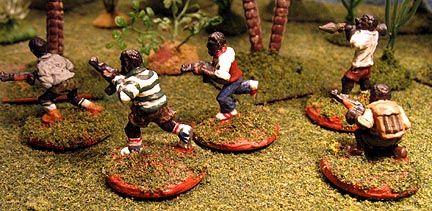
to 'Liberate' Your ProjectI had been browsing the web one day and came across photos on the internet (not THOSE kind!) of their 20mm line covering modern Africa Wars. They were really cool looking -- beefy 20mm guys firing machine guns from the hip, or unique beret or bush hat clad men slinking through the jungle. Plus, they were very affordable. Earlier, I'd priced out the number of figs I'd need in 28mm and been scared off. Looking at Liberation Miniatures, flint and steel had now collided to provide the spark. I forwarded a link to the photos (and Liberation Minis' web page) to the guys in my Sunday night gaming group. Half expecting a rebuff ("...ANOTHER period you expect us to buy stuff for, Mike?"), I was surprised by their encouragement. Go for it, they said. And in the ensuing days, as I forwarded them sections of my rules, adapting Heroscape and grafting on bits of AK-47, they became even more enthusiastic. A couple even said they might be interested in buying figs, too, when the time came.
Probably the hairiest part of combining Heroscape and AK-47 was balancing the point system. With three classes of troops (Militia, Regular, Professional), exactly HOW much more should a Professional rifleman cost than a Militia one? And how much extra should it cost to equip a figure with a Light Machine Gun? My friend Tom proved very helpful, as we bounced ideas off of each other. He would disagree with me on some areas, agree in others, discuss why he felt certain things should cost more, or less.
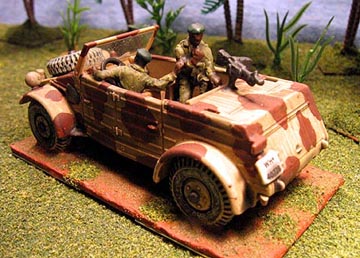
It helped the process that AK-47 already pares down the number of weapons in its rules. As my game was to be a man-to-man level game, rather than AK-47's platoon-based one, I pared the weapons types down even further. Infantry would be armed only with either small arms, Light Machine Guns, Rocket-Propelled Grenades (RPGs), mortars and/or grenades. Vehicles could be mounted with either Heavy Machine Guns or the equivalent of Recoilless Rifles, or no weapons at all. There would be only two types: unarmored Jeeps/Trucks or Armored Cars. There would be no tanks in the bush, in my Africa Wars.
Ah, but that brought up the next question to be solved: Where in Africa would my wars be fought? Although I leaned a few ways on this issue already, I checked out a few books from the library. "War in Peace," edited by Robert Thompson proved particularly helpful, providing 4-5 page synopses (with pictures!) of Africa's various 20th century post-colonial wars. I was hunting a conflict with a wide variety of local factions and foreign powers involved, to give my players as much freedom as possible in creating their forces. If one wanted to play a communist-backed insurgency, another a religious movement, and a third a super-power backed client force, I wanted these to have existed in that war. This would also allow me to fully utilize AK-47's excellent Political Maneuvering charts that help bring a player's faction to life.
After browsing through Thompson's book, there really appeared to be only one choice: The Congo. It has been argued that no colonial power prepared their African possession less for independence than the Belgians did in The Congo. Less than two years before The Congo's independence, the Belgian Foreign Service raised a huge outcry at an academic's proposal for a 25-year plan for granting sovereignty. The number of university-educated Congolese at independence was minute, and those that had been trained to take over Belgian positions of power next to non-existent. So, it is no wonder The Congo experienced a wild and wooly ride in its first years of independence.
And the foreign powers that thrust themselves into their affairs seemed never ending: Belgium aided and abetted the attempted secession of the minerally rich province of Katanga; The UN arrogantly meddled in much of the nation's affairs; The U.S. intrigued to remove the first elected Prime Minister fearing his "instability" and Soviet leanings; The USSR wormed and weaseled their way into having military forces on the ground; White-ruled Rhodesia provided a conduit for mercenary forces (and its own politics) to enter the country; Various other African states like Ghana and Egypt tried to shove The Congo along its "radical" path. So, virtually any idea a player could come up with for an African force, The Congo probably saw it.
So, part one of the project was done: I had committed to gaming Africa's Warlord Wars in 20mm, using The Congo as a historical model. The rules adaptations were pretty much done (doubtless, tinkering will go on throughout the process). The next step would be to buy the miniatures. The spark had started a fire, and now it needed fuel.
Next issue: The Liberation Miniatures Purchase and Constructing Forces