Go to page 1 |
2 |
3 |
4 |
5 |
6 |
Home
Go to page 1 | 2 | 3 | 4 | 5 | 6 | Home
Body
central
|
Streamline Your Routine
Time-crush crisis? Here's your what-to-do a d what-to-ditch list. Would you rather spend time sweating at the gym or sipping something cool with your boy? We thought so, and therefore asked Rich Barretta, owner of NYC's Duomo Gym to settle the score on how to get maximum bod benefits in minimal minutes.  Get intense. Bag yoga and upper-body stretch session; stick with cardio moves, like jumping ropes or hiking, which blast off up to 300 calories per half hour. Finishing by stretching the muscles you taxed (and toned) during cardio: hamstrings, quads and calves.
Do double time. When weight training, alternate nonstop sets of arm moves with the legs, rather than wasting time by resting in between.
Skip days. Crunches and other calisthenics will tone you when done every other day, so feel free to ditch the everyday-or-else drill-sergeant mentality.
Get intense. Bag yoga and upper-body stretch session; stick with cardio moves, like jumping ropes or hiking, which blast off up to 300 calories per half hour. Finishing by stretching the muscles you taxed (and toned) during cardio: hamstrings, quads and calves.
Do double time. When weight training, alternate nonstop sets of arm moves with the legs, rather than wasting time by resting in between.
Skip days. Crunches and other calisthenics will tone you when done every other day, so feel free to ditch the everyday-or-else drill-sergeant mentality.
|

| |
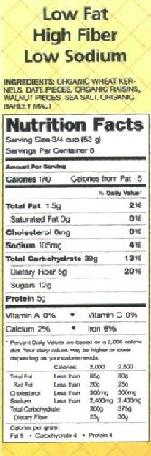 |
Want to know what goes in your food? Read the label/ here, a crash course on what you'll find: Serving sizes: How much of the product the manufacturer defines as a serving. (In this case, � cup.) All the nutritional information that follows is based on this serving size. Servings per container: Number of servings in the entire box. (In this case, 8. So if you're planning to eat the whole box, multiply the values by 8.) Calories: Number of total calories per serving. The specified "calories from fat" figure allows informs you as to exactly how much of the total calories are fat calories. The higher the number, the fattier the food. Percent Daily Values: Based on a 2,000-calorie fat diet, it's an average computation of nutritional value. Your daily values may be higher or lower depending on your minimum caloric requirement. Total Fat: Amount of fat per serving. By law, food manufacturers must reveal how much fat goes into the product. What is not specified is whether it's saturated (from animal resources, associated with high cholesterol levels and heart disease) or unsaturated (from plant resources, considered heart-healthy), so read the list of ingredients, too. |
When I lift weights, my muscles sometimes shake. What's going on?
Don't worry. Shaking limbs are very rarely a sign of anything serious. You're probably just overdoing it, or your muscles may be fatigued after doing a strenuous cardio workout, says Wayne Westcott, director of fitness research for the South Shore YMCA in Quincy Massachusetts. That's because overtaxed muscle fibers begin to spasm when trying to deal with extra stress-a heavier weight, a tricky new exercise move-but thus should stop as soon as you quit what you're doing. Luckily, steadying this shaky situation just requires a simple ease-up tip: If you're strength training, do fewer reps or switch to a lower weight until it is easy to do the standard two sets of 8 to 10 reps; If you're trying out a new move in class and get a case of shakes, ask your instructor for an easier version to build upon. If trembling continues on a regular basis after four to six workouts, see your doctor to rule out a possible neurological problem. |
|
Cholesterol:
Amount of cholesterol per serving. Sodium is often linked with high blood pressure. The recommended daily consumption is 2,400 mg, about 1 tsp. Remember, salt-free doesn't necessarily mean sodium-free.
Total carbohydrates: Amount of carbohydrates per serving. Dietary fiber: Total fiber content. Soluble fiber, found in fruits and beans, help lower your cholesterol levels and control your blood sugar levels. Insoluble fiber, contained in all plant food, especially grains, encourage regular elimination of wastes. Experts recommended 25-30g daily. Proteins: Amount of protein per serving. | ||
One out of five adult Filipinos are
overweight, while nearly 3% are obese.
overweight, while nearly 3% are obese.
-FNRI S & T Media Service, September 19999: CT Gayya
Go to page 1 | 2 | 3 | 4 | 5 | 6 | Home
© 2004 MiaCarmel. All Rights Reserved.