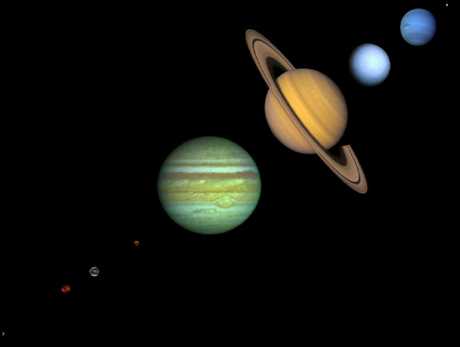
The above composite shows the nine planets with approximately correct relative sizes.
The Nine Planets of Our Solar System
This website is going to attempt to teach you some of the basics about the 9 known planets within our solar system. In addition there will be several links to pages containing more in depth information on this topic. Well, let us begin at the beginning. First, there is the Sun... or as the scientific community likes to call it, Sol. From here we slowly spiral out to Mercury, Venus, Earth, Mars, Jupiter, Saturn, Uranus, Neptune, and lastly, Pluto.
The above composite shows the nine
planets with approximately correct relative sizes.
One way to help visualize the relative sizes in the solar system is to imagine a model in which it is reduced in size by a factor of 1 billion. Then the Earth is about 1.3 centimeters in diameter (the size of a grape). The Moon orbits about a foot away. The Sun is 1.5 meters in diameter (about the height of a man) and 150 meters (about a city block) from the Earth. Jupiter is 15 centimeters in diameter (the size of a large grapefruit) and 5 blocks away from the Sun. Saturn (the size of an orange) is 10 blocks away; Uranus and Neptune (lemons) are 20 and 30 blocks away. A human on this scale is the size of an atom; the nearest star would be over 40000 km away. Now doesn't that just make you think about how insignificant we are in the grand scheme of things??
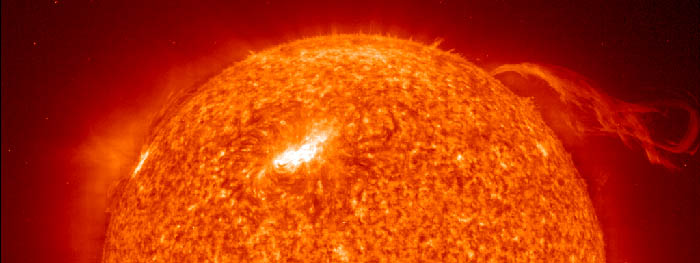
OK, now we start off with Sol (the sun). The Sun is about 4.5 billion years old. Since its birth it has used up about half of the hydrogen in its core. It will continue to radiate "peacefully" for another 5 billion years or so (although its luminosity will approximately double in that time). But eventually it will run out of hydrogen fuel. It will then be forced into radical changes which will result in the total destruction of the Earth. The Sun is an ordinary G2 star, one of more than 100 billion stars in our galaxy. The diameter of the sun is 1,390,000 kilometers and it has a mass of 1.989x10 to the 30th kilograms or 1,989,000,000,000,000,000,000,000,000,000 kilograms. Basically, this thing is HUGE and weighs a massive amount. I can't even begin to imagine the idea of a mass this great. The Sun is by far the largest object in the solar system. It contains more than 99.8% of the total mass of the Solar System (Jupiter contains most of the rest). The Sun is, at present, about 75% hydrogen and 25% helium by mass. The outer layers of the Sun exhibit differential rotation: at the equator the surface rotates once every 25.4 days; near the poles it's as much as 36 days. This odd behavior is due to the fact that the Sun is not a solid body like the Earth. The temperature at the core of the sun is 15.6 million Kelvin and the pressure is 250 billion atmospheres, or 250 times that of our own atmosphere. The surface of the Sun, called the photosphere, is at a temperature of about 5800 K.
 Sunspots are "cool"
regions, only 3800 K (they look dark only by comparison with
the surrounding regions).
Sunspots can be very large, as much as 50,000 km in diameter.
The Sun is about 4.5 billion years old. Since its birth it
has used up about half of the hydrogen in its core. It will
continue to radiate "peacefully" for another 5 billion
years or so (although its luminosity will approximately double in
that time). But eventually it will run out of hydrogen fuel.
It will then be forced into radical changes which will result in
the total destruction of the Earth.
Sunspots are "cool"
regions, only 3800 K (they look dark only by comparison with
the surrounding regions).
Sunspots can be very large, as much as 50,000 km in diameter.
The Sun is about 4.5 billion years old. Since its birth it
has used up about half of the hydrogen in its core. It will
continue to radiate "peacefully" for another 5 billion
years or so (although its luminosity will approximately double in
that time). But eventually it will run out of hydrogen fuel.
It will then be forced into radical changes which will result in
the total destruction of the Earth.
Now, off we go to the 9 planets.
Mercury
Venus
Earth
Mars
Jupiter
Saturn
Uranus
Neptune
Pluto
If you have any questions or comments you'd like to give me about this website, feel free to email me at [email protected]
Theme from Star Trek II: The Wrath of Kahn