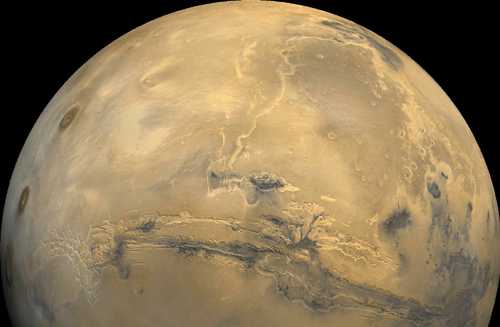
Mars is the fourth planet from the Sun and the seventh largest. It orbits 227,940,000 kilometers from the Sun, has a diameter of 6,794 kilometers, and a mass of 6.4219x10 to the 23rd kilograms. Mars is the god of War. The planet probably got this name due to its red color; Mars is sometimes referred to as the Red Planet. The name of the month March derives from Mars. Mars has been known since prehistoric times. It is still a favorite of science fiction writers as the most favorable place in the Solar System (other than Earth) for human habitation.
 The
first spacecraft to visit Mars was Mariner 4 in 1965. Several others
followed including Mars 2, the first spacecraft to land on Mars and the
two Viking landers in 1976.
The
first spacecraft to visit Mars was Mariner 4 in 1965. Several others
followed including Mars 2, the first spacecraft to land on Mars and the
two Viking landers in 1976.
 Ending
a long 20 year hiatus, Mars Pathfinder landed successfully on Mars on July
4th, 1997.
Ending
a long 20 year hiatus, Mars Pathfinder landed successfully on Mars on July
4th, 1997.
Though Mars is much smaller than Earth, its surface area is about the same as the land surface area of Earth. Except for Earth, Mars has the most highly varied and interesting terrain of any of the terrestrial planets, some of it quite spectacular:
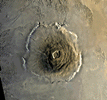 -
Olympus Mons (pictured left): the largest mountain in the Solar System
rising 24 kilometers (78,000 ft.) above the surrounding plain. Its
base is more than 500 kilometers in diameter and is rimmed by a cliff 6
kilometers (20,000 ft) high.
-
Olympus Mons (pictured left): the largest mountain in the Solar System
rising 24 kilometers (78,000 ft.) above the surrounding plain. Its
base is more than 500 kilometers in diameter and is rimmed by a cliff 6
kilometers (20,000 ft) high.
- Tharsis: a huge bulge on the Martian surface that is about 4000 kilometers across and 10 kilometers high.
- Valles Marineris: a system of canyonss 4000 kilometers long and from 2 to 7 kilometers deep.
- Hellas Planitia: an impact crater in the southern hemisphere over 6 kilometers deep and 2000 kilometers in diameter.
Much of the Martian surface is very old and cratered, but there are also much younger rift valleys, ridges, hills and plains. The interior of Mars is known only by inference from data about the surface and the bulk statistics of the planet. The most likely scenario is a dense core about 1700 kilometers in radius, a molten rocky mantle somewhat denser than the Earth's and a thin crust. Mars' relatively low density compared to the other terrestrial planets indicates that its core probably contains a relatively large fraction of sulfur in addition to iron (iron and iron sulfide). Like Mercury and the Moon, Mars appears to lack active plate tectonics; there is no evidence of horizontal motion of the surface such as the folded mountains so common on Earth. With no lateral plate motion, hot-spots under the crust stay in a fixed position relative to the surface. This, along with the lower surface gravity, may account for the Tharis bulge and its enormous volcanoes. There is no evidence of current volcanic activity, however. And though Mars may have been more volcanicly active in the past, it appears to never have had any plate tectonics.
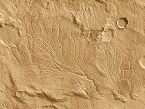 There
is very clear evidence of erosion in many places on Mars including large
floods and small river systems. At some time in the past there was
clearly water on the surface. There may have been large lakes or
even oceans. But it seems that this occurred only briefly and very
long ago; the age of the erosion channels is estimated at about nearly
4 billion years. (Valles Marineris was NOT created by running water.
It was formed by the stretching and cracking of the crust associated with
the creation of the Tharsis bulge.) Early in its history, Mars was
much more like Earth. As with Earth almost all of its carbon dioxide was
used up to form carbonate rocks. But lacking the Earth's plate tectonics,
Mars is unable to recycle any of this carbon dioxide back into its atmosphere
and so cannot sustain a significant greenhouse effect. The surface
of Mars is therefore much colder than the Earth would be at that distance
from the Sun. Mars has a very thin atmosphere composed mostly of
the tiny amount of remaining carbon dioxide (95.3%) plus nitrogen (2.7%),
argon (1.6%) and traces of oxygen (0.15%) and water (0.03%). The
average pressure on the surface of Mars is only about 7 millibars (less
than 1% of Earth's), but it varies greatly with altitude from almost 9
millibars in the deepest basins to about 1 millibar at the top of Olympus
Mons. But it is thick enough to support very strong winds and vast
dust storms that on occasion engulf the entire planet for months.
Mars' thin atmosphere produces a greenhouse effect but it is only enough
to raise the surface temperature by 5 degrees (K); much less than what
we see on Venus and Earth. When it is in the nighttime sky,
Mars is easily visible with the naked eye. It's apparent brightness
varies greatly according to its relative position to the Earth.
There
is very clear evidence of erosion in many places on Mars including large
floods and small river systems. At some time in the past there was
clearly water on the surface. There may have been large lakes or
even oceans. But it seems that this occurred only briefly and very
long ago; the age of the erosion channels is estimated at about nearly
4 billion years. (Valles Marineris was NOT created by running water.
It was formed by the stretching and cracking of the crust associated with
the creation of the Tharsis bulge.) Early in its history, Mars was
much more like Earth. As with Earth almost all of its carbon dioxide was
used up to form carbonate rocks. But lacking the Earth's plate tectonics,
Mars is unable to recycle any of this carbon dioxide back into its atmosphere
and so cannot sustain a significant greenhouse effect. The surface
of Mars is therefore much colder than the Earth would be at that distance
from the Sun. Mars has a very thin atmosphere composed mostly of
the tiny amount of remaining carbon dioxide (95.3%) plus nitrogen (2.7%),
argon (1.6%) and traces of oxygen (0.15%) and water (0.03%). The
average pressure on the surface of Mars is only about 7 millibars (less
than 1% of Earth's), but it varies greatly with altitude from almost 9
millibars in the deepest basins to about 1 millibar at the top of Olympus
Mons. But it is thick enough to support very strong winds and vast
dust storms that on occasion engulf the entire planet for months.
Mars' thin atmosphere produces a greenhouse effect but it is only enough
to raise the surface temperature by 5 degrees (K); much less than what
we see on Venus and Earth. When it is in the nighttime sky,
Mars is easily visible with the naked eye. It's apparent brightness
varies greatly according to its relative position to the Earth.