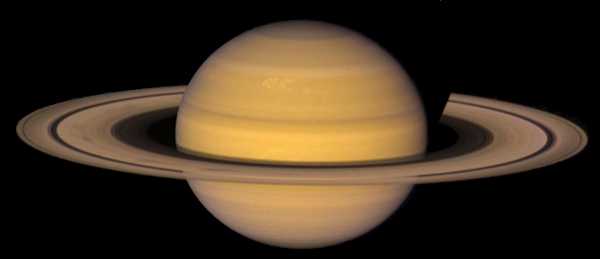
Saturn is the sixth planet from the Sun and the second largest. It orbits 1,429,400,000 kilometers from the Sun, has a diameter of 120,536 kilometers, and a mass of 5.68x10 the 26th kilograms. Saturn has been known since prehistoric times. Galileo was the first to observe it with a telescope in 1610; he noted its odd appearance but was confused by it. Early observations of Saturn were complicated by the fact that the Earth passes through the plane of Saturn's rings every few years as Saturn moves in its orbit. A low resolution image of Saturn therefore changes drastically. It was not until 1659 that Christiaan Huygens correctly inferred the geometry of the rings. Saturn's rings remained unique in the known solar system until 1977 when very faint rings were discovered around Uranus and shortly thereafter around Jupiter and Neptune).
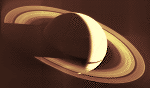 Saturn
was first visited by Pioneer 11 in 1979 and later by Voyager 1 and Voyager
2. Cassini, now on its way, will arrive in 2004. Saturn is visibly
flattened (oblate) when viewed through a small telescope; its equatorial
and polar diameters vary by almost 10% (120,536 kilometers vs. 108,728
kilometers). This is the result of its rapid rotation and fluid state.
The other gas planets are also oblate, but not so much so. Like Jupiter,
Saturn is about 75% hydrogen and 25% helium with traces of water, methane,
ammonia and "rock", similar to the composition of the primordial Solar
Nebula from which the solar system was formed. Saturn's interior
is similar to Jupiter's consisting of a rocky core, a liquid metallic hydrogen
layer and a molecular hydrogen layer. Traces of various ices are
also present. Saturn's interior is hot (12000 K at the core) and
Saturn radiates more energy into space than it receives from the Sun.
Saturn
was first visited by Pioneer 11 in 1979 and later by Voyager 1 and Voyager
2. Cassini, now on its way, will arrive in 2004. Saturn is visibly
flattened (oblate) when viewed through a small telescope; its equatorial
and polar diameters vary by almost 10% (120,536 kilometers vs. 108,728
kilometers). This is the result of its rapid rotation and fluid state.
The other gas planets are also oblate, but not so much so. Like Jupiter,
Saturn is about 75% hydrogen and 25% helium with traces of water, methane,
ammonia and "rock", similar to the composition of the primordial Solar
Nebula from which the solar system was formed. Saturn's interior
is similar to Jupiter's consisting of a rocky core, a liquid metallic hydrogen
layer and a molecular hydrogen layer. Traces of various ices are
also present. Saturn's interior is hot (12000 K at the core) and
Saturn radiates more energy into space than it receives from the Sun.
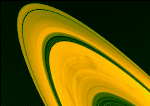 Saturn's
rings are extraordinarily thin: though they're 250,000 km or more in diameter
they're no more than 1.5 kilometers thick. Despite their impressive
appearance, there's really very little material in the rings -- if the
rings were compressed into a single body it would be no more than 100 km
across. The ring particles seem to be composed primarily of water
ice, but they may also include rocky particles with icy coatings.
Saturn's
rings are extraordinarily thin: though they're 250,000 km or more in diameter
they're no more than 1.5 kilometers thick. Despite their impressive
appearance, there's really very little material in the rings -- if the
rings were compressed into a single body it would be no more than 100 km
across. The ring particles seem to be composed primarily of water
ice, but they may also include rocky particles with icy coatings.
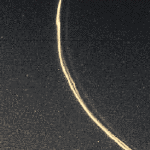 Saturn's
outermost ring, the F-ring, is a complex structure made up of several smaller
rings along which "knots" are visible. Scientists speculate that
the knots may be clumps of ring material, or mini moons. The strange
braided appearance visible in the Voyager 1 images is not seen in the Voyager
2 images perhaps because Voyager 2 imaged regions where the component rings
are roughly parallel. The origin of the rings of Saturn (and the
other jovian planets) is unknown. Though they may have had rings
since their formation, the ring systems are not stable and must be regenerated
by ongoing processes, probably the breakup of larger satellites.
When it is in the nighttime sky, Saturn is easily visible to the naked
eye. Though it is not nearly as bright as Jupiter, it is easy to
identify as a planet because it doesn't "twinkle" like the stars do.
The rings and the larger satellites are visible with a small astronomical
telescope.
Saturn's
outermost ring, the F-ring, is a complex structure made up of several smaller
rings along which "knots" are visible. Scientists speculate that
the knots may be clumps of ring material, or mini moons. The strange
braided appearance visible in the Voyager 1 images is not seen in the Voyager
2 images perhaps because Voyager 2 imaged regions where the component rings
are roughly parallel. The origin of the rings of Saturn (and the
other jovian planets) is unknown. Though they may have had rings
since their formation, the ring systems are not stable and must be regenerated
by ongoing processes, probably the breakup of larger satellites.
When it is in the nighttime sky, Saturn is easily visible to the naked
eye. Though it is not nearly as bright as Jupiter, it is easy to
identify as a planet because it doesn't "twinkle" like the stars do.
The rings and the larger satellites are visible with a small astronomical
telescope.