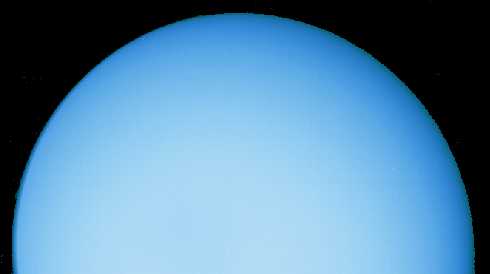
Uranus is the seventh planet from
the Sun and the third largest (by diameter). Uranus is larger in
diameter but smaller in mass than Neptune. It orbits 2,870,990,000
kilometers from the Sun, has a diameter of 51,118 kilometers, and a mass
of 8.683x10 to the 25th kilograms. Uranus, the first planet discovered
in modern times, was discovered by William Herschel while systematicly
searching the sky with his telescope on March 13, 1781. It had actually
been seen many times before but ignored as simply another star (the
earliest recorded sighting was
in 1690 when John Flamsteed cataloged it as 34 Tauri). Herschel named
it
"the Georgium Sidus" (the Georgian
Planet) in honor of his patron, the infamous (to Americans) King George
III of England; others called it "Herschel". The name "Uranus" was
first proposed by Bode in conformity with the other planetary names from
classical mythology but didn't come into common use until 1850. Uranus
has been visited by only one spacecraft, Voyager 2 on Jan 24 1986.
Uranus is composed primarily of rock and various ices, with only about
15% hydrogen and a little helium (in contrast to Jupiter and Saturn which
are mostly hydrogen). Uranus (and Neptune) are in many ways similar
to the cores of Jupiter and Saturn minus the massive liquid metallic hydrogen
envelope. It appears that Uranus does not have a rocky core like
Jupiter and Saturn but rather that its material is more or less uniformly
distributed. Uranus' atmosphere is about 83% hydrogen, 15% helium
and 2% methane.
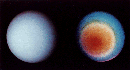 Like
the other gas planets, Uranus has bands of clouds that blow around rapidly.
But they are extremely faint, visible only with radical image enhancement
of the Voyager 2 pictures.
Like
the other gas planets, Uranus has bands of clouds that blow around rapidly.
But they are extremely faint, visible only with radical image enhancement
of the Voyager 2 pictures.
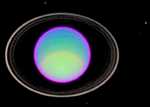 Recent
observations with Hubble Space Telescope show larger and more pronounced
streaks. Further Hubble Space Telescope observations show even more
activity. Uranus is no longer the bland boring planet that Voyager
saw. It now seems clear that the differences are due to seasonal
effects since the Sun is now at a lower Uranian latitude which may cause
more pronounced day/night weather effects. By 2007 the Sun will be
directly over Uranus's equator. Uranus' blue color is the result
of absorption of red light by methane in the upper atmosphere. There
may be colored bands like Jupiter's but they are hidden from view by the
overlaying methane layer.
Recent
observations with Hubble Space Telescope show larger and more pronounced
streaks. Further Hubble Space Telescope observations show even more
activity. Uranus is no longer the bland boring planet that Voyager
saw. It now seems clear that the differences are due to seasonal
effects since the Sun is now at a lower Uranian latitude which may cause
more pronounced day/night weather effects. By 2007 the Sun will be
directly over Uranus's equator. Uranus' blue color is the result
of absorption of red light by methane in the upper atmosphere. There
may be colored bands like Jupiter's but they are hidden from view by the
overlaying methane layer.
 Like
the other gas planets, Uranus has rings. Like Jupiter's, they are
very dark but like Saturn's composed of fairly large particles ranging
up to 10 meters in diameter in addition to fine dust. There are 11 known
rings, all very faint; the brightest is known as the Epsilon ring.
The Uranian rings were the first after Saturn's to be discovered.
This was of considerable importance since we now know that rings are a
common feature of planets, not a peculiarity of Saturn alone. Uranus
is sometimes just barely visible with the naked eye on a very clear night;
it is fairly easy to spot with binoculars (if you know exactly where to
look). A small astronomical telescope will show a small disk.
Like
the other gas planets, Uranus has rings. Like Jupiter's, they are
very dark but like Saturn's composed of fairly large particles ranging
up to 10 meters in diameter in addition to fine dust. There are 11 known
rings, all very faint; the brightest is known as the Epsilon ring.
The Uranian rings were the first after Saturn's to be discovered.
This was of considerable importance since we now know that rings are a
common feature of planets, not a peculiarity of Saturn alone. Uranus
is sometimes just barely visible with the naked eye on a very clear night;
it is fairly easy to spot with binoculars (if you know exactly where to
look). A small astronomical telescope will show a small disk.