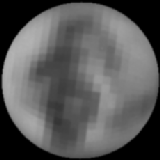
Pluto
Pluto is the farthest planet from the Sun and by far the smallest. Pluto is smaller than seven of the solar system's moons (the Moon, Io, Europa, Ganymede, Callisto, Titan and Triton). It orbits 5,913,520,000 kilometers from the Sun, has a diameter of 2,274 kilometers, and a mass of 1.27x10 to the 22nd kilograms.
In Roman mythology, Pluto is the god of the underworld. The planet received this name (after many other suggestions) perhaps because it's so far from the Sun that it is in perpetual darkness. Pluto was discovered in 1930 by a fortunate accident. Calculations which later turned out to be in error had predicted a planet beyond Neptune, based on the motions of Uranus and Neptune. Not knowing of the error, Clyde W. Tombaugh at Lowell Observatory in Arizona did a very careful sky survey which turned up Pluto anyway. After the discovery of Pluto, it was quickly determined that Pluto was too small to account for the discrepancies in the orbits of the other planets. The search for Planet X continued but nothing was found. Nor is it likely that it ever will be: the discrepancies vanish if the mass of Neptune determined from the Voyager 2 encounter is used. There is no tenth planet.
 Pluto is the only
planet that has not been visited by a spacecraft. Even the
Hubble Space Telescope can resolve only the largest features on
its surface. Fortunately, Pluto has a satellite, Charon. By
good fortune, Charon was discovered (in 1978) just before its
orbital plane moved edge-on toward the inner solar system.
It was therefore possible to observe many transits of Pluto over
Charon and vice versa. By carefully calculating which
portions of which body would be covered at what times, and
watching brightness curves, astronomers were able to construct a
rough map of light and dark areas on both bodies. Pluto's
radius is not well known. JPL's value of 1137 is given with
an error of +/-8, almost one percent. Though the sum of the
masses of Pluto and Charon is known pretty well, the individual
masses of Pluto and Charon are difficult to determine because
that requires determining their mutual motions around the center
of mass of the system which requires much finer measurements --
they're so small and far away that even the Hubble Space
Telescope has difficulty. The ratio of their masses is
probably somewhere between 0.084 and 0.157; more observations are
underway but we won't get really accurate data until a spacecraft
is sent. There are some who think Pluto would be better
classified as a large asteroid or comet rather than as a planet.
Some consider it to be the largest of the Kuiper Belt objects (also
known as Trans-Neptunian Objects). There is considerable
merit to the later position, but historically Pluto has been
classified as a planet and it is likely to remain so. Pluto's
orbit is highly eccentric. At times it is closer to the Sun
than Neptune (as it was from January 1979 thru February 11 1999).
Pluto rotates in the opposite direction from most of the other
planets.
Pluto is the only
planet that has not been visited by a spacecraft. Even the
Hubble Space Telescope can resolve only the largest features on
its surface. Fortunately, Pluto has a satellite, Charon. By
good fortune, Charon was discovered (in 1978) just before its
orbital plane moved edge-on toward the inner solar system.
It was therefore possible to observe many transits of Pluto over
Charon and vice versa. By carefully calculating which
portions of which body would be covered at what times, and
watching brightness curves, astronomers were able to construct a
rough map of light and dark areas on both bodies. Pluto's
radius is not well known. JPL's value of 1137 is given with
an error of +/-8, almost one percent. Though the sum of the
masses of Pluto and Charon is known pretty well, the individual
masses of Pluto and Charon are difficult to determine because
that requires determining their mutual motions around the center
of mass of the system which requires much finer measurements --
they're so small and far away that even the Hubble Space
Telescope has difficulty. The ratio of their masses is
probably somewhere between 0.084 and 0.157; more observations are
underway but we won't get really accurate data until a spacecraft
is sent. There are some who think Pluto would be better
classified as a large asteroid or comet rather than as a planet.
Some consider it to be the largest of the Kuiper Belt objects (also
known as Trans-Neptunian Objects). There is considerable
merit to the later position, but historically Pluto has been
classified as a planet and it is likely to remain so. Pluto's
orbit is highly eccentric. At times it is closer to the Sun
than Neptune (as it was from January 1979 thru February 11 1999).
Pluto rotates in the opposite direction from most of the other
planets.
 The surface
temperature on Pluto is not well known but is probably between 35
and 45 Kelvins (-228 to -238 C). Pluto's composition is
unknown, but its density (about 2 gm/cm3) indicates that it is
probably a mixture of 70% rock and 30% water ice much like Triton.
The bright areas of the surface seem to be covered with ices of
nitrogen with smaller amounts of (solid) methane and carbon
monoxide. The composition of the darker areas of Pluto's
surface is unknown but may be due to primordial organic material
or photochemical reactions driven by cosmic rays. Little is
known about Pluto's atmosphere, but it probably consists
primarily of nitrogen with some carbon monoxide and methane.
It is extremely tenuous the surface pressure being only a few
microbars. Pluto's atmosphere may exist as a gas only when
Pluto is near its perihelion; for the majority of Pluto's long
year, the atmospheric gases are frozen into ice. Near
perihelion, it is likely that some of the atmosphere escapes to
space perhaps even interacting with Charon. The Pluto
Express mission planners want to arrive at Pluto while the
atmosphere is unfrozen. Pluto can be seen with an amateur
telescope but it is not easy.
The surface
temperature on Pluto is not well known but is probably between 35
and 45 Kelvins (-228 to -238 C). Pluto's composition is
unknown, but its density (about 2 gm/cm3) indicates that it is
probably a mixture of 70% rock and 30% water ice much like Triton.
The bright areas of the surface seem to be covered with ices of
nitrogen with smaller amounts of (solid) methane and carbon
monoxide. The composition of the darker areas of Pluto's
surface is unknown but may be due to primordial organic material
or photochemical reactions driven by cosmic rays. Little is
known about Pluto's atmosphere, but it probably consists
primarily of nitrogen with some carbon monoxide and methane.
It is extremely tenuous the surface pressure being only a few
microbars. Pluto's atmosphere may exist as a gas only when
Pluto is near its perihelion; for the majority of Pluto's long
year, the atmospheric gases are frozen into ice. Near
perihelion, it is likely that some of the atmosphere escapes to
space perhaps even interacting with Charon. The Pluto
Express mission planners want to arrive at Pluto while the
atmosphere is unfrozen. Pluto can be seen with an amateur
telescope but it is not easy.
Well, that pretty much does it for the 9 planets within our Solar System. Below are some links connecting to sites in which you can find more information concerning the planets and the Solar System. Also, feel free to e-mail any questions you might have about this page to the following address: [email protected]
Views of The Solar System
StarChild
Exploring The Planets
The Solar System
Virtual Solar System
Planetary Tour Guide
Browse The Solar System
Our Solar System
Solar System Live
A Space Library
Windows To The Universe
Theme from 2001: A Space Odyssey