decline.
|
Sales |
|
Introduction Growth Maturity Decline |
|
Time |
 |
|||
 |
|||
(IDD Market - Hutchison Page 7)
PRODUCT
LIFE CYCLE
The
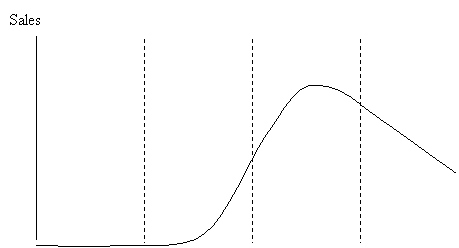
product life cycle is the course of a product’s sales and profits over its
lifetime. It involves four distinct stages: introduction, growth, maturity, and Sales Introduction
Growth
Maturity
Decline Time
decline.
Introduction
stage is a period of slow sales growth as the product is introduced in the
markets. Profits are nonexistent in this stage because of the heavy expenses of
product introduction.
Growth
stage is a period of rapid market acceptance and increasing profits. In this
stage, companies will keep their promotion spending at the same or a slightly
higher level. The firms will also use several strategies to sustain rapid market
growth. They improve product quality and add new product features and models.
They enter new market segments and new distribution channels. They shift some
advertising from building product awareness to building product conviction and
purchase, and they also lower prices at the right time to attract more buyers.
Maturity stage is a period of slowdown in sales growth because the product has achieved acceptance by most potential buyers. Profits level off or decline because of increased marketing outlays to defend the product against competition. Competitors begin marking sown prices, increasing their advertising and sales promotions. They also try to differentiate their services and images in order to stay in the market.
Decline stage is the period when sales fall off and profits drop. The decline may be slow or rapid. The decline is also due with many reasons, including technological advances, shifts in consumer tastes and increased competition.
 For
the IDD service, it has achieved acceptance by most potential consumers. IDD is
no longer a new service for the public. Besides, after the Government retrieves
the patent from Hong Kong Telecom, there is vigorous competition in the market.
‘Price war” is introduced. The competitors also focus on advertising to
differentiate their services and images. Therefore, it is considered that the
service has reached the maturity stage in the product life cycle.
For
the IDD service, it has achieved acceptance by most potential consumers. IDD is
no longer a new service for the public. Besides, after the Government retrieves
the patent from Hong Kong Telecom, there is vigorous competition in the market.
‘Price war” is introduced. The competitors also focus on advertising to
differentiate their services and images. Therefore, it is considered that the
service has reached the maturity stage in the product life cycle.
However,
for Hutchison Telecom, its IDD service is still in the growth stage. The company
should improve the service’s quality. Its advertising should also focus on
building product conviction and purchase. Moreover, the company can lower prices
and increase promotion to capture more customers.
Segmentation
Definition
The division of the total market into smaller, relatively homogeneous groups is called market segmentation.
Criteria
for Effective Segmentation
1.
The market segment must present measurable power and size.
2.
Marketers must find a way to effectively promote to and serve the market
segment.
3.
Marketers must identify segments sufficiently large to give them good
profit potential.
4.
The firm must target a number of segments that match its marketing
capabilities.
Hutchison
IDD used the demographic variable to segment its market. In demographic
segmentation, it used user status to segment its market. They were residential
segment and business segment. Hutchison segments its market to Heavy user,
moderate user and light user.
After
the segments have been identified, it is necessary to develop profiles of them,
because the profiles can help to understand their needs, so the marketers can
develop the appropriated approaches and serves to them.
For
business user, they used IDD service to communicate with their business
partners, they may require good quality rather than cheap price service. For
example, easy connection services.
For
residential user, they offer discount during the off-peak period. In order to
encourage the heavy users, Hutchison designed a mid-night plan, during
1:00am-7:00am, the charges are much lower than off peak hours and peak hours.
Page1
Page2 Page3 Page4
Page5 Page6 Page7
 Page8
Page9 Page10
Page8
Page9 Page10