Welcome once again to the Mango Bite Interview Box managed by [email protected]. Please be in touch if you have an idea for the next interview.
The Hurley-Basu residence, though having moved from Calcutta to Nara, is still a place where travelers are always welcome for a visit! This time, our interview took place by both email and directly. Maura Aunty and I interviewed 8-year old Ruby Spiegel traveling through Japan with her mother during her summer vacation this year.
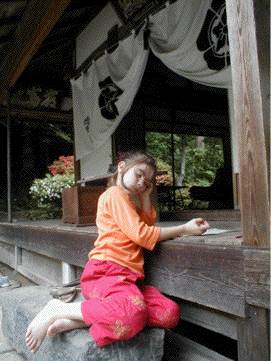 H: How was the plane ride over from New York to Nara? What were your first impressions of Japan?
R: It took 17 hours altogether with flight changes. I didn't feel very amazed because it was an airport and all airports look the same, with lots of people. There were Japanese people all around calling out foreign sounds. I fell asleep on the bus and was startled to see a lady I have never met before smiling and waving at me, with a little girl beside her. I saw a little boy walking around waving his arms saying "kukoo lookoo" I knew I was in Japan and had reached Maura's bus station. We could only be in JAPAN! It was only 5 in the morning when I woke up againŠI was jet lagged. It will always happen when you travelŠa fact of life.
H: You traveled to Hiroshima with your mother. What were your impressions of Hiroshima Peace Park and Museum?
R: I went to the Peace Park and the first thing I saw were a lot of hedges around a statue of a lady holding a baby with another baby. It reminded me of Maura with Malini and Bapuji. Then I saw these beautiful little paper cranes all around her ankles and it looked like they were coming to perch on her. They almost seemed alive and were looking at you, and they were all different colors. Then I lost sight of that because there was a mob of school children in uniforms, like we always kept seeing on the subway. Inside the park looked like an image in a book. It didn't seem real to me with all the hedges shaped so neatly. All the statues had cranes pouring out of their hands and feet. Then we passed school children saying prayers and offering flowersŠall in Japanese (which I can't speak).
In the museum, there were lots of scenes of planes and clouds of smoke. We could see a cloud of smoke that looked like a mushroom about to dissolve into thin air. At the end it showed a little crane that said, "Peace." I realized this was serious, that it was talking about peace and love. I became very serious. We could see a replica of the city before the bombing and then one after. It looked like at the end of a fire, nothing but smoky ashes, not a beautiful site to see. My mother read all the signs. We went to a computer and pressed the "English" button, and read that Hiroshima was attacked a long time ago and was rebuilt since then. This is one of the newest cities in Japan just 50 years old. That's how old my father is! I won't tell more about that. Lots of what I saw was upsetting. It is better to see this for yourself than imagine or talk about it. Everyone should see it with their own eyes, and not judge from my point of view.
H: What is the city of Kyoto like? What did you and your mother do there? Did you meet any interesting people there?
R: We stayed in an old Japanese-style house run by a man named Ian and his wife. My mom and he got a long very well. He's very nice and has good ideas about things. He recommended many good places and told us where not to go. He runs a bed and breakfast with a toilet, shower, and rooms upstairs for guests. He even has a washing machine and did our laundry, which my mother liked a lot. My favorite part was the bathroom slippers made of wood. Theses were very comfortable and I started wearing them around, until I was told I shouldn't because they were only for the bathroom.
I told my mother I wanted to go somewhere "artsy" so she took me to an indigo dyeing factory. I was excited, even when we got so lost getting there. It was like a home. There was a lady named Jane who told me she had been practicing this for four years. I asked her how much you can learn by doing this and she said you learn how to dye different fabrics and clothing and learn how to make the dye and where it comes from. There is a lot to study. I took a scarf that was white and tied it all up. First, I dipped it in a big barrel of water to soak it, then in a dye that wasn't very strong. I wore rubber gloves so I wouldn't stain my hands blue. I dipped for 50 seconds and then put it in the sun. It was green and then turned blue. I dipped it about 6 times, in the middle of every dip you put it in water so that the dye isn't able to dry. We then went to the second highest vat. It was purplish and mucky. I had to dip it in this four times. Then it was time to wait in the sun and see if it would get bluer. It did get blue so we dipped it in water and then the highest vat. This was a deep color. I took it out and waited until the color turned dark, dark blue. She examined it and finally said it looked fine. We took off our rubber boots and went into a room and opened up the ties. It was all shades of blue with little spots of white on it. This is all natural dye, no chemicals. In a week, we must wash it and let it dry in the sun.
H: What else did you try in Japan?
R:We did so many things in two weeks it is hard to name them all. I got to dress up like a geisha and get my photos taken. It took a long time to get made up and to put the costume on. We also ate lots of noodles, sushi and weird kinds of fish. We went to hot baths called onsen where you go in with many other people. We took the train places and saw temples. One day I visited a school near Maura's house and did a culture exchange talk with kids that were almost my age too. They sang traditional Japanese songs and asked questions about the life of students in the US. I played a song for them on the piano and they taught me how to make an origami peace crane in their home room class. We went to a printing studio within an old temple called Tokugenji and took the bullet train up north. Lots of things to try in Japan!
Go to:
Front cover
Mango Bite: An interview with Ruby Spiegel by Hia Mookherjee
Peace Crane Story
Mustard Seed - Japan Projects and News
Mehandi: Mini Chaterjee's cultural corner
Book Review by Jijo Raychoudhuri
The (Japanese) Public Bath by Ruby Spiegel
PEN-PAL Connections
Letter (from Mayumi)
Virtual Library by Pradeep Parekh
HAIKU for peace and people and the planet
Back cover