Southern Yankee Workshop

Custom Handmade Benches


My Lumber Yard Shopping List
The Tools That I Used
How I Made My Patterns
The Way I Sawed The Lumber
How I Made The Shapes
How I Made The Patterns
How I Did The Joinery
How I Assembled The Parts
How I Hid The Screw Holes
How I Painted This Bench
Other Woodworking Web Pages
Benches Built By Web Surfers Like You
Links To Master Carpenter Norm Abram
Links To Suppliers and Purveyors
Absolute Authority on the Minnesota Vikings
Learn More About My Woodshop

How I Made My Patterns?

Draw The Bench You Want

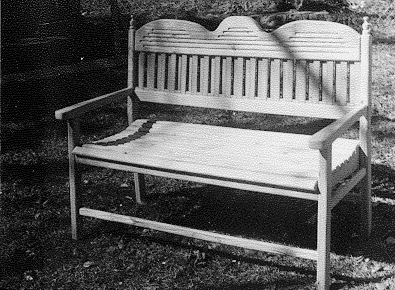
The first step is to sit down and draw a free hand sketch of what you want your garden bench to look like. I always do this because it allows me to be artistic and because I want the sketch to look at while I make my paper patterns. The only parts that change from one design to the next are the pieces that the back rest are made of. I make the same legs and arms on every bench as well as the seat profile. I do this for simplicity and because I do not need to have as many patterns this way.

Make Paper Patterns first

Next step is to make paper patterns of the pieces. I like to cut the pieces out of paper and assemble the pieces on my workbench. This was how I went about figuring out what shape the legs need to be and how high on the back leg the mortise is supposed to be for the arm and cross brace pieces that make up the left and right leg assembly when added to the legs. Another good reason to use paper to make patterns is because when folded, cutting symmetrical shapes is a breeze. Flip the patterns over and check to be sure that they are the same no matter which way you use them. Draw the shape using the pattern facing up, then turn the pattern over and line it up with the original mark and draw the shape again. If there is a difference, take note as to which side is high and which is low. The side that has the big gap between the first and second lines is low, and the side where the pattern is hiding the first pencil line is high. If you press hard onto the paper over the first line, the line will transfer so that you can know precisely where to cut the pattern. Spend some time making the paper patterns so that you work out the shape problems with inexpensive materials as opposed to the project lumber. Make these patterns full size and as accurate as possible.

Now Put Those Pattern To Use

Take the completed paper patterns and draw them on to the piece directly and cut with a jigsaw or a band saw. This is the method I used when I made my first bench. There was a lot of planing and sanding to make it all look right, but it is not impossible to make the bench this way. BEWARE of the jigsaws tendency to cut angled curves as the saw blade bends and follows the grain rather than the line. I switched to the band saw because I thought this would make that particular problem go away. I was almost right. A band saw does not do this, but I have had the band saw cut a dome for the same reason, because the blade followed the grain rather than the line. The problem is caused because pressure treated wood is so wet when you first get it. If you let it dry it twists and warps. Make the bench with wet wood, because the pieces will stay straight as they dry with the rest of the bench because the mortise and tenen joinery is all helping to hold this bench�s shape together and will help maintain this shape as the bench dries out. I made several benches with the jigsaw, but I thought there had to be a better way.

The Band Saw

If you have a band saw, there is an easier and quicker way to cut all these pieces out. I usually always cut close to the line leaving it in place and then I use a belt sander to sand down to the line and complete the profile. Sometimes, it is a good idea to look at exactly how the wood will be fed into the band saw because if you draw the shape on the wrong side of the wood, it will be harder to cut the shape with the band saw. Put some thought into this when setting up all the pieces to cut the shapes.

Clean As You Go

It is always good wood shop practice to clean up all the messes as you complete each task. This makes for a healthier place to work and makes it easier to keep on task because you can lay all the pieces out in an orderly fashion. I always wear OSHA approved dust masks when working with pressure treated lumber because I do not want to have that saw dust in my body

Thank you for spending time looking at my web page.

� 1999 Southern Yankee Workshop


E-Mail us for further information by clicking on the copyright above.


Counter


This page hosted by Get your own Free Home Page
Hosted by www.Geocities.ws

1