|
|
|
|
|
| |
DESIGN
OF AN ONLINE AUTOMATED SNP VIEWER |
| |
| |
ABSTRACT |
|
|
| |
| |
Single-nucleotide polymorphisms
(SNPs) have become increasingly important in the drug
development process of pharmaceutical companies. Pharmacogenetic
research relies on SNP-information to reveal why individuals
differ in their abilities to absorb or clear certain drugs
and to help determine why an individual may experience
adverse side effects to a particular drug. |
|
| |
| |
Information regarding SNPs can
be found at many different sources and in various databases.
However none of these resources provides all the information
needed for meaningful pharmacogenetic research. AstraZeneca
have decided to overcome this problem by consolidating
SNP information from different resources and by developing
appropriate tools for productive SNP analysis. |
|
| |
| We have designed a system for
automated mining of SNP-information and the generation
of new information previously unavailable. An interactive
viewer was developed to aid visualisation of the gene
of interest, the coding region, the SNP locations and
the effects of the polymorphisms at the protein level.
The developed system provides a template for the identification
of SNPs that might play key role in disease genes or genes
with differential behaviour on drugs and medical treatments. |
| |
| |
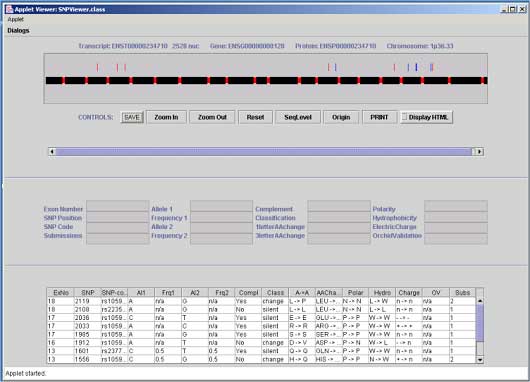
| The Initial Applet View. |
| |
| |
|
|
| |
| |
| The applet window is divided
into three distinct sections (separated by horizontal
lines). |
| |
 The
top division contains four visual components. The
top division contains four visual components. |
|
| |
 A
line of information declaring the chromosome/arm number
and the accession numbers of gene (Human Gene entry),
transcript (Human transcript entry) and protein (Human
Protein entry) associated with the viewed transcript. A
line of information declaring the chromosome/arm number
and the accession numbers of gene (Human Gene entry),
transcript (Human transcript entry) and protein (Human
Protein entry) associated with the viewed transcript. |
| |
The
transcript bar showing the exons in black colour and the
spaces between them in red. The SNPs are presented as
coloured lines above the transcript bar (red for change,
blue for silent and yellow for UTR SNP). |
| |
A
collection of control buttons that perform a number of
actions |
|
| |
A
scrollbar for navigation of the transcript |
|
| |
|
|
| The
middle division contains a collection of text fields that
display information. A label (blue text) next to each
text field declares the type of information displayed
in that text field. |
| |
| The
bottom panel displays an Excel-like table containing all
the information associated with each SNP. |
| |
| The applet also contains an
extra button at the top left corner of the window called
“Dialogs” that provides help and version information. |
| |
| |
| |
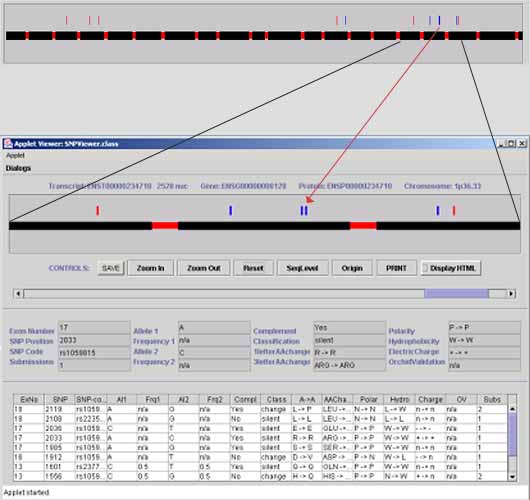
The zooming capabilites of the
system is demonstrated below (either by button zooming
and scrolling to the desired area or by directed zooming
on a specific exon). The red arrow shows how clustered
SNPs become distinguishable after zooming. After the third
zoom-in the SNP rectangles increase in width to allow
easier selection.
|
|
| |
|
|
| |
| |
|
|
| |
|
|
|
| |
|
|
| |
REFERENCES: |
|
|
| |
|
|
| Marth GT, Korf I, Yandell MD,
Yeh RT, Hu Z, Zakeri H, Stitziel NO, Hillier L, Kwok PY,
Gish WR (1999). "A General approach to single - nucleotide
polymorpshism discovery", Nature Genet.
23, 452-456 |
| |
| Smigielski EM, Sirothkin K,
Ward M, Sherry T (2000). "dbSNP: a database of single
nucleotide polymorhisms", Nucleic Acids Research.
28(1), 352-355 |
| |
| Tolle R (2001). "Information
technology tools for efficient SNP studies", AM
J Pharmacogenomics. 1(4), 303-314 |
| |
| Kirk BW, Feinsod M, Favis R,
Kliman RM, Barany F (2002). "Single nucleotide polymorphism
seeking long term association with complex disease",
Nucleic Acids Research. 30(15), 3295-3311 |
| |
| |
| |
| PREVIOUS
PROJECTS: |
| |
| SNP
Viewer |
|
| Kinesins
Structural Bioinformatics |
|
| Microarray
Data Analysis |
|
| Methylation
Studies in Cancer |
| |
| |
|
|
|
|
| |