|
|
|
|
|
| |
METHYLATION STUDIES OF CASPASE 8 AND E-CADHERIN
|
| |
| |
ABSTRACT |
|
|
| |
| |
Promoter CpG island
methylation is known to be associated with inactivation
of tumour suppressor genes in neoplasia. Caspase-8, a
cysteine protease of the apoptotic pathway is frequently
inactivated by methylation in neuroblastoma, a childhood
tumour of the peripheral nervous system. The methylation
and silencing of caspase 8 confers resistance to apoptosis
and ultimately promotes amplification of tumour cells.
The E-cadherin tumour suppressor gene is also a common
target for hypermethylation in various leukemias and carcinomas.
It has been recently proposed that methylation reflects
the dynamic loss of E-cadherin expression during metastatic
progression. |
|
| |
| |
This study examined the promoter
methylation state and mRNA expression of caspase 8 and
E-cadherin in control cancer cell lines and six formalin
fixed stage IV neuroblastoma tissues. The promoter hypermethylation
of caspase 8 and E-cadherin was determined by utilizing
sodium bisulfite treatment on DNA extracted from those
cell lines and tissues followed by methylation-specific
polymerase chain reaction (MSP), methylation-specific-single-strand
conformation analysis (MS-SSCA) and direct bisulfite-DNA
sequencing of PCR products. The mRNA expression of the
genes was studied by reverse-transcriptase polymerase
chain reaction (RT-PCR). |
|
| |
|
|
| |
We found that E-cadherin is
heavily methylated in the malignant 231 breast tumour
cell line and also showing low levels of methylation in
three of the neuroblastoma tissues. Caspase 8 was heavily
methylated in three of the neuroblastomas cases while
the other three showed a heterogeneous mixture of methylated
and unmethylated DNA. SSCP and DNA sequencing analyses
indicated that the methylation pattern is unstable and
might correlate with the heterogeneous loss of genes during
tumour progression. |
|
| |
|
|
| |
|
|
| |
|
|
| |
|
|
| |
|
|
| |
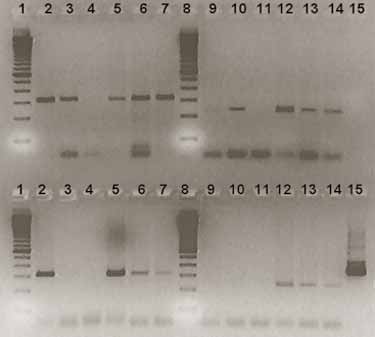
Methylation status of the bisulfite
treated samples.
Unmethylated amplicons are shown in upper row while the
methylated are shown in the bottom row. Lanes 2-7 represent
amplification of caspase 8 gene while lanes 9-14 correspond
to E-cadherin. Case 1 (lane 2) shows caspase 8 to be methylated
at a ratio of 1:1 unmethylated/methylated. Case 4 neuroblastoma
shows strong methylation of caspase 8 (lane 5) at a ratio
of 1:3 unmethylated/methylated. Case 5 shows methylation
of caspase 8 and E-cadherin (lanes 6 and 13 respectively)
at a ratio of 3:1 unmethylated/methylated for both genes.
|
|
| |
| |
|
|
| |
|
|
| |
| |
|
|
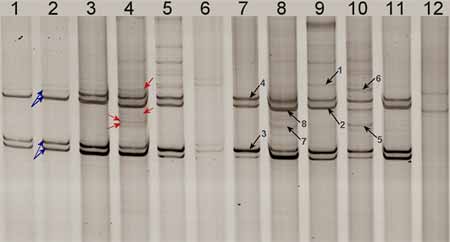
MDE gel electrophoresis
for Single Stranded Conformation Polymorphism analysis.
Caspase 8 heterogeneous alleles, duplicated by Taq polymerase
3' A-overhangs (Forrest et al., 2000) are shown as the
two pairs of strongest bands in each lane (blue arrows).
In the first two lanes of 11-B where the wild-type sequence
is present there are no other polymorphic sequences. The
same is also observed in the case of the unmethylated
amplified sequences (lanes 3, 5, 7, 9 and 11). However,
the methylated
sequences (lanes 4, 8, 10) show high variation in their
molecular structure from one another and this is visible
in the multiple bands of each lane (red arrows). |
|
| |
| |
|
REFERENCES: |
|
|
| |
|
|
| Baylin S.B, Herman J.G. (2000).
"DNA hypermethylation in tumourigenesis", Trends
Genet, 16: 168-173. |
| |
| Budihardjo I, Oliver H, Lutter
M, Luo X and Wang X. (1999). "Biochemical pathways
of Caspase activation during apoptosis", Annu
Rev Cell Biol, 15: 269-90 |
| |
| Burri N and Chaubert P. (1999).
"Complex methylation patterns analysed by single-strand
conformation polymorphism", Biotechniques,
26: 232-34. |
| |
| Robertson K.D and Wolffe A.
(2000). "DNA methylation in health and disease",
Nature Rev, 1:11-19. |
| |
| |
| |
|
|
| PREVIOUS PROJECTS: |
| |
| SNP
Viewer |
|
| Kinesins
Structural Bioinformatics |
|
| Microarray
Data Analysis |
|
| Methylation
Studies in Cancer |
| |
|
|
| |
| |
| |