
|
Ludwigs |
|
Apistogrammas Killifish L/F White Cloud + Tetras |
|
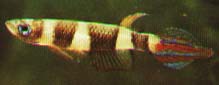
Epiplaty annulatus |
|
Like all Epiplaty the annulatus loves if the sun shines into the aquarium, and the males begin then usually to drive. If the female does not want to breed, the male will threaten her, with a violent tail strike, until the female is willing. At the breeding both fish press themselves together in to the substrate. The sticky eggs are put in to plants, root of floating plants and such things like nylon yarn or artificial fibre Wool, which is gladly accepted, the eggs can be carefully collected. I prefer searching the eggs from the breeding substrate and keep the eggs in a small container until the hatch. The eggs are scarcely l mm large and yellowish coloured. After 10-11 days at 22�C to 24�C there hatch, the egg yolk are consumed after 11-12 days. Then the young fish are 3.5 mm and must be fed new hatchet Brine Shrimp, Paramecium and fine dry food will be taken immediately. If one pays attention to clean water the first weeks, the rising of the baby is not difficult. After 4-5 weeks the young fish are 7-8 mm long and shows some of the annulatus marking. Young annulatus grow slowly and have to be at least half a year old before the are ready for breeding for the first time. |

|
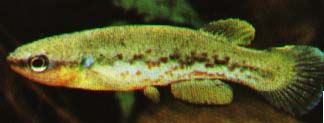
Rivulus cylindraceuse the animals are relatively easily to breed, but interesting for the beginner and for the advanced hobbyist. Since the Rivulus breeds on command, one can observe the breeding act well. If the female is ready to breed you can see the eggs in the belly from the side. for plants use Myriophyllum, nylon wool is also suitable. the water temperature is 23� to 25� C. Already a short time after, the male drives the female violently. Soon after the breeding takes place, where the male presses himself to the side of the female. Approximately two hours depending upon size of the females 10 to 50 eggs are laid. If the spawning is finish, one can see the female belly is empty, one catches the fishes out of the breeding tank. The transparent eggs are about 0.8 mm. The development of the embryo in the egg takes about. 12 days on 25� C, One guards against too lower water temperature, otherwise a part of the eggs go fungi. Soon after the dark looking young fish will hatch, they go searching for food. I fed the fry with best success fresh hatched Brine Shrimp, Paramecium and fine dry food, in the case of plentiful feeding there growing up well, although growth precedes generally rather slowly. At the age of 7 months at best, we can breed the Rivuilus for the first time. |
|
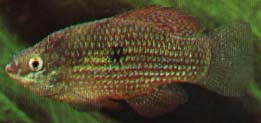
Jordanella floridae, American Flagfish the magnificently coloured male of the killi family, maintains its brood. In addition he builds a pit in the ground with the help of the fins. Into this pit the female put the eggs, after driven hart from the male before each mating, 5 to 10 completely clear eggs will be laid at each spawning, which can be recognised only with difficulty. The male fertilises them directly. In the whole 70 to 150 eggs are delivered, depending upon age and condition of the pair, the male guards the eggs. In small breeding Tank one should remove the female immediately after the eggs Laid. In larger Tank she can remain until the eggs hatch and the young fishes are swimming free, now we take her, as well as the male out of the breeding tank. The young fish hatch after 6 to 9 days. They are very fast growing and accept immediately fresh hatchet brine shrimp, one can give also fine dry food, which the fish eat gladly, however the young fish need also plentifully algae or fine cut Zucchini, spinach or so, if they are to develop well. Under best conditions they are ready to breed after 4 months. One breeds American Flagfish best in a sunny with lots of Algae infested aquarium. The breeding Tank needs not to be large; Aquariums with contents of 15 litres upward are sufficient. In reference to the temperature they are quite insensitive, but the tempera�ture between 20� and 23� C is best. The Water condition is not very important. They can take very hard or soft water. One must consider to their need for vegetable food, if one wants to keep them healthy. |