
|
Ludwigs |
|
Apistogrammas Killifish L/F White Cloud + Tetras |


|
Cynolebias whitei and constanciae |
|
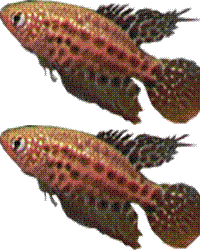
fill a plastic container [Margarine] with boiled peat 4 cm high and place into a corner of 30-40 cm Aquarium. The Cynolebias whitei as expressed substrate breeder find very fast out, where they can Spawn. Since they borrow themselves nearly completely into the soil, substantial injuries can occur with hard and often sharp edged gravel. Therefore the Fishes prefers the soft peat. How does the Spawning take place? 10-15 seconds the dear partners remain in the garden peat, whereby some eggs being laid and fertilised? First the male appears again, and a few seconds later the female. This remarkable play repeats itself until the eggs are exhausted, after 14 days one can remove the plastic container carefully from the aquarium and pour all content through a net. after the peat is only lightly damp bag it up in to a Plastic Bag, Since the eggs of Cynolebias are not light sensitive, for short time one can examine the peat how "productive" the whitei was the eggs are 2 mm of Size if you see a few one can be sure the are lots more in the peat. The producing duration of the eggs amounts to about 10-12 weeks, depending upon moisture content of air and temperature. Fill an Aquarium after this period with water 10-12 cm high. Then put the peat with the eggs in to the new set up tank the Cynolebias eggs will start hatching after one hour. Those already 5 mm large, nearly black coloured young fish can be Feed with new hatchet brine shrimp and fine try food. One will be able to admire with joy, how quickly the Cynolebias grow up. |
|
Hatching Killifish Eggs: plant spawners |
|
With the exception of a few species, killifish will spawn with regularity, depositing a few eggs daily in the spawning medium provided. A synthetic mop, made of nylon or acrylic yarn, has proven to be the most practical medium for the plant spawner, (most species of Aphyosemion and Roloffia] The eggs can be easily picked from the mops and then water incubated in small containers. (The eggs are very soft when first deposited and they should not be picked until they have had time to harden.) The incubation period of killifish eggs is 2+ weeks for most plant spawners Infertile or infected eggs should be removed to prevent the good ones from going bad. It is not necessary to check daily, except to observe the egg development and to look for fry. If water incubation proves to be unsuccessful, and it is certain that the eggs are initially fertile, many hobbyists will incubate the eggs on top of peat moss, a method that reduces the possibility of infection. The peat moss should be boiled before use and then packed into a small Container such as a petridish a thin layer will do. After the eggs have been placed on top, the container should be covered with a lid to avoid excessive evaporation. Eggs can be collected and placed in water and then transferred to the peat moss. It is important that the eggs do not touch each other, to reduce the chances of them becoming infected. After the eggs are fully developed, they can be placed in water for hatching. Although the incubation time, on the average, will be longer using this method |
|
|
|
Hint 1 Teaspoon of cooking salt to every 4 ltr will prevent velvet, the most common killifish disease |