DEPARTMENTS
• Autobiography
• Genealogy
• Pictures
• Activities
• Elementary
• Secondary
• Fashion designs
• Poems
• Short Stories
• Medical History
• Newspapers
• Yasemin Tayfur
• Bohol
• Loboc 400
• BENEFACTORS
• How to help
LOBOC 400
• A
magical, nostalgic visit to Loboc
• Loboc
400 Matron Queen International
• First
runner-up
• Second
runner-up
• Third
runner runner-up
A magical, nostalgic visit
to Loboc
By Leo P. Udtohan
WHEN the first Spaniards arrived, they saw on the riverbank a house owner who was pounding rice. When the foreigners asked what the name of the place, the man thought the strangers asked what he was doing, so he answered: "ga loboc (I am pounding rice)" And the place was named Loboc.
***
The story was a favorite subject in my history class (not to tell the history subjects I have had taken up in college) that came to mind when found out that I was going to Loboc for Bolibokingking, a festival held on May 24 in honor of their second patron saint Mary Guadalupe. Traditionally, the townfolks don their best clothing made up of local products. Participated in by every barangay, the participants would then dance their way to the church. My friend, who was hungry at that moment whispered, "what's the use of having a bolibokingking festival in this modern age?" I paused for a moment and gave him the faintest idea - As we move further, much of the tradition is forgotten and eventually gone. There is a need to revive and preserve our cultural heritage for the future generations to appreciate.
Bohol's capital
After the euphoric celebration,
we had a good time visiting the second oldest church in Bohol, the Loboc
river cruise and the tarsier habitat. At present, the town of Loboc is
composed of 28 barangays. Traveling to Loboc is not a problem, since all
of the major bus companies in Bohol ply the lucrative road going to the
world famous Chocolate Hills in Carmen. It is only a half-hour drive from
Tagbilaran city that is by bus. If one will travel by public transportation,
it will take you almost one hour. If you are from Balilihan-Sikatuna route,
you can take the short cut which will cut your travel by hours. Loboc has
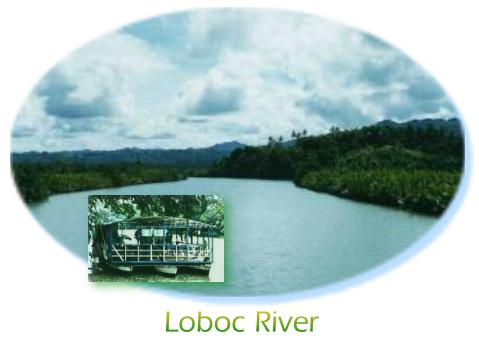
given way to tourism development, but its mysterious-longest Loboc River,
old-centuries St. Peter Church and the people remain unchanged. Much about
Loboc has changed, remember luminaries, foreign dignitaries and people
of different walks of life have been to this place-but the river, the church
and the people remain the same. From the historical point of view, Fray
San Antonio, wrote an account about this place between 1738 and 1744 stated
"that Loboc had been the capital of Bohol twice. The (entire) island of
Bohol belongs to the province and jurisdiction of Cebu. The island of Bohol
is oval in shape, divided into six sectors formed by six principal rivers.
The toast begins at Loboc, its capital, and the point that forms the bar
of the Cauliron River is northeast by east to southeast by west of it at
a distance of six leagues. The town of San Miguel de Hagna is located between
this point and that of Loboc." Again, Loboc became the capital of Bohol
for the second time during the Japanese occupation. In Bohol Guerillas
in Action by Pio Fernandos, he wrote "On Jan. 23, 1943, a conference was
held in Loboc the provisional provincial capital, which was attended by
all the provincial officials and all high officers of the Bohol Force."
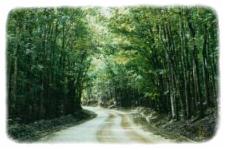
The Loboc man-made forest.
Another proof was the inscription of the Plus Ultra, Latin for "and beyond"-the coat-of-arms embossed at the Loboc Church, which according to historian-lawyer Simplicio Apalisok is the only one in the country he had known. The coat-of-the-arms of the kings of Spain represented their overseas possessions.
Around 1604, the Jesuits
established a Seminario-Colegio, a boarding school for boys. The first
stone church was built in 1602. It was destroyed by fire in 1638 and rebuilt
around 1670. In 1734, a bigger church was built beside the site of the
older one. This is the Loboc church presently standing, a fine example
of Jesuit colonial architecture of the 18th century. There were two saintly
figures lived and were buried inside the Loboc church: Fr. Alonso de Humanes,
SJ, whose gravesites became the object of pilgrimages after his death in
1633, and the remarkable native boy, Miguel Ayatumo, a student of the Seminario-Colegio,
who died on the odor of sanctity at age 16 in 1609. The church contains
interesting treasures: the decorative stone carvings and friezes on the
exterior walls; a relief of St. Ignatius in polychrome stucco intriguingly
hidden behind the main altar,; seven ancient retablos from both the Jesuit
and Recollect periods; ceiling murals and the unique three-storey convento,
the only one of its kind in the country.
Music capital
With renowned Loboc Children's
Choir, winner of the national young music competition and extended its
arms abroad and the presence of the folks who formed the group Suroy Musikero,
no doubt, Loboc is the capital of Bohol. The repertoire of the soprano
singer Damaris Taldo adds colors to the Loboc music history. Although floods
visit the town since in the past, music is always in the air. There were
two brass bands and their repertoires were the balitaws, fandangos and
curacha. These bands, now the Suroy Musikero, had a big turnout of participating
musicians during fiestas and special occasions, making people forget their
traumas of the floods.
During the frightful years
of the Japanese brutal occupation, these bands soothe wartime tensions,
anxieties and nostalgia. Rather, their music infused strength and courage
to defenseless civilians, even soldiers.
Thus, the name of Loboc
is synonymous with musical acumen, a fact recognized by all the people
of Bohol and it is not only famous for music, this town is also noted for
its carpentry and furniture making.
There were many balikbayans who just came home from far places just to join the people celebrating the town's 400 years. The Uli Loboc slogan surely gave everyone a nostalgic and historical visit to Loboc.
I was itching to go back to Tagbilaran at evening to mark, of all occasions, my 21st year on this planet with my family. The memories that lingered in my mind were the many images of Loboc, the most vivid of them all is the happy, hardworking and simple life of Lobocanons.


The Friends of Ruth Persigas
Udtohan
c/o Leo P. Udtohan
128-1 Graham avenue, Booy
Caingget
Tagbilaran city, 6300 Bohol
Philippines
How
to help save a child with leukemia.
