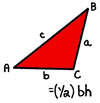
If you know two angles and the side of a triangle, then you can use the law of sines to find the other sides. Likewise, if you know two angles and the side of a triangle, you can use the law of sines to find the missing side.
Examples
In triangle ABC:
If angle C=110�, and Angle A= 20�, and side a= 25, find sides b and c
Sin20/25 = Sin110/c. By cross multiplying, you get:
Sin20c= (25)(sin110)
Sin20c=23.5
c= 23.5/sin20
c is approximately equal to 68.7 centimeters.
Now find the side b. The missing angle can be found more simply by subtracting the sum of the two angles from 180�. 180-(110+20)=50�.
Sin50/b= sin20/25. Again, by cross multiplying, you get:
(25)(sin50)=sin20b
19.2=Sin20b
19.2/Sin20=b
b=56 centimeters
In triangle ABC:
If Angle A equals 48�, side a equals 9, and side b equals 7, find angle B.
Sin(48)/9= sin(B)/7 By cross multiplying you get:
7*sin(48)=9*sinB
5.2=9*sinB
5.2/9= sinB
.58=sinB
sin^-1 (inverse sine).58=35.5�
B= 35.5�
*Note: All answers are approximate. Make sure that your calculator is set in degree mode