And more autumn color
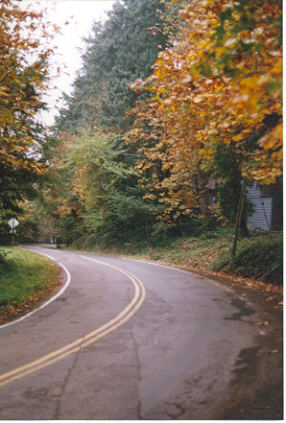
Standing at the canyon one quarter of a mile below Whitbeck, looking back toward the city. According to the 1918 plat, the land in the foreground belonged to S.M. and Carrie Day, while most of the land around and behind it belonged to Charles C. and Elizabeth (Eliza) D. Whitten. Charles Whitten, a master carpenter, contractor, and land sales promoter, was one of the signers of the petition to establish Lorane Highway, which was initially called C.C. Whitten Road. He and Eliza lived on the west side of the upper reaches of Friendly Avenue (Friendly Street) on Whitten Drive, which was named after him. Eliza or Charles named Inspiration Point. |
|
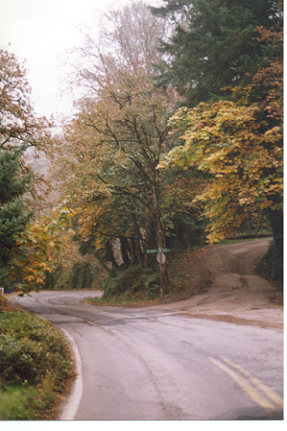
Lorane Highway at Van Buren, looking toward the city. The higher ground is part of the land that in 1918 belonged to Queenie Bessie Howe, who also owned most of the land around Madison. |
|
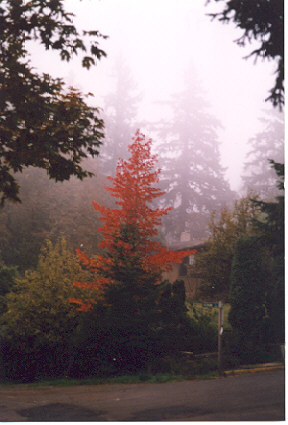
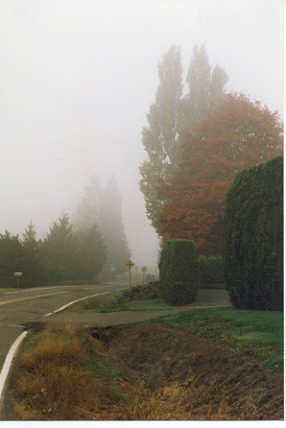
This has to be one of the trees with the most spectacular autumn foliage color in the area. This is the northeast side of the Kervon Court entrance, property that in 1918 was owned by Mary Jane Rutherford, who maintained pear and peach orchards here. Her principal residence was a large two-story house at the northeast corner of the Chambers Street/Crest Drive intersection, where she owned a much larger piece of land, but she built a bungalow in this area that was mainly occupied during the summer harvests. She was one of the few pioneer residents to have a telephone at the time. Because the new Lorane Highway cut through the east section of her orchards, Mary Jane was paid $317.50 at the time the road was constructed to cover damages to her property. |
|
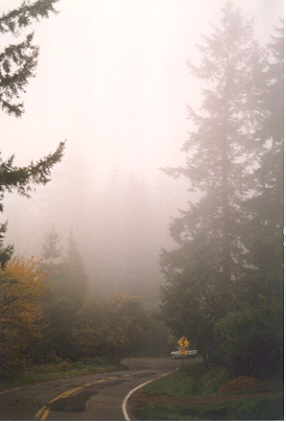
Standing on Lorane Highway just below EmRay Drive, looking toward the intersection with Kervon court. The land to the left (north) side of the road was owned by J.J. Glick, the land on the right (south) side of the road was part of the orchards of Mary Jane Rutherford. |
|
Lorane Highway at Hionda Avenue, past the divide and looking downhill toward Chambers Street. One of the homes that was constructed here during the 1970s was the first energy-efficient home in Eugene. Under the first Eugene Water and Electric Board energy conservation program, features included R19 insulation in the floors and walls, R38 insulation in the attic, and double-glazed metal windows. |
Updated: 2004