Back to Luzi Matzig's Home Back to Luzi Matzig's Home
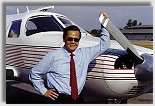
High flier up above
|

|
Luzi Matzig in TravelAsia
TravelAsia, May 31, 1996
The Cornell School of Hotelmen held their meeting
in Phuket earlier this month. The topic for discussion - Beyond
Borders. Yeoh Siew Hoon reports.
"Beyond Borders" was the theme but the
panellists had their own interpretation of what borders meant:
To Chanin Donavanik of Dusit Hotels & Resorts, it meant "accidental
expansion"; to Bill Heinecke of Royal Garden Resorts, "a
borderless market in which all food tastes the same and entertainment
is seamless"; to Luzi Matzig of Diethelm Travel, borderless
Mekong tours; and to Jim Reinnoldt of Northwest Airlines, it meant
the sky.
The panel was moderated by Robert Hecker of Horwath
Asia/Pacific, who did well in ensuring discussions stayed focused
and did not spill over borders.
Kick-off time with Chanin's style of humour. The
chief executive of Dusit candidly admitted his hotels had happened
largely by acci-dent. "We opened our second hotel 10 years
ago, now we have 60 hotels. Why the expansion? Let me tell you,
it was a very big accident on my part.
"When I came back from Boston University, I
lectured at Chulalongkorn University. Then my mom asked me to
help with the hotel. Then my cousin got into financial trouble
and we bought his hotel in Chiang Mai - that's how we got our
second hotel.
"Then a Singapore friend asked me to join in
the Laguna project and operate Dusit Laguna, so I said yes.
"We did not have a strategic plan, we did not
have people with vision who said, expand this way.
"My mother, who is my boss, was in charge of
keeping the company financially-sound and well-managed from day
one. When I took over 15 years ago, we had a lot of cash, no debt.
We did not have to borrow until six-seven years ago. Since then,
she's been complaining to me - she doesn't like borrowing."
Dusit's first overseas hotel in Dallas also happened
by accident. "Another friend from Indonesia asked us to join
in. I'm glad we did. It is doing very well," said Chanin.
The buying of Kempinski? Another accident. "The
former chairman of Inter-Continental asked me if I wanted to buy
something. At the time, we were bidding on another hotel which
has since been bought by another Thai company.
"For 30 per cent more in price, we thought,
why not buy a whole company? Maybe that was a mistake, one hotel
has fewer headaches than one company.
"The Germans are great operators but it's very
difficult to convince them what they should be doing. But I am
happy to say, most of them are happy to be part of our family."
And Chanin said there were still opportunities for
growth. Dusit-Kempinski has signed a new hotel in Geneva and soon,
London and Paris will be in the network. "We will merge our
second brand with another company, to expand it."
Onto Heinecke, who said the world was one borderless
market in which all consumers want the same thing - great products
delivered by great people at the right price.
"Everyone is the same everywhere. Which was
the best-selling movie in Thailand last year? Jurassic Park, just
as in the US. Before that, it was Jaws."
He cited the group's venture into Ripley's Believe
It or Not in Pattaya. "People were sceptical, who would pay
US$6 to see a three-legged horse, the Titanic made of matchsticks,
a piece of the Berlin Wall?
"When we put in Motion Master, people said,
who would pay US$4 to be shaken and scared? We received 700,000
visitors in the first year and are expecting one million this
year.
"We will open Ripley's in Hong Kong with the
Peninsula Group and we will go into India and China."
As for food, Heinecke's Minor Group has also proven
tastes are universal. "People said Thais wouldn't eat cheese. When we opened Pizza Hut, Thailand imported
less than a ton of cheese a year. Today, Thais consume twice that
everyday. Our factory produces 500 tons of cheese a year."
Luzi Matzig, general manager of Diethelm Travel,
took the discussion over to the Mekong, "the latest buzzword
in regional destination groupings".
"Everyone is talking about this new area - and
rightly so. The opening up of the Mekong area for tourism and
the decision by tourism authorities to position Mekong as a single
tourism destination is the most significant event in Asia/Pacific
tourism this decade."
But he added, "How soon the Mekong's tourism
goals will be realised will be up to the will and commitment of
the political and tourism leaders involved."
"Beyond Borders" in the Mekong, he said,
meant minimal visa formalities, minimal red tape on tour handling,
maximum ease of access either by air, road or water and maximum
emphasis on quality of service.
He said tour combinations were many and varied -
given the new air routes such as Air Mandalay's Yangon-Phuket
service planned for this October. "Then there is the Mekong
river - cruises on the Mekong will be a hot ticket item once visa
formalities are eased and the standard of vessels improved."
Matzig had some word of caution for hoteliers, saying,
"Travellers who choose the Mekong destinations do not want
to stay in hotels where they could be anywhere. Developers should
learn from the mistakes of other destinations and build small,
environmentally-sensitive hotels instead of huge five star towering
blocks. Charge mid-market rates for mid-market hotels. Don't make
the mistake as in Bangkok where five star hotels are charging
three star rates. It confuses everybody."
|
 Photos
 Luzi Matzig in other news sources