| Frank & Lisa's Amazing Cross-Australia Adventures |
| The Queensland Coast (6) |
| on to South Australia's Barossa Valley ...or |
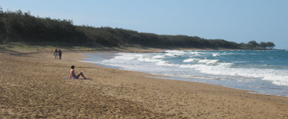
| After our tour we headed back to the Turtle Sands and hit the beach. The beach seemed totally ordinary. You never would have suspected the magic that was to take place there every night for the next few |
| Mon Repos & Bundaberg (cont'd) |
 |
 |
 |
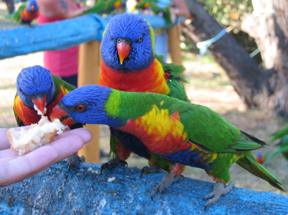
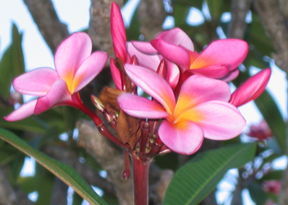
| months as loggerhead turltes came out of the water to lay their eggs and then as young hatchlings escaped from their shells and attempted the dangerous journey back towards the ocean. We fed the lorikeets (pic below left) with the other tourists in the afternoon and then had dinner out on our balcony under the beautifully fragrant frangipani trees (pic below right). Then that night we headed back to the rookery to try our luck again. |
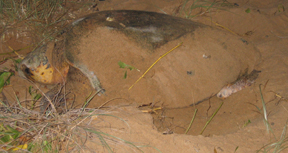
| Tonight we were a bit better prepared after our hours of waiting the night before. We brought books and snacks to help pass the time. We got there well before the rookery opened. Spots are assigned in a first come first served bassis, with only 70 people allowed to view a given turtle nesting. We were the last two people in the first group. That meant that all we needed was one turtle. However, there was a large group of young school children in our group, so I was expecting the experience to be a bit chaotic. Fortunately, come 10pm there had still been no turtle and the school group headed for home. By 11pm we got lucky and off we went to the beach. The nesting process is a very set routine. The loggerhead had to settle in properly before we could approach it, or there was a chance that it would not lay and head back to sea instead. We arrived once it had dug itself a nice hole and was comfortable inside. It then used its back flippers to dig an egg pit to lay its eggs into. At that point we were allowed to look and take photos at the rear of the turtle without disturbing her. The researchers |
 |
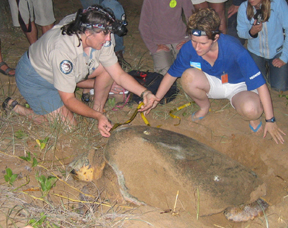 |
| filled in her nest as the researchers measured her and checked her tag information (pic below right). Then all photography had to cease as she turned around and we were allowed to follow her at a distance back down the beach to the ocean. Sea turtles are not built for travelling across the sand, and our poor mother was obviously exhausted by the time she hit the water again. The whole process took over an hour. |
| took an egg or two out of the pit for analysis and only had a few minutes to get them back before she filled in the egg pit. At that point we could form a circle all the way around her to watch her and take photos (pic left). She filled in the egg pit and |
| Our mother was expected to return at intervals for the next 2 months to repeat the process with more eggs. Then beginning in January hatchlings would begin to crawl up out of the sand and make their trecherous journeys across the sand and into the ocean. Only about 2-3 hatchlings are believed to survive beyond their first few days. Then they disappear into the sea and are not seen again until they begin their breeding cycles decades later. |
| And so our Queensland Coast adventure came to an exciting and happy conclusion. We made the return drive down the coast the following day, just in time to attend my friend Maylin's 21st birthday celebration in Brisbane with a wrapped gift and clean clothes! |
| Northern Territory: Red Centre , 2 / Top End , 2 NSW & ACT: Hunter Valley / Sydney / Canberra , 2 Queensland Coast: 1 , 2 , 3 , 4 , 5 , 6 South Australia: Barossa Valley / Kangaroo Island / McLaren Vale & Coonawarra Victoria: Great Ocean Road , 2 , 3 / Melbourne New Zealand (North Island): Aukland / Rotorua / Tongariro / Wellington (South Island): Nelson / Westland / Queenstown / Milford / Dunedin / Mt Cook / Christchurch |