
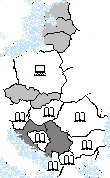
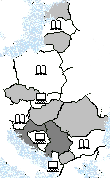
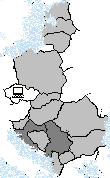
The Water Quantity problem is covered by different indicators in CEE countries. Even the EEA (1998b) and OECD (1993) have no suggested common indicators. The GEO-2 does not present any indicators of water quantity (UNEP 1999). As can be seen from Table 14, common indicators were almost impossible to find.
Irrigated land is a pressure indicator which was suggested by the EEA in the Guidelines (EEA 1996), and therefore reported for the Dobris+3 report in the majority of CEE countries (EEA 1998b). However, it is included only in the Polish SoE report on the Internet. Figure 23 shows how this data can be presented.
|
|
|
|
|
|
|
|
|
|
 |
 |
 |
|
| Dobris+3 |
|
|
|
| GEO-2 | |||
| OECD 1993 |
|
Legend:
|
|
Indicators present in the SoE reports on the Internet |
|
|
Indicators presented in the Dobris+3, GEO-2, and the OECD Core Set, or reported as measured in CEE countries, but not present on the Internet |
| Indicators not reported as measured in CEE countries, and not covered in the Dobris+3, GEO-2, and OECD Core Set |
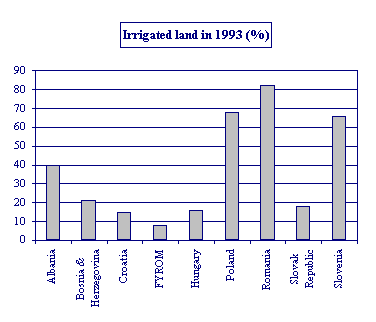
Figure 23. Irrigated land in some CEE countries. The bar graph shows the percentage of irrigated land in different countries. It is possible to make a comparison between countries, but the countries surface area should be taken into account. Data source: FAO Back
The state indicator, freshwater reserves, is covered in 7 countries. Common response indicators have not been found. However, the OECD suggested water prices as a response indicator (OECD 1993). Therefore, it has been included in the Table 14. Unfortunately, it has been reported only in the Czech Republic.
It is possible to conclude that the Water issue is presented by many indicators in CEE countries. However, they are so variable that common ones have been almost impossible to find. This is especially true for the Water Quantity problem. The Water Quality problem, on the other hand, is represented by a greater number of commonly used indicators, because the eutrophication is widely recognized as a large problem, and its causes are well known. The response indicator is also very familiar, because waste water treatment is widely used. The eutrophication problem relates the Water issue to Socio-Economic Developments (use of fertilizers in agriculture, which is related to human population development), and, at the same time, to the Land issue, as well as the Marine and Coastal Environment (see sections 4.3 and 4.4).
The last section deals with the Urban Environment issue, which is, as it will be shown, related to all others.