
4.7 Urban Environment
The Urban Environment issue contains different problems, and is related to all other problems and issues. The Urban Air Quality is a problem related to the Atmosphere issue; the urban water supply can be seen as a part of the Water issue; the Land Use problem in urban areas is connected to the Land issue; the process of urbanization affects nature and forests as well; and urban population growth is one aspect of the Socio-Economic Developments. Therefore, for all these problems, common indicators will not be presented in this section. They have been discussed previously, and, with some modifications, can be used to describe the problems related to this issue as well (for details refer to sections 4.1, 4.2, 4.3, 4.5, and 4.6). The Urban Environment issue is covered in all electronic CEE reports (see table 3, Chapter 4). Tables containing all measured and proposed indicators can be found in the Appendix (Tables A-12, A-13, and A-14) . They also contain the indicators from the Dobris+3 (EEA 1998b), GEO-2 (UNEP 1999), and OECD Set (OECD 1993).
According to the GEO-2 and Dobris+3, the most important problem, air pollution, mainly by tropospheric ozone, in urban areas is caused by growth in traffic. Problems with waste, waste water treatment, and noise are also regarded as important (UNEP 1999; EEA 1998b). The OECD suggests in its Set the urban environmental quality issue, which includes air pollution, water, noise, and land use indicators (see Tables A-12 to A-14 in the Appendix). It deals with the waste as a separate issue (OECD 1993).
The problems which will be presented in this section are Waste and Noise, because their origin is to the greatest extent related to the urban environment, and they have not been covered in the previous sections. The most common indicators will be presented in the subsection that follows. They will be treated together, because the Noise problem is not frequently present in SoE reports.
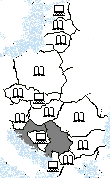
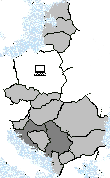
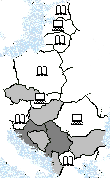
As Table 15 shows, waste indicators are well covered in CEE reports, as well as in the Dobris+3 (EEA 1998b) and OECD Set (OECD 1993). On the contrary, the GEO-2 does not use any indicators for waste (UNEP 1999).
|
|
|
|
|
|
|
|
|
|
 |
 |
 |
|
| Dobris+3 |
|
|
|
| OECD 1993 |
|
|
|
|
|
Indicators present in the SoE reports on the Internet |
|
|
Indicators presented in the Dobris+3, GEO-2, and the OECD Core Set, or reported as measured in CEE countries, but not present on the Internet |
| Indicators not reported as measured in CEE countries, and not covered in the Dobris+3, GEO-2, and OECD Core Set |
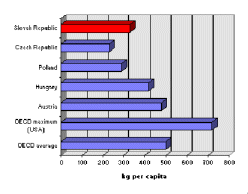
Municipal waste generation is one of rare indicators that is present, or reported as measured, in all CEE countries. It was also used in the Dobris+3 report (EEA 1998b), and suggested by the OECD (1993). A way of presentation on the Internet is shown below (Figure 24):
State indicators for the Waste problem have not been included here, because, according to the OECD, waste is by itself a pressure on the environment, and not a part of it, and, therefore, there is no state related to it (OECD 1993). The response indicator, waste recycling and reprocessing is not so widely present when compared to the pressure one, but its coverage is still satisfactory; it shows efforts made in order to minimize use of new resources in production. One way of graphical presentation is by using a bar graph (Figure 25).
The situation with the problem of Noise is more complicated. Although it has been acknowledged by the EEA (1998b), UNEP (1999), and OECD (1993) as very important, most CEE SoE reports on the Internet do not contain indicators for this problem. In addition, these indicators are even not reported as measured in the majority of countries (see Table A-14 in the Appendix). Therefore, only one state indicator, population exposed to noise, has been included in this subsection. This indicator was also proposed by the OECD (1993) and EEA (1996, 1998b) (see Table 15).
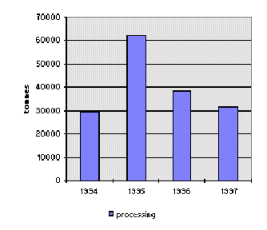
Figure 25. Recycling of waste glass in the Slovak Republic. The graph shows the amounts of glass recycled. Comparison between different years can be made, as well as the trend over time observed. From: SoE Slovakia (1999) [on-line]. URL: http://www.sazp.sk/slovak/periodika/sprava/budapest/waste/wasteman/response/waste_c3.html. Source: MZP SR. Back
This section represented the Urban Environment issue, which includes many different problems, and is related to all other environmental issues. It is the only issue covered in all CEE reports on the Internet, probably because of the high degree of concern about the impact on the quality of human life in urban areas. The most important indicators under this issue have been discussed in the previous subsections, and in the last subsection the Waste and Noise problems have been introduced. It can be concluded that most indicators of urban air and water quality, as well as waste can be found without difficulties, while the situation with land use and noise problems seems more complicated.