
4.1 Socio-Economic Developments
This part of an SoE report contains general information about a region or a particular country. The main indicators that are usually presented here are related to population state and trends, economy, or industry. It may also contain maps of a region or a country, and other general information on, for example, climate or political situation. It gives a general picture of the main causes of pressure on the environment, because these are mostly caused by human activities. This is why these indicators are very good in stressing the expected magnitude of impacts on the environment. Society is also the only source of response to these adverse impacts. Therefore, all this shows that this issue should be a very important part of all SoE reports.
Unfortunately, this is not the case in many countries. As already pointed out in Table 4, this issue is very poorly covered in the CEE SoE reports on the Internet. Information on population, economy, industry, trade, or legislation can be very easily obtained, and is a type of basic information all statistical offices in most countries collect. Accordingly, the Dobris+3 (EEA 1998b), GEO-2 (UNEP 1999), and the OECD (1993) set show very good coverage of the issue. Therefore, there seems to be no clear reason why this information is omitted from the national reports.
Pressure and response indicators are generally well covered for all CEE countries. State indicators are not defined by the OECD and EEA (1993; 1998b), and therefore, they are not included here. However, Denisov, Mnatsakanian, and Semichaevsky (UNEP/CEU 1997), identify precipitation, air temperature, or mineral reserves as state indicators under this issue in a few countries. According to the Dobris+3 report (EEA 1998b), air temperature and precipitation are state indicators under the Climate Change problem in the Atmosphere issue, and will be referred to as such in this work.
Table 5 shows the chosen Socio-Economic Developments indicators covered in the SoE reports. It can be seen that the two chosen pressure indicators are covered in all CEE countries. Response indicators are covered to a lesser extent. A detailed table of all measured and proposed indicators under this issue in national SoE reports, as well as those proposed by the OECD in 1993 (OECD 1993), and those used in the Dobris+3 (EEA 1998b) and GEO-2 (UNEP 1999) reports can be found in the Appendix (Table A-1).
|
|
|||
|
|
|
||
 |
 |
||
| Dobris+3 |
|
|
|
| GEO-2 |
|
|
|
| OECD 1993 |
|
|
|
|
|
|||
|
|
|
|
|
 |
 |
 |
|
| Dobris+3 |
|
||
| GEO-2 | |||
| OECD 1993 |
|
|
|
Legend:
|
|
Indicators present in the SoE reports on the Internet |
|
|
Indicators presented in the Dobris+3, GEO-2, and the OECD Core Set, or reported as measured in CEE countries, but not present on the Internet |
| Indicators not reported as measured in CEE countries, and not covered in the Dobris+3, GEO-2, and OECD Core Set |
Population data is easily measured and available in all countries. Presenting the population number in a country as a line graph can show population trends in a clear and understandable way to all readers (see the next figure as an example of two different population trends in two CEE countries).
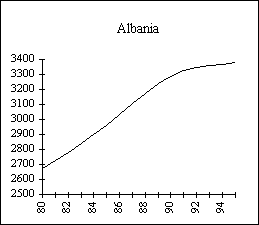
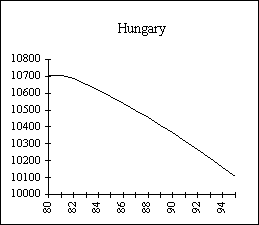
Figure 7. Population trends in Albania and Hungary (1000s). Line graph shows the number of people over a time period. It is possible to observe population trends in different countries and to compare them. It can also be expected that higher number of people means stronger pressure on the environment. However, country's surface should also be taken into account. Data source: EEA Dobris+3 Warehouse
However, it does not give a complete picture, because the pressure on the environment depends on other factors too. One of the most important is available space. Using the data on population number and country area, it is possible to calculate population density. Population density is a more realistic indicator of environmental pressure, and is particularly useful when comparing countries, because it can be presented, for example, on a map, so that readers can easily conclude which countries experience stronger pressure.
Another widely measured indicator of socio-economic development is GDP. It has, however, been criticized lately as not a good indicator of welfare. It does not take into account non-paid work and usage of natural resources. Environmental impacts on human health and quality of life are only partially considered. Finally, environmental expenditures are counted as an increase in GDP, and not as social costs (van Dieren 1995).
There are many incentives to overcome these deficiencies, but until now there has been no internationally accepted indicator which could replace the GDP. The WRI suggested that the total material requirement (TMR) be used instead of the GDP. This indicator measures all resources used in a national economy, and the TMR/GDP ratio shows the efficiency of an economy. According to their research, highly developed countries studied use 35-70% imported resources, usually from undeveloped countries, and do not pay the cost of environmental damage made there (WRI 1997).
GDP was used in both the Dobris+3 (EEA 1998b) and GEO-2 (UNEP 1999) reports, and therefore in this report too. Figure 8 represents one way of presentation of GDP state and trends.
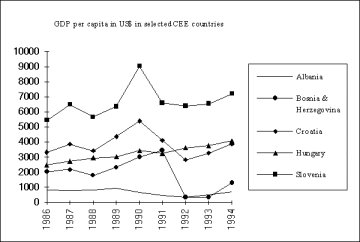
Figure 8. GDP per capita in US$ in selected CEE countries for the period 1986-1994. Using a line graph, it is possible to compare the countries and to see trends in GDP over time. Data source: EEA Dobris+3 Warehouse
Response indicators under this issue are generally not very often present in SoE reports in the Region. Environmental expenditures (the amount of money spent on environmental protection) presents a response indicator which is supposed to show the costs of the environmental protection and mitigation of adverse impacts. This indicator is not included in most SoE reports in CEE.
Legislation, conventions, and international co-operation is another response indicator. It shows the determination of governments to solve environmental problems, as well as to co-operate with other countries in solving global problems. Data on international co-operation can be easily obtained from the conference secretariats and international programs. It is also very useful to include texts of basic environmental legislation here, because it will facilitate the access for the public, and improve public participation. Here, the advantages of presenting the information on the Internet over the printed versions can be observed. Printed versions of SoE reports do not allow placing the full texts in the report. On the Internet, texts can be stored and accessed easily if necessary.
A third response indicator, often mentioned in SoE reports in CEE is environmental impact assessment (EIA) and public participation. It is expected to indicate the number of projects that require an EIA, and the degree of public participation in the process. However, the process of EIA is not developed in all CEE countries, and is not comparable internationally, because the selection criteria on which projects are subjects of the EIA are not standardized. Therefore, the use of this indicator should be limited to national level, and interpretation handled with care.
This section examined the Socio-Economic Developments issue in SoE reports in CEE. It showed that, compared with other issues, it is not frequently present in SoE reports. However, pressure caused to the environment by human activities is reflected through all other issues presented in SoE reports, and societal response is the main driving force of environmental protection and improvement. Therefore, bearing in mind its importance, as well as the availability of data and possibility to graphically present it on the Internet in a very straightforward way, this issue deserves to be treated as a separate part of every SoE report.
The next section deals with the Atmosphere issue, which is covered much better than Socio-Economic Developments. As will be shown, pressures on the atmosphere are caused by human activities which are a consequence of economic development. These pressures also have an impact on other parts of the environment, such as land and water, which will be discussed later.