
The Atmosphere issue is present in all CEE SoE reports on the Internet, except in the Albanian one, although some indicators are noted by Denisov, Mnatsakanian, and Semichaevsky (UNEP/CEU 1997) for Albania, but only for the Acidification problem. Problems under this issue are: Climate Change, Acidification, and Tropospheric ozone. The next three subsections deal with each of them separately.
4.2.1 Climate Change
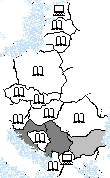
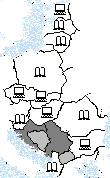
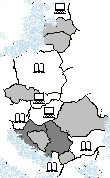
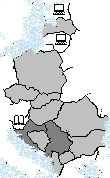
This problem is, generally speaking, well covered by indicators. This is particularly true for pressure indicators: as can be seen from Table 6, emissions of greenhouse gases - CH4, N2O, and CO2, as well as energy consumption are the main indicators accepted in the majority of countries. State and response indicators are not covered as well as the pressure ones. A detailed table of all measured and proposed indicators under this issue in national SoE reports, as well as those proposed by the OECD in 1993 (OECD 1993), and those used in the Dobris+3 (EEA 1998b) and GEO-2 (UNEP 1999) reports can be found in the Appendix (Table A-2). It shows that in the GEO-2 report, in the chapter which deals with the SoE in Europe and Central Asia, only CO2 emissions are considered a pressure indicator, and Kyoto agreements a response. The section that deals with the atmosphere is generally poorly developed, with attention focused on the Acidification problem (UNEP 1999). On the contrary, Dobris+3 deals with the climate change in detail (EEA 1998b).
|
|
|
|
|
|
|
|
|
|
|
|
 |
 |
 |
 |
|
| Dobris+3 |
|
|
|
|
| GEO-2 |
|
|
||
| OECD 1993 |
|
|
Legend:
|
|
Indicators present in the SoE reports on the Internet |
|
|
Indicators presented in the Dobris+3, GEO-2, and the OECD Core Set, or reported as measured in CEE countries, but not present on the Internet |
| Indicators not reported as measured in CEE countries, and not covered in the Dobris+3, GEO-2, and OECD Core Set |
The most important climate change pressure indicators are greenhouse gases (GHG) emissions. The adverse effect of GHG on precipitation, air temperature, and sea level is well known, and therefore emissions of CH4, CO2, and N2O have been measured in almost all CEE countries (see Figure 9 as an example of graphical presentation).

Figure 9. CO2 emissions in Estonia. This line graph shows quantities of emitted substance and trends in emission over time. From: SoE Estonia (1999). URL: http://nfp-ee.eionet.eu.int/SoE/index_en.htm. Source: Institute of Ecology, 1996. Report to the Secretariat of the UN Framework Convention on Climatic Change (FCCC).
The next pressure indicator is energy consumption, which was included in the Dobris+3 report (EEA 1998b), although not proposed by the OECD in 1993. The process of global climate change is to the greatest extent attributed to fossil fuel combustion, because, according to the EEA (1998b), fossil fuels contribute 90% of energy production in Europe. This is why energy consumption deserves to be acknowledged as an important pressure indicator of climate change. Figure 10 is one way to present this indicator.
Mean air temperature is a state indicator which is measured widely, but usually not included in SoE reports in CEE countries, and the data is not easily accessible through the Internet. It should be included as an indicator of state, because it can show trends over time, and the data should be made more accessible. A positive example of presentation of this indicator can be seen in figure 11.
Energy prices and taxes are a response indicator that shows how the demand and supply of energy can be driven. The most important price here is that of crude oil, because all other energy prices depend on it (EEA 1998b). Higher energy prices lower the demand, and this influences production and resource consumption, as well as lowers pressure on the environment. Unfortunately, this indicator is not included in most SoE reports in CEE countries (see Table 6), although there is no specific reason why.
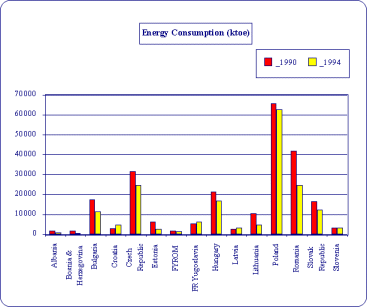
Figure 10. Energy consumption in CEE countries in 1990 and 1995. It shows the amount of energy used in particular countries, but, at the same time, it is possible to make a comparison between countries. WARNING: What is not taken into account here is population number and country size, which have a strong impact on energy consumption (for example, compare the size of Poland and Macedonia on the map 1). Data source: EEA Dobris+3 Warehouse Back

Figure 11. Trend in annual mean air temperature in Budapest over the past 200 years. From SoE Hungary (1999). URL: http://www.gridbp.meh.hu/GRID3VER/STATE/KLIMA/1KLIMALL.HTM Back
This subsection presented the most frequent climate change indicators in CEE. This is where the connection between the Socio-Economic Developments issue and the Climate Change problem can be established (energy consumption is directly proportional with population growth and economic development). Further, societal response (energy pricing and taxation) plays a very important role in environmental protection.
The next subsection concentrates on the Acidification problem. Again, it shows pressures caused by human impacts (Socio-Economic Developments), as well as connections with other issues, especially Land and Water.