
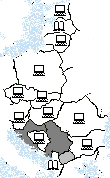
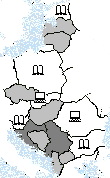
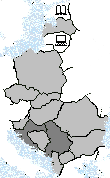
As in the previous case, this problem is, generally speaking, well covered by indicators, particularly pressure ones. As can be seen from Table 7, emissions of acidifying substances - SO2, NOx, and NH3, are the main pressure indicators used in the majority of countries. On the other hand, state and response indicators are not covered well enough. A detailed table of all measured and proposed indicators under this issue in national SoE reports, as well as those proposed by the OECD in 1993 (OECD 1993), and those used in the Dobris+3 (EEA 1998b) and GEO-2 (UNEP 1999) reports can be found in the Appendix (Table A-4). In the GEO-2, only the above mentioned pressure indicators are presented; there are no state or response indicators (UNEP 1999). In the Dobris+3 report, this problem is described much better, including wide explanations of trends in acidifying substances emission, as well as in international community response to this problem (EEA 1998b).
The most important acidification pressure indicators are emissions of acidifying substances. The main sources of these emissions are energy production (SO2), transport (NOx), and agriculture (NH3) (EEA 1998). Figure 12 is one way of graphical presentation.
The pH of precipitation is a state indicator which is measured in some countries, but usually not included in electronic SoE reports. One exception is the Slovakian SoE report, where this indicator is presented in figure 13.
The number of cars with catalytic converters is a response indicator that shows the efforts targeted to prevention of air pollution caused by motor vehicles. At this point, a connection between acidification and climate change indicators can be made: fuel prices and taxation, presented already in the previous subsection (see Table 6), can be used as a response indicator for the acidification problem as well.
|
|
|
|
|
|
|
|
|
|
 |
 |
 |
|
| Dobris+3 |
|
|
|
| GEO-2 |
|
||
| OECD 1993 |
|
|
|
Legend:
|
|
Indicators present in the SoE reports on the Internet |
|
|
Indicators presented in the Dobris+3, GEO-2, and the OECD Core Set, or reported as measured in CEE countries, but not present on the Internet |
| Indicators not reported as measured in CEE countries, and not covered in the Dobris+3, GEO-2, and OECD Core Set |
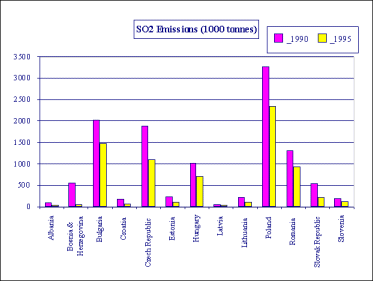
Figure 12. SO2 emissions in CEE countries 1990-1995. A bar graph is good at showing differences between observed years, as well as in the quantities of emitted SO2. Data source: EEA Dobris+3 Warehouse Back

Figure 13. pH of precipitation in 1997 in some Slovakian towns. In this way, it is possible to compare the acidity of precipitation in different areas and to see which part of the country experiences the strongest pressure. From: SoE Slovakia (1999) URL: http://www.sazp.sk/slovak/periodika/sprava/budapest/acidif/state/acid_b1.html. Source: SHMU. Back
In addition, indicators described in this subsection are of great importance not only for the Atmosphere issue, but also for Water and Land (emissions of acidifying substances which cause acid precipitation, lead to acidification of water and soil). In the same sense, fuel prices and taxation, as well as the number of cars with catalytic converters, can be used as indicators of response in Water and Land issues. Moreover, the number of cars with catalytic converters is an appropriate response indicator of the Tropospheric Ozone problem, which will be discussed in the next subsection.