
4.4 Marine and Coastal Environment
The Marine and Coastal Environment issue is not covered in many SoE reports in an appropriate way. In addition, the OECD (1993) does not propose any marine and coastal environment indicators in its core set. In the GEO-2 the situation is presented separately for the Baltic Sea, Mediterranean, and Black Sea. It presents this issue by mentioning general problems in particular seas, without dealing with separate indicators (UNEP 1999). The EEA in the Dobris+3 report covers Marine and Coastal Environment in detail (EEA 1998b).
Table 10 shows the coverage of selected marine and coastal environment indicators in SoE reports in CEE. As can be seen, better coverage is present only in the Baltic states reports, probably due to various international efforts and initiatives targeted to protection of the Baltic Sea Region. Table A-7 in the Appendix shows all measured and proposed indicators under this issue in CEE countries, as well as in the Dobris+3 (EEA 1998b).
Two pressure indicators are included in Table 10 - coastal pollution loads, which has been measured in the Baltic states and proposed by the EEA (1996), and fish catch. A way of graphical presentation of phosphorous load from rivers (line graph) is shown in figure 16.
|
|
|
|
|
|
|
|
|
|
|
|
 |
 |
 |
 |
|
| Dobris+3 |
|
|
|
|
|
|
Indicators present in the SoE reports on the Internet |
|
|
Indicators presented in the Dobris+3, GEO-2, and the OECD Core Set, or reported as measured in CEE countries, but not present on the Internet |
| Indicators not reported as measured in CEE countries, and not covered in the Dobris+3, GEO-2, and OECD Core Set |
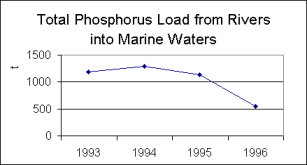
Figure 16. A way of presentation of nutrient loads into the sea. Using a line graph, trends in nutrient loads over time can be shown. It is also possible to predict the future pressure that can be expected from this source. From: SoE Estonia (1999). URL: http://nfp-ee.eionet.eu.int/SoE/index _en.htm. Source: Tallinn Technical University. Back
The selected state indicator is concentrations of nutrients in coastal waters. This indicator shows the result of the coastal pollution loads, and is an example of how pressure and state indicators are connected. Unfortunately, these concentrations are again measured only in the Baltic states. An interesting way of presentation (combined line graph) is shown in figure 17.
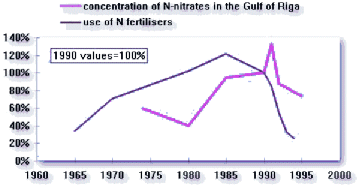
Figure 17. One way of presenting nitrate concentrations in sea water. It is a good idea to compare the nitrate concentrations in the sea with the use of N fertilizers. In this way, the connection between these two indicators, as well as the impact of fertilizer use on marine pollution can be seen. From: SoE Latvia (1998). URL: http://www.vkmc.vdc.lv/soe96/Water/balt_sea.html#pollutionload. Sources: Institute of Aquatic Ecology, University of Latvia, State Enterprise "Raziba".
The response indicator in Table 10 is fishing quotas, which shows government efforts to cope with the problem of over fishing. Again, it is worth mentioning that national legislation and international co-operation is a good indicator of societal response, but should be included under the Socio-Economic Developments (see section 4.1).
The indicators (coastal pollution loads and nutrient concentration) presented in this subsection are also related to the problem of eutrophication caused by the use of fertilizers and pesticides in agriculture. At this point, connections between land, water, and marine environment can be observed (see sections 4.3 and 4.6).
Section 4.5 will present the Nature issue, divided into two problems - biodiversity loss and forest degradation, which will be treated in separate subsections.