
4.6 Water
The Water issue is treated in many different ways in SoE reports. The GEO-2, for example, shows only two indicators (see Table A-10 in the Appendix) and discusses the general state and trends in water quality and quantity in Europe and Central Asia (UNEP 1999). The OECD covers water related problems by two issues: Water Resources and Eutrophication (OECD 1993). The EEA in the Dobris+3 deals with the problems of water abstraction and use, as well as with the quality of ground- and surface waters. In addition, it discusses the problem of water pollution and measures for water protection (EEA 1998b).
In this thesis, the Water issue is divided into two problems: Eutrophication and Water Quality, as well as Water Quantity. The justification for this has been found in the fact that the UNEP (1999), EEA (1998b), and OECD (1993) identify the nutrient contamination as the most important factor which causes a decrease in water quality. The second problem, Water Quantity, is also characterized as very important (UNEP 1999; EEA 1998b; OECD 1993). The most common indicators used to describe these two problems are presented in the next two subsections.
4.6.1 Eutrophication and Water Quality
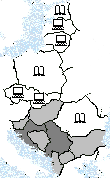
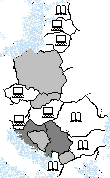
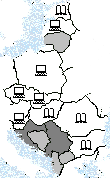
The problem of eutrophication is caused by the use of fertilizers in agriculture. Table 13 shows the most common indicators which describe this problem. A detailed table containing all measured and proposed indicators in CEE, as well as in the Dobris+3 (EEA 1998b), GEO-2 (UNEP 1999), and OECD Set (OECD 1993), can be found in the Appendix (Table A-10).
The use of fertilizers is a good pressure indicator, because an increase in the fertilizer quantities used leads to higher risk of eutrophication. However, it was discussed in section 4.3, when dealing with the Land issue, and will not be repeated here. The pressure indicator in Table 13 is nutrient discharge in waters. It has not been measured in many CEE countries, although it was proposed by the OECD (1993) and used in Dobris+3 (EEA 1998b). Figure 21 is an example of its graphical presentation.
|
|
|
|
|
|
|
|
|
|
 |
 |
 |
|
| Dobris+3 |
|
|
|
| GEO-2 |
|
||
| OECD 1993 |
|
|
|
|
|
Indicators present in the SoE reports on the Internet |
|
|
Indicators presented in the Dobris+3, GEO-2, and the OECD Core Set, or reported as measured in CEE countries, but not present on the Internet |
| Indicators not reported as measured in CEE countries, and not covered in the Dobris+3, GEO-2, and OECD Core Set |
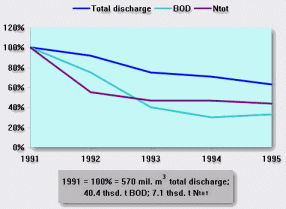
Figure 21. Waste water discharge in Latvia. Here, total waste water discharge is compared with total BOD and total N discharge. The graph shows a relationship between these discharges, as well as the trend over time. From SoE Latvia 1998. URL: http://www.vkmc.vdc.lv/soe96/Water/wast_wtr.html#discharge. Source: Environment Data Center. Back
As Table 13 shows, state indicator - concentration of nutrients in water, is covered better than the pressure one. This indicator is directly related to the discharge of nutrients, and again connected to human activities through agriculture. An excellent way of presentation is on the Lithuanian Web site:
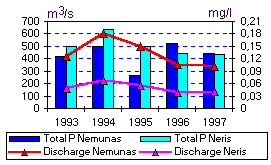
Figure 22. Total waste water discharge and total P concentration in two rivers in Lithuania. In this way, it is possible to se the relation between discharge and concentration. The comparison of two rivers can also be made, and trends over time followed. From: SoE Lithuania (1999). URL: http://nfp-lt.eionet.eu.int/water.htm. Source: Lithuania JRC.
Response indicators of water quality are very different. In this work, waste water treatment comprise different indicators, from number of waste water treatment plants, to share of population connected to them. Unfortunately, this prevents international comparison. However, knowing the fact that most CEE countries posses data on waste water treatment plants, it can be expected that a common indicator will soon be adopted.