
4.3 Land
The last section concluded that the Atmosphere issue is covered in a satisfactory way in the majority of SoE reports. On the contrary, the Land issue is not treated in all SoE reports, but is still covered better than the Socio-Economic Developments or Marine Environment (see Table 3, Chapter 4). In the Estonian and Slovakian reports, it is partly presented in the Toxic Contamination issue. In addition, different indicators have been used to describe the issue, and data is not easily comparable. Table 9 shows the coverage of selected land indicators in SoE reports. All measured and proposed indicators under this issue in CEE countries, as well as in the Dobris+3 (EEA 1998b), GEO-2 (UNEP 1999), and the OECD set of indicators (OECD 1993), are contained in Table A-6 in the Appendix.
|
|
|
|
|
|
|
|
|
|
|
|
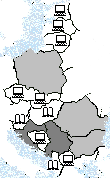 |
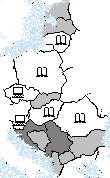 |
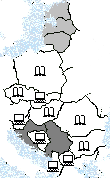 |
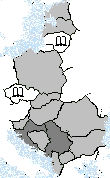 |
|
| Dobris+3 |
|
|
|
|
| GEO-2 |
|
|||
| OECD 1993 |
|
|
|
|
|
Indicators present in the SoE reports on the Internet |
|
|
Indicators presented in the Dobris+3, GEO-2, and the OECD Core Set, or reported as measured in CEE countries, but not present on the Internet |
| Indicators not reported as measured in CEE countries, and not covered in the Dobris+3, GEO-2, and OECD Core Set |
According to the GEO-2, the highest pressure on land comes from agriculture and forestry (UNEP 1999). As can be expected, consumption of pesticides and fertilizers are the pressure indicators present in the majority of CEE reports. Figure 15 shows a bar graph as a possible way of presenting the consumption of fertilizers. The OECD also finds agriculture and forestry the main causes of land degradation, and suggests land use changes as an indicator of desertification and erosion (OECD 1993). However, the presence of land use changes indicator in the SoE reports on the Internet is scarce (see Table 9).
Coverage of state indicators varies considerably in SoE reports. In Table 9, different state indicators are grouped under the degree of soil degradation. The degradation can be caused by erosion, acidification, contamination, salinization, and desertification. All these problems are not present in all countries, and that is why they are not presented here as separate indicators. This, of course, means that soil degradation can be described by different indicators, which causes problems in comparison between countries.

Figure 15. Consumption of fertilizers in the Slovak Republic (in tonnes of pure nutrients). It is possible to see the difference between quantities of used fertilizers in different years, as well as the trend over time. From SoE Slovakia (1999) [on-line], URL: http://www.sazp.sk/slovak/periodika/sprava/budapest/toxic/pressure/toxic_a3.html. Source: SU SR. Back
This problem was acknowledged by the World Bank in 1997. They stress that it is too early to expect that data on land quality can be compared internationally, and that first sub-national and national sets should be developed. Currently available data is problematic because it is not "geographically focused", and in most cases of state indicators, data simply does not exist. One solution is to use the GIS techniques in reporting on the state of land cover (World Bank 1997).
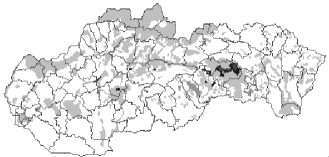
A good way to graphically present land degradation are maps. Figure 16 shows an example.
Response indicators are not present in most reports, including the Dobris+3 Guidelines (EEA 1996). The OECD proposes rehabilitated areas as a response indicator, but concludes that data on rehabilitated areas is not available at the international level (OECD 1993).
This section presented the Land issue and related indicators. It showed that, although some common indicators can be found, it is still far from being comparable at the international level. It is also possible to connect this issue to human activities (agriculture and forestry). Further, it is related to the Water issue through the Eutrophication problem (caused by use of fertilizers in agriculture), which will be treated later, and Acidification (see subsection 4.2.2 in the Atmosphere issue).
The section that follows introduces the Marine and Coastal Environment, which is, in comparison with other issues, present in the smallest number of electronic SoE reports.