 |
|
|
|
|
|
|
|
|
|
|
|
|
|
|
|
|
|
|
|
|
|
|
|
|
|
|
|
|
|
|
|
|
|
|
|
Profiles |
|
|
|
Martin Luther King |
|
Sam Walton |
|
Eleanor Roosevelt |
|
|
|
Home |
|
|
|
Leadership Style
Walton�s vision stemmed from his ability to recognise better solutions. He possessed a high level of contextual intelligence[2] where he understood his environment and was keenly aware of how to make it work for him. In the mid 1960�s, Walton realised that �computerising merchandise controls� was necessary to sustain Wal-Mart�s growth.[3] So Walton searched for the best computer talent.[3] While working under J.C. Penney, Walton understood the value of learning from knowledgeable and talented people. He would surround himself with such talent. Many business leaders, like Donald Trump and Richard Branson, use the same technique. |
|
|
|
|
What is
Leadership? |
|
|
|
|
|
Leadership
Theories |
|
|
|
|
|
Types of
Leadership |
|
|
|
|
Profiles |
|
|
|
The Wal-Mart culture is based on teamwork. Walton believed that �individuals don�t win, teams do� (Sam Walton). He would use the term �associates� instead of worker or employee. Furthermore, he introduced the Wal-Mart cheer.[5] Creating an identity, such as the daily cheer, is characteristic of team leadership.[1] Through this teamsman approach, Walton effectively made himself a servant-leader. While he worked on the same level as his associates, the focus was taken off him and placed upon the collective group. Interestingly, collective identity is a quality of charismatic leadership.[1] |
|
|
|
 |
|
|
|
|
|
|
Interviews |
|
|
|
|
|
|
|
Site Map |
|
|
|
|
|
|
|
|
|
|
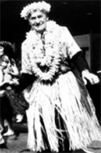
Indeed, Walton was a charismatic leader. He would bolster enthusiasm. He would even hula down Wall Street for losing a company bet.[5] More to the point though, Walton had a way of interacting with other people.[4] A long-time acquaintance revealed that Walton �had a way of making people feel they were part of a team�.[4] He was a socialised charismatic[1], with people like Martin Luther King and Mother Theresa. Martin Luther King�s charisma is largely associated to his oratory skills whereas Walton's speaking skills were not quite as eloquent. However, like King, Walton �made sense when he did talk, and people responded to him�.[4] To have a "magnetic effect over people"[1] is characteristic of a charismatic leader. In fact, one Wal-Mart manager observed that, �people would be this high up off the floor to see him [Walton].�[4] |
|
|
|
 |
|
|
|
|
|
HOME |
|
1 |
|
2 |
|
3 |
|
|
References: |
|
|
|
|
|
|
|
|
|
|
|
|
[1] Dubrin, A., Dalglish, C. & Miller, P. (2006). Leadership, 2nd Asia-Pacific edition. Australia: John Wiley & Sons.
[2] Mayo, A.J. & Nohria, N. (2005). In their time: the greatest business leaders of the twentieth century. Boston, Massachussetts: Harvard Business School Publishing.
[3] Time Inc. (2003). Sam Walton. In Builders & Titans. Retrieved September 13, 2006.
[4] Vance, S.S. & Scott, R.V. (1992). Sam Walton and Wal-Mart stores inc: a study in modern southern entrepreneurship. Journal of Southern History, 58 (2) 231-252.
[5] Wal-Mart Stores, Inc. (2001). Wal-Mart Stores Timeline. Retrieved September 13, 2006.
Images:
Reichman, E. (1988). Sam Walton. Time & Life Pictures. [cheer]
Wal-Mart Stores Inc (2001). Sam hula. |
|
