|
Catalogue:
Design:
Feedback:
|
Haymaking
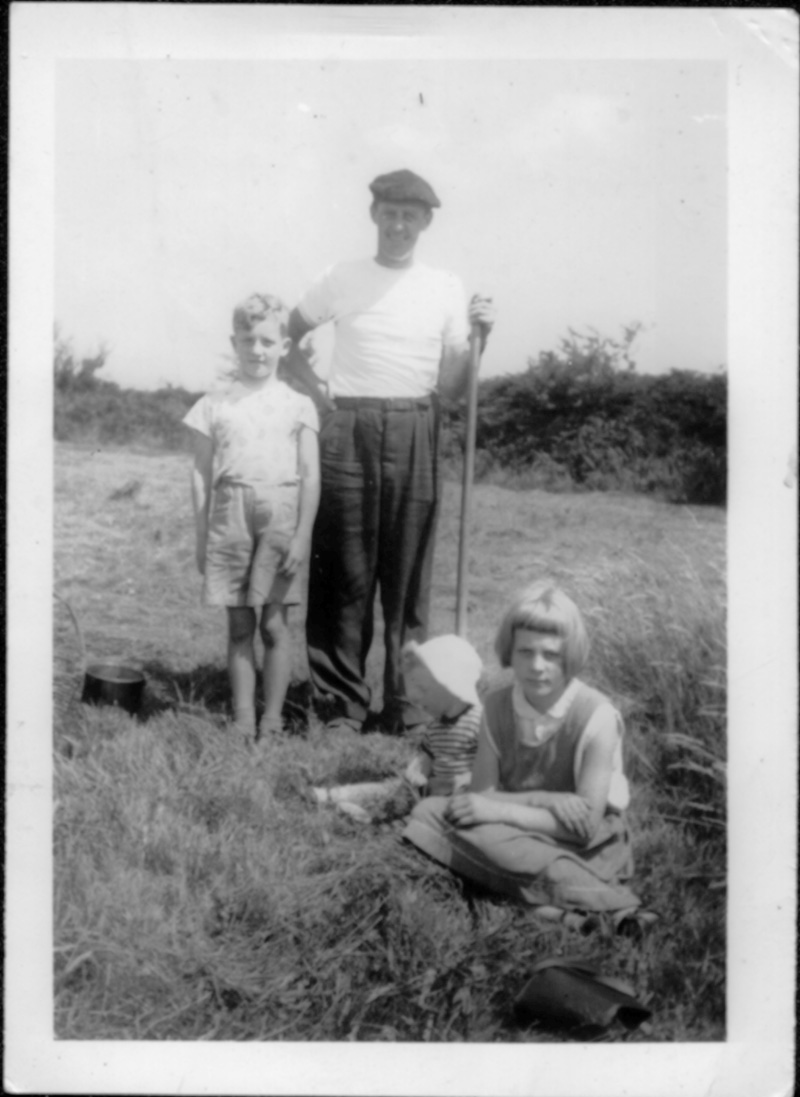
The summer in Kylegariff meant many things: school holidays, warm weather, fresh white-wash for the walls, cutting turf in the bog, and the return of the family home on holidays. My aunt Nell in Limerick, my uncle John in Dublin and my uncle Paddy and Gerard in Birmingham came to Kylegariff every summer for a few weeks to escape the city, enjoy the freedom of the countryside, and help out with saving the hay. Saving the hay was a long and labour-intensive job in those days which stretched out over the length of the summer.
Autumn saw the bringing in of the hay, filling the hay barn, building hay reeks (in a good year) bringing home the turf from the bog, harvesting the potatoes and other veg, fishing for salmon in the river, hunting hare, rabbit and pheasant.
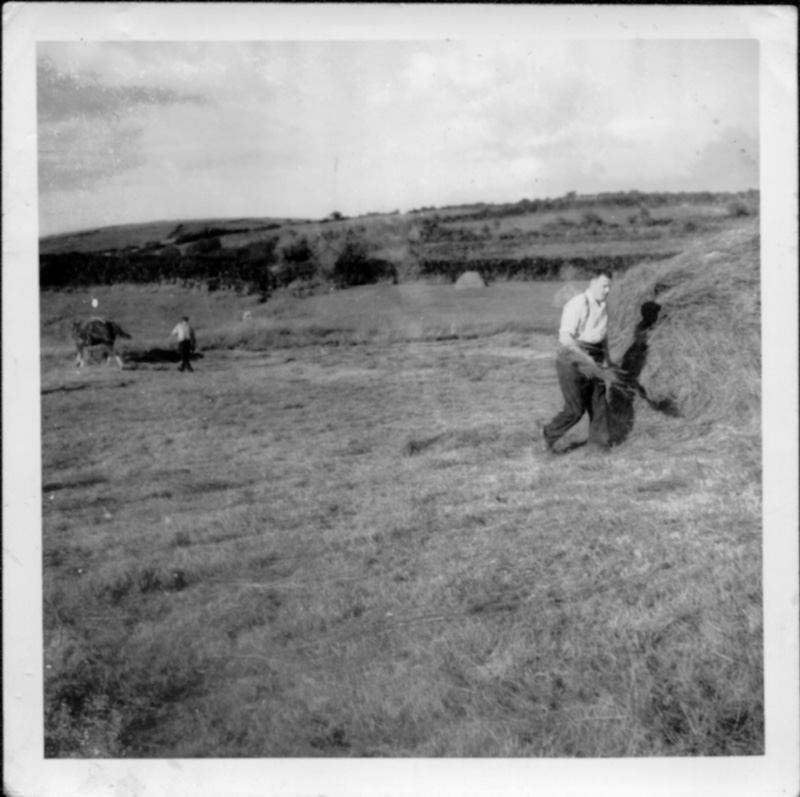
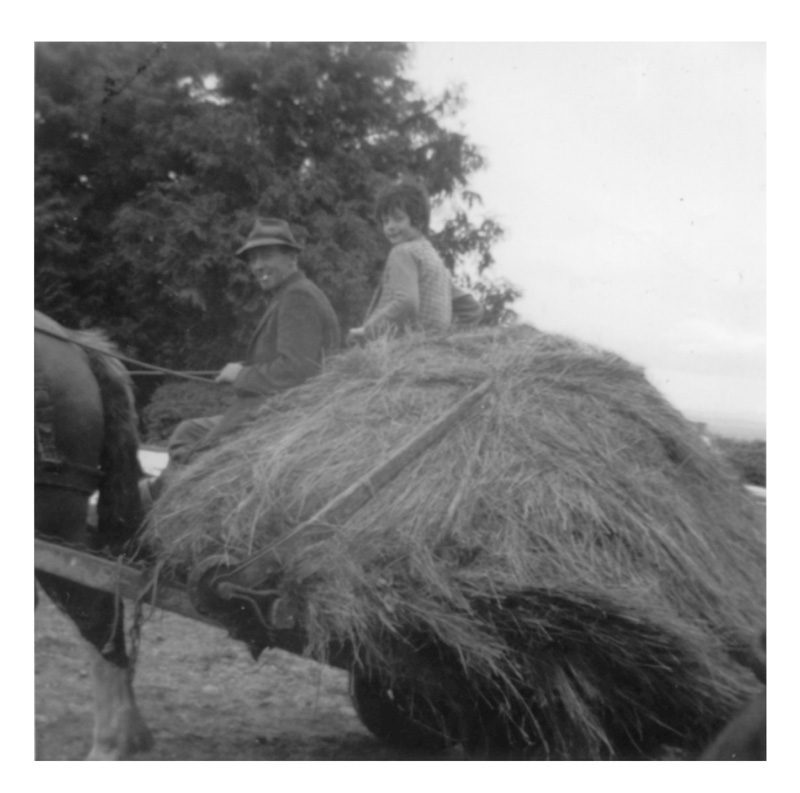
Haymaking was a labour-intensive job. As we can see from the photo above, Paddy Ryan is building a "pike". A pike is the Limerick word for a stack of freshly cut hay that it build in the meadow, thus protecting the hay until it is time to draw it in to the barn. kids were expected to help out too. As a youngester there were many jobs that were ideally suited. Like for example "walking on the pike" - trampling down the hay in pikes with your feet as they are being build so as to make it more compact. Or when a pike was complete, "pulling the butt" of the pike was another job. This involved tidying up the bottom of the pike and pulling away loose hay to protect the pike againt wind and rain while it sat out in the meadow. Finally, "tying the pike" with a "sugan" (rope made of twisted hay) or cord to prevent the wind knocking it over.
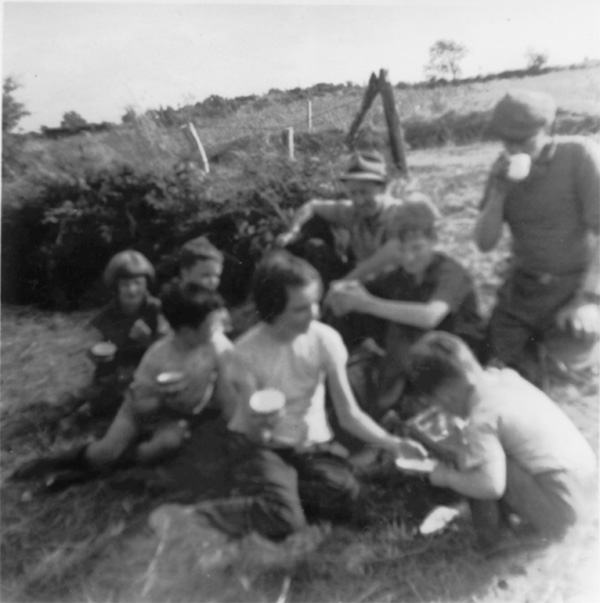
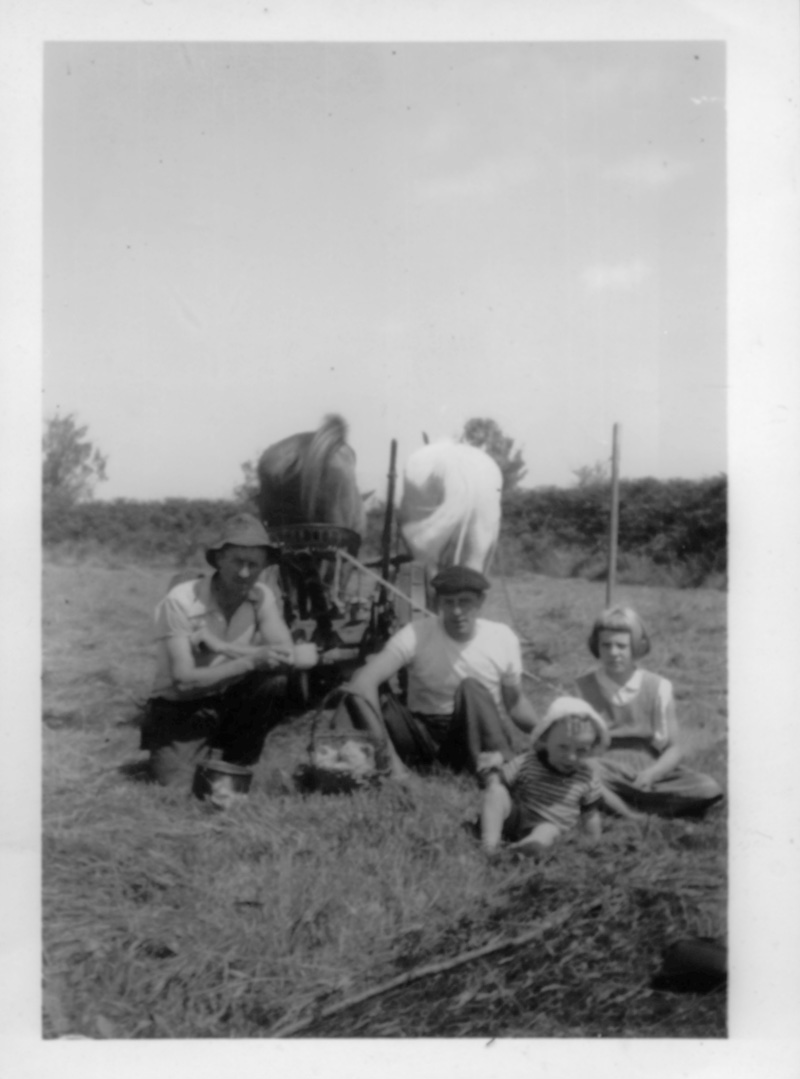
Of course haymaking wasn't all work. Every day in the meadow meant a picnic also, as we can see from the photograph below!
The Ryans, like all farming families, had a wide variety of animals. Horses, cows, pigs, hens, dogs and cats. At any one time we would have had a number of horses on the farm. The horses were used for work, and transport. They were used to pull the "trap" to the creamery, or for goin to the local village for messages or going to mass. In terms of work, all the heavy machinery was horse-drawn: plough, harrow, hay cutter, wheel-rake, hay turner, hay-float.
Every year our family kept and fattened a pig or two for our own use, like most farming families. When the pig was killed, it was a bit of an event, and often neighbours would gather to help and take a fresh peice of ham home. At that time every farmer was an amateur butcher (as well as vet, builder, carpenter, mechanic and so on). The whole pig was used, including the pigs head and feet (crubeens) with very little wasted.
One of the tasks involved here was making home-made black pudding, using the pig's cleaned intestines (known as "pig gut"), and a mixture of pig's blood, oatmeal, pig fat and salt. The fresh black pudding was boiled to preserve it, and would be eaten for many months afterwards. Another task was salting the "fletches" of meat to preserve it. A fletch was a large slab of meat, maybe 2' x 2' x 6''. The fletch was first scored with cuts with a large butchers knife, and then salt was vigourously rubbed into the meat by hand to preserve it. Getting a cut on your hand on that day, with so much salt involved, was one thing you wanted to avoid! Another method of preserving the pork (and provide a different taste to the meat) was to smoke it. This involved hanging the bacon above the open fire and allowing it to be preserved by the wood and turf smoke. So it was a common sight in farm houses up until the last quarter of the 20th century to see fletches of bacon hanging to smoke over an open fire.
Many funny stories are told about my grandmother in the latter part of her life. Appearently even when she was in her eighties and unable to walk without a zimmerframe, she was still leathel. When visitors came to visit, she is reputed to have often gone out into the yard and caught a hen and given it last rites with one deft swipe of her hand. The hens never stood a chance.
|