Pumpkins are actually a form of squash. The Squash Vine Borer (abbreviated SVB by the growing community) is usually by far the greatest threat your crop will face from the insect world. Many a new grower may not even know of them until their plants are heavily infested. After all, the seed packets say all you have to do is sow their pumpkin seeds in the ground and you will easily have fruit a few months later, right? If you have read my log or visited other sites, pumpkins are actually one of the most challenging, yet still fun and rewarding, crops to grow. There is even the saying that you are not a gardener until you have grown pumpkins. Then some people, like me in their first year, may think they have plenty of time before their vines are old enough to need preventative treatment. When I discovered SVBs in my vines, it was a tough fight for the rest of the season to limit their activity. Therefore, it is never too early to start dealing with them. This is why I have set up this section of the
website just for them.
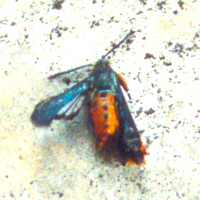
First of all, what exactly is a SVB? They are moths whose larvae develop in your vines. The adult moth is slightly smaller than an inch long. Their width is a little more than an inch across when wings are outstretched. These measurements are of the ones I have seen in my garden in Texas. They have a mostly black body with some orange in spots, especially on the abdomen and legs. Their wings are somewhat transparent with some metallic green coloring. They move like a wasp. They are most active in the morning and early afternoon hours. One of the pictures above is of an adult SVB I killed with a flyswatter.
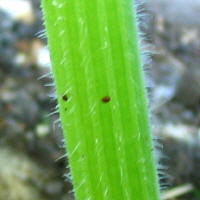
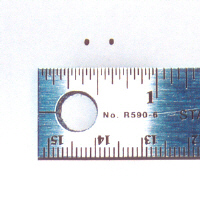
Now, it is not the adults who munch on your leaves like you might think moths may do. Instead, it is their life cycle that is so damaging. These adults lay their eggs on the vines and leaf stems of your plants. Some other sites say that the greatest danger is in the first few feet of vine near the base root of a plant. However, my experiences tell that the whole length of a vine is just about equally as susceptible. These eggs are brownish/reddish ovals about a millimeter across and are laid in individual spots. They are hard to see but I have a picture above of two eggs on a leaf stem and another picture of two next to a ruler. They are even deposited on the underside of the vine, making them very hard to get to. When they hatch, the larvae will chew through the vine and deposit themselves in the center of the same.
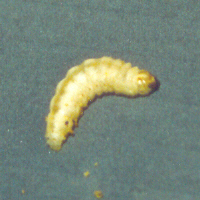
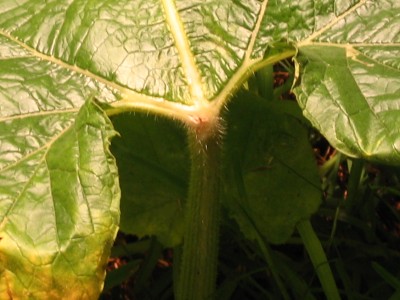
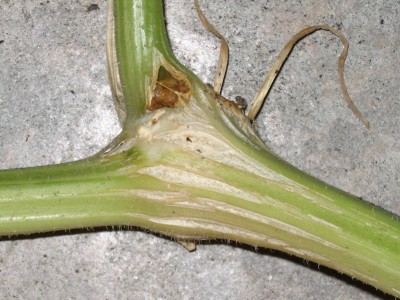
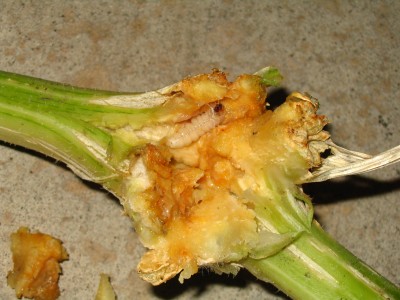
The growth of these larvae is the most harmful phase for your crop. A picture of a larva taken from one of my vines is shown above on a gray background. As they grow, they consume a great deal of water and nutrients that otherwise feed your plant. They also damage the area they are in, thus inhibiting the flow of those things to the rest of the vine. In the process, they excrete mushy sawdust looking waste that eventually oozes out of the spots where they entered the vine. Often, this is the first time many growers will know they are there. Yet, by then they will have already irreversibly compromised the strength of your plant. As they grow, the entry wounds usually grow, thus creating splits. The larger pictures show how they look in the vine. In these examples, they found residence in leaf stems. The first large picture shows how even the top of a leaf stem is susceptible to infestation. They may remain in that location or drop down to the base of the stem during growth. Such leaves will wilt and die. The second picture shows a hole at the base of a leaf stem with a vine borer in it. The "mushy sawdust" mentioned earlier often oozes from such holes. Also take notice of the swelling and discoloration of the vine near the point of infestation. The last picture shows the damage done inside a vine (leaf stem base in this case) by a larva. The "mushy sawdust" can be seen all over the place, including a piece in the lower left corner of the picture that just fell out of the vine.
After a few weeks, they finally chew their way out of the vine, creating an even nastier split, and burrow into the ground. There, they form an earthen cocoon and pupate until the next season. The following year, the adults emerge and the cycle begins again. In warmer climates though, a second generation may be
possible in a year.
So, how do you control these pests? First of all, prevention is key. If you see the eggs on the stems or leaves, remove them. Be sure to look all the way down to the base at soil level. The best method is to use a small piece of duct tape. You can touch the eggs with it and it won't stick to the plant (especially stems) if you are gentle; be a little more careful with the leaves. You risk dropping a few eggs if you use tweezers or your fingers. A small mirror on a telescoping rod can help you see in difficult spots too. Pop the eggs between your fingernails.
Next, apply pesticides as early as possible but lightly on young plants. Avoid spraying young leaves and vine tips since pesticides can "burn" them. Sprays that are legal and most effective in your area may vary and the links below provide more depth in this area. As the eggs hatch, the larvae will eat the treated surface of the vines and die. I used Diazinon in 2003 and had moderate success with it. New infestations were cut by about 75% after I started using it. Yet, the 25% left were still quite harmful. I tried Malathion in 2004 and 2005. In did much better since only a few SVB breeches were observed but it does burn the plants so be careful to not apply too much. However, it washes off in the rain too so it is a balancing act. I've also read good things about sprays containing Lambda-cyhalothrin, permethrin, or Bifenthrin. I haven't tried those yet though. On the other hand, systemic pesticides (such as Merit - made by Bayer) are products that actually soak into the plants and make the plants themselves toxic to pests. They can either be applied to the leaves and vines or to the roots. Follow the directions on the bottle and be careful with dosage and application with these pesticides as well, you don't want to kill your pollinators too. I plan to try this type of pesticide myself in the future. Whatever type of pesticide you use, you also need to keep a regular schedule of application according to the instructions and reapplication may be needed after a moderate to heavy rain (excluding systemic pesticides though).
If you can catch them, also kill the adult moths. A flyswatter works best but be sure to not hit the pumpkin leaves in the process! Once, I even swatted one between my hands.
If larvae are found inside the vine, chemical control is ineffective. I've tried it. They need to be mechanically or organically removed. The most popular way is to slit the vine with a knife and dig them out. Afterwards, bury that part of the vine to protect it from infection and to encourage development of secondary roots that will offset damage done by the borer and you. Sometimes though, you have to go exploratory and create a larger slit than necessary just to find them. I have toyed with the idea of using a flashlight at night, shining the light through the vine to spot the shadow and thus the SVB. When found, you can use a sharpened wire to stab and kill the larvae, thus reducing the slit to a small hole. Better yet, I have had great success killing larvae by injecting Bt (Bacillus thuringiensis), which is an organic pesticide, into the vine at the points of SVB infestation. The bacteria infect and kill the larvae in a parasitic manner while doing no harm to the plants. This method also leaves just small needle holes instead of gaping cuts in your vines. When the pumpkins are harvested, promptly destroy the vines to interrupt any remaining borers. Till the soil two or more times before the next season in order to disrupt any SVB cocoons that may be buried in it. Winter temperatures usually kill the exposed cocoons and multiple tillings help this process along. Finally, practice crop rotation for future seasons. However, the yards of many may not allow for this and the distance from last year's site may not be enough to make a difference anyways. In that case just stay extra diligent next year, but shouldn't you already be so from what I have just told you?
Here are some links (mostly from educational institutions and agricultural extensions) for further reading on the SVB and ways to control them:
"Squash Vine Borer and Squash Bug" by Ric Bessin
University of Kentucky Entomology. Some good color photos plus info on the Squash Bug, another pest that feeds on the outside of your plant and transmits disease.
"Squash Vine Borer" by Frank A Hale
The University of Tennessee - Agricultural Extension Service. This is a PDF file, you will need Adobe Acrobat Reader to view it. If you don't have it, click here.

 Home
Home