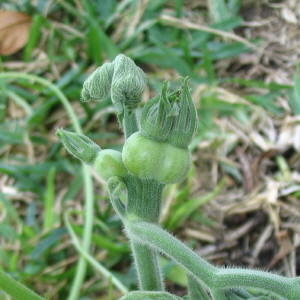
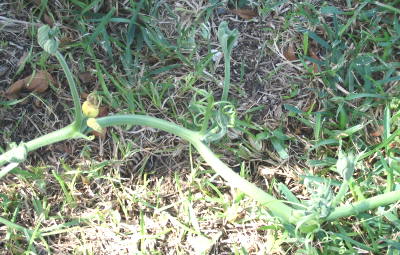
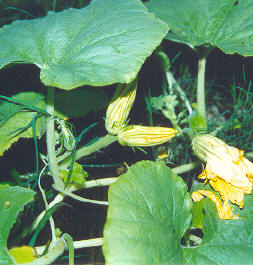
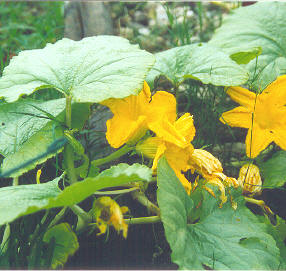
As I grew Luminas during the 2004 season, a pair of conjoined female flowers formed on one of my vines as seen above. A third female developed nearby but its infant pumpkin was not joined to the others. The vine itself was strange too in that during its early growth it wanted to grow in a circle no matter how many times I straightened it out. Eventually it did grow straight but not before many splits developed on the vine, including a section where the latter part of the vine was hanging on by just a ribbon of tissue. It seemed that the vine was destined to be a runt but all of a sudden it became one of the fastest growing ones in the patch. Then, it slowed down again but the new vine growth failed to produce viable leaves. Short stems with small, thick, and curled up nubs that were supposed to be leaves developed instead. I had the same thing happen last year to a vine that was extremely old but this vine was still in its prime. On this new strange growth, these conjoined flowers formed. I tried to nurture them to maturity but they shriveled up and died at about pea-size. A picture of the strange vine growth and yellowing flowers can be seen in the picture below. I did get a small normal pumpkin off of the more normal part of the vine but since the original seed was treated whatever genetics caused this will not have the chance to be passed on and they can only be documented through these pictures.
This is a two-headed Lumina male flower from the 2003 season.
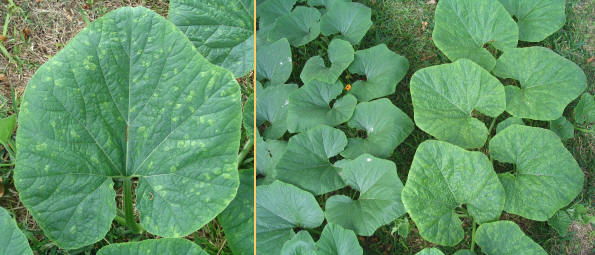
Going back to the 2004 Lumina season, something strange happened to the leaves on one of my vines as well. The vine grew to 71 feet in length. Starting around the 50 foot mark, the newer leaves began developing with these yellowish spots on them. As leaves further down developed, more of their surfaces became less green and more yellowish. The picture above shows one of these leaves along with a comparison between healthy green leaves on another vine and the strange ones on the 71-footer. This was happening as the leaves appeared and was not a result of Powdery Mildew or other disease introduced later. My theory is that the vine grew so long that it started to encounter nutrient deficiencies.
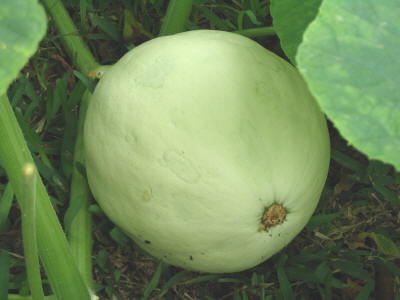
Also, when a pumpkin was pollinated on that section of the vine, it developed strange spots too as seen above. The spots appeared very early on and grew with the pumpkin. The fruit was able to reach maturity and was harvested successfully.

 Home
Home