Venus
Home
About Author
My CD Rack
My Comic Shelf
In The Sky
My GuestBook
Over View
The Sun
Mercury
Venus
Part 2

Venus, the second planet out from the sun, is named after the roman goddess of love. Early photographs showed a planet filled with thick, swirling clouds. It was believed that these clouds hid a beautiful civilization beneath, and it was for this reason that Venus received her name.

Unfortunately, Venus does not hold a beautiful civilization beneath her clouds. In fact, it is quite the opposite. Venus is literally a ball of fire floating through space and serves as a stark reminder of what can happen to a planet overcome by the greenhouse effect. Venus' atmosphere is made up of almost 96% carbon dioxide (CO2.) What happens is that the sun's radiation heats the surface of the planet, when the heat tries to escape, it is trapped by the planet's thick atmosphere, making Venus the hottest of all the planets at 482 degrees Celsius (900 degrees Fahrenheit)

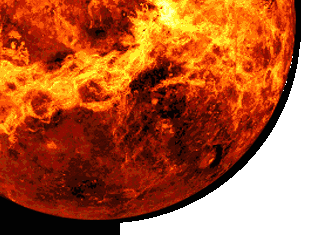
Venus' landscape is a venerable see of fire. The are noticeable mountains and highland areas with valleys filled with lava. Lava is a result of the large volcanic activity across the surface of the planet. In fact, 85% of the planets surface is believed to be volcanic rock. Most of the impact craters are very large. Small asteroids or other objects would burn up while passing through Venus' thick atmosphere. Only the larger asteroids could penetrate and they leave lasting scars.

Unlike the other planets, Venus rotates from east to west. On Venus, the sun would rise in the west and set in the east. The result of this is that a day on Venus lasts approximately 243 earth days, whereas a year lasts only 225.

    Mass 4.9e+24 kg

    Equatorial radius 6,051.8 km

    Mean density 5.3 gm/cm^3

    Mean distance from the Sun 108,200,000 km

    Rotational period -243.02 days

    Orbital period 224.70 days

    Tilt of axis 177.00 degrees

    Equatorial surface gravity 8.9 m/sec^2

    Mean surface temperature 482°C

    Maximum surface temperature 427°C

    Minimum surface temperature -173°C

    Atmospheric composition: Carbon Dioxide 96%

    Atmospheric composition : Nitrogen 3+%

    Atmospheric composition:
    traces of:
    Sulfur dioxide, water vapor, carbon monoxide, argon, helium, neon, hydrogen chloride, and hydrogen fluoride.

More information on Venus

[Home] [About Author] [My CD Rack] [My Comic Shelf] [In The Sky] [My GuestBook]
Hosted by www.Geocities.ws

1