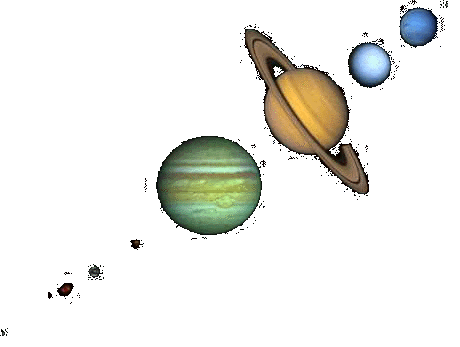
The above composite shows the nine planets with approximately correct relative sizes.One way to help visualize the relative sizes in
the Solar System is to imagine a model in which it is reduced in size by factor of a billion. Then the Earth is about 1.3 cm in diameter (size of a grape). The moon orbits about a foot away.
The Sun is 1.5 m in
diameter (the height of a man) and 150 m away from Earth (about a city block). Jupiter is 15 cm (the size of a large grapefruit) and 5 blocks away from the Sun. Saturn (the size of a orange) is 10 blocks away; Uranus
and Neptune (lemons) are 20 and 30 blocks away respectively. A human on this scale is the size of an atom; the nearest star would be 40000 km away.
Not shown in the above illustrations are the numerous smaller bodies
that inhabit the solar system: the satellites of the planets; the large number of asteroids (small rocky bodies) orbiting the Sun, mostly between Mars and Jupiter but also elsewhere; and the comets (small icy bodies)
which come and go from the inner parts of the solar system in highly elongated orbits and at random orientation to the ecliptic. With a few exceptions, the planetary satellites orbit in the same sense as the planets and
approximately in the plane of the ecliptic but this is not generally true for comets and asteroids.