|
|
 |
|
|
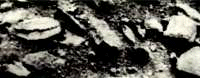
The first spacecraft to visit Venus was Mariner 2 in 1962. It was subsequently visited by many others (more than 20 in all so far),
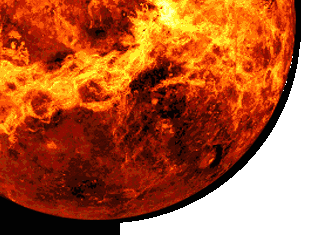
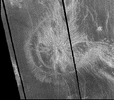
including Pioneer Venus and the Soviet Venera 7 the first spacecraft to land on surface. Most recently, the orbiting US spacecraft Magellan produced detail maps of Venus' surface using radar (above).Venus' rotation
is somewhat unusual in that it is both very slow (243 Earth days per Venus day, slightly longer than Venus' year) and retrogrades. In addition, the periods of Venus' rotation and of its orbit are synchronized such that
it is always present the same face toward Earth when the two planet are at their closest approach. Whether this is a resonance effect or merely coincidence is not known.
- Venus is sometimes regarded as Earth's sister planet. In some ways they are very similar:
- Venus is only slightly smaller than Earth (95% of Earth's diameter, 80% of Earth's mass).
- Both have few craters indicating relatively young surfaces.
Their densities and chemical compositions are similar.Because of these similarities, it was thought that below its dense clouds Venus might be
Earthlike and might even have life. But, unfortunately, more detailed study of Venus reveals that in many important ways it is radically different from Earth. |
|
|
|
|
|
The pressure of Venus' atmosphere at the surface is 90 atmospheres (about the same as the pressure at a depth of 1 km in
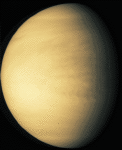
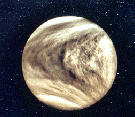
Earth's oceans). It is composed mostly of carbon dioxide. There are several layers of clouds many kilometers thick composed of sulfuric acid. These clouds completely obscure our view surface. This dense
atmosphere produces a run-away greenhouse effect that raises Venus' surface temperature by about 400 degrees to over 740 K (hot enough to melt lead). Venus' surface is actually hotter than Mercury's despite
being nearly twice as far from the Sun. |
|
|
|
|
There are strong (350kph) winds at the cloud tops but winds at the surface are very slow, no more that a few kilometers per
hour. |
|
|
|
|
|
Venus probably once had a large amount of water like Earth but it all boiled away. Venus is now quite dry. Earth would have suffered the
same fate had it been just a little closer to the Sun. We may learn a lot about Earth by learning why the basically similar Venus turned out so differently.Most of Venus' surface consist of gently rolling plains with
little relief. There are also several broad depressions: Atalanta Planitia, Guinevere Planitia, and Luvinia Planitia. There are two large highland areas: Ishtar Terra in the Northern Hemisphere (about the size of
Australia) and Aphrodite Terra along the equator (about the size of South America). The interior of Ishtar consists mainly of a high plateau, Lakshmi Planum, which is surrounded by the highest mountains on Venus
including the enormous Maxwell Montes. |
|
|
|
|
|
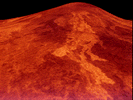
Data from Magellan's imaging radar shows that much of the surface of Venus is covered by lava flows. There are several large
shield volcanoes (similar to Hawaii or Olympus Mons) such as Sif Mons (above). Recently announced findings indicate that Venus is still volcanically active, but only in a few hot spots; for the most part it
has been geologically rather quiet for the past few hundred million years. |
|
|
|
|
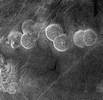
There are no small craters on Venus. It seems that small meteoroids burned up in Venus' dense atmosphere before reaching the surface.
Craters on Venus seem to come in bunches indicating that large meteoroids that do reach the surface usually break up in the atmosphere.The oldest terrain on Venus seem to be about 800 million years old. Extensive
volcanism at that time wiped out the earlier surface including any large craters from early in Venus' history. |
|
|
|
The interior of Venus is probably very similar to that Earth: an iron core about 3000km in radius, a molten rocky mantle comprising the
majority of the planet. Recent results from the Magellan gravity data indicate that Venus' crust is stronger and thicker than had previously been assumed. Like Earth, convention in the mantle produces stress on the
surface, which is relieved in many relatively small regions instead of being concentrated at plate boundaries, as is the case on Earth.Venus has no magnetic field, perhaps because of its slow rotation. It has no
satellites and thereby hangs a tale. Venus is usually visible with the naked eye. Sometimes (inaccurately) referred to as the morning star or the evening star, it is by far the brightest "star" in the sky. |
|