 King
Robert the Bruce King
Robert the Bruce
King
Robert the Bruce King
Robert the Bruce
The Bruce
family, from Brix in Normandy, were in England before William the
Conqueror and were granted land in Galloway, by King David I, in the
12th century.


 Castles

Robert the Bruce's grandfather, Robert Bruce of Annandale, had estates in Huntingdon as well as Scotland. He was one of the claimants to the throne of Scotland on the death of Queen Margaret, Maid of Norway, in 1290 (he was a descendant of King Alexander II). While he was unsuccessful, his son, Robert Bruce, Earl of Carrick and his grandson, Robert the Bruce, refused support for John Balliol, who had been selected by the English King Edward I.
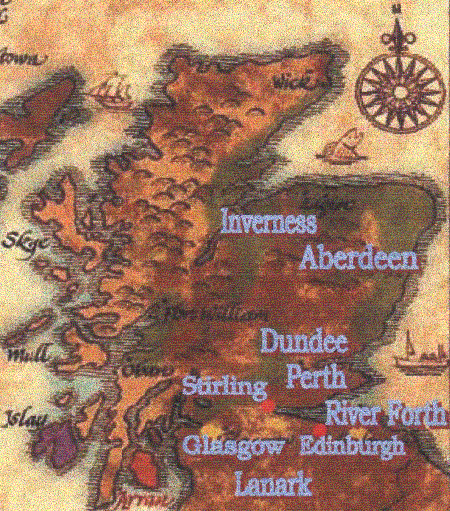
Robert the Bruce was probably born in Turnberry Castle, in Ayrshire, Scotland, on 11th July 1274. However, there are alternative claims for his place of birth, notably Lochmaben Castle in Annandale, Dumfriesshire, Scotland, which was the seat of the Bruce family.
Robert the Bruce lent support to William Wallace and became a Guardian of Scotland (with John Comyn) but when Edward offered a truce in 1302, Robert accepted and joined Edward's "Scottish Council". In 1304, on the death of his father, the Earl of Carrick, Robert was reputedly the richest man in Britain.
But in 1306, after a quarrel with John Comyn, Bruce stabbed Comyn to death and declared himself King of Scotland. He was crowned at Scone, Scotland, in March 1306. He then began a guerilla war against the English King Edward I. Initially he was not successful but gradually, with increasing support, he captured a number of castles - chivalrously allowing the defenders to return to England. During this time, the "Declaration of Arbroath" was sent to the Pope in Rome, pleading the case for a Scotland free of English domination.
Having heavily defeated the English army at the Battle of Bannockburn in 1314 and defeating Edward II's invasion in 1322 by a "scorched earth" policy, Edward III of England eventually agreed to the Treaty of Edinburgh - Northampton in 1328, which recognized Scotland's independence, ending the 30 years of the Wars of Independence.
King Robert was gravely ill by this time and died at Cardross in Scotland on 7th July 1329. His body was buried in Dunfermline Abbey, Scotland. At his request, his heart was taken on a Crusade by James Douglas. In a fight against the Moors in Spain, Douglas was killed and the embalmed heart was returned to Scotland. It was buried in Melrose Abbey. Recently a new stone was placed over the spot where his heart is interred. It says, in Scottish, "A noble hart may hae nae ease, gif freedom failye" - "A noble heart may have no ease if freedom fail".
back to Scotland's Greatest Patriot
