 |
|
|
|
 |

|
 |
|
|
|
|
|
|
|
|
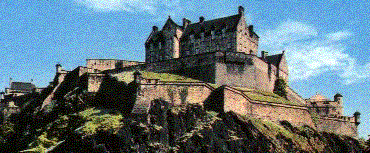
With the exception of St. Margaret's Chapel, nothing survives of the early royal castle. We have King Robert I (the Bruce) to thank for that!
In 1296, King Edward I of England invaded Scotland and Edinburgh Castle soon fell into his hands. A large garrison was installed - 347 strong in the year 1300. After the English kings death in 1307, the English grasp on Scotland weakened. In the Spring of 1314, a surprise night attack led by Sir Thomas Randolph, Earl of Moray and Bruce's nephew, recaptured the castle. It was a daring plan involving a party of thirty handpicked men making the very difficult ascent up the north precipice and taking the garrison by surprise. Bruce immediately ordered the dismantling of the defences to prevent reoccupation by the English. Shortly after, Bruce's army routed the English at the Battle of Bannockburn, near Stirling, Scotland.

|
|
|
|
|
|
|
|
Bruce had adopted a scorched earth policy, once liberating the castles, he would burn them to the ground to prevent English reoccupation. By 1314 only two castles remained : Bothwell and Stirling. Stirling, a "gateway" between north and south Scotland, was the most important. Bruce had given his talented brother, Edward Bruce, the task of bringing the valuable possession into submission, whilst he teamed up with the mighty Angus MacDonald of the Isle, successfully returning the Isle of Man to the Scots. Arriving back after this expedition, Robert the Bruce, was met with the disparaging news that his brother had entered into an agreement with the English guardian of Stirling Castle, Sir Phillip Mowbray. An agreement that would set the stage for a decisive "open" battle between the "decadent," "idle" King Edward II of England and the "industrious", "bold" Robert the Bruce, King of the Scots. A battle neither was prepared to fight, but one neither could refuse.
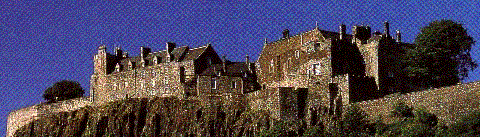
Stirling Castle - is arguably the most magnificent fortress in Scotland. The Battle of Stirling Bridge, is where William Wallace defeated the English army in 1297 ,and paved the way for the decisive victory at nearby Bannockburn in 1314.

