
 Home Home |
|
|
|
 |

|
 |
Gaelic: Brus
Motto: Fuimus (We have been)
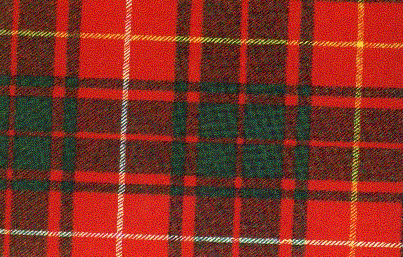
Bruce was a Norman knight from Brix, in France, who came to England in 1066. His son became Lord of Annandale, Scotland, when David I became King of Scotland. At the battle of the Standard, 22nd August 1138, at Northallerton, Robert's son took his own son prisoner. The Bruce's gained their claim to the kinship of Scotland, when the 5th Lord married David's great-granddaughter. The famous Robert the Bruce became King of Scotland, in 1306, and defeated the English at the Battle of Bannockburn, Scotland, in 1314.


Home |
|
|
|
|
|
|
Gaelic - Uallas
Motto: Pro liberate sperandumest (For liberty we hope)
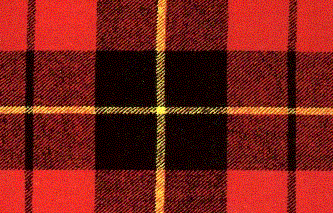
Wallace Clansmen's Crest: A dexter (right) arm in armour, embowed (arched), in hand a sword, all proper.
Wallace comes from the Medieval Latin Wallensis, which means Welsh. Richard Wallace, who lived in the 12th century, obtained lands in Ayrshire, Scotland. His great-grandson was the famous Scottish hero, William Wallace (1274-1305). William led resistance against the English, his guerrilla tactics gaining more and more support from the Scottish nobles as time went on. Eventually, William was betrayed and taken to London, where Edward I had him executed.
Home |
|
|
|
|
|
|
In the Spring of 1297, after his wife had been murdered by the Sheriff of Lanark, William Wallace and a group of his supporters stole into the town late at night. Wallace made his way to the home of Hesilrig and gained revenge for the death of his beloved Marion. The garrison of English soldiers were put to the sword and from surrounding towns and villages men who were bitter of heart, and weighed down by the burden of bondage, flocked to Wallace's banner.
During the early summer months of 1297, Wallace and his volunteer army marched throughout Scotland capturing Castles and Towns, driving the invaders south. In their march north, the towns of Glasgow, Scone, Perth, Dundee(see map) and all the land north of the River Forth and River Clyde was liberated by the Scottish army. Eventually they reached Aberdeen in Scotland, routed the Garrison troops and "destroyed the fleet of 100 English ships".
On the 11th September 1297, William Wallace and another noble Scottish Knight, Andrew De Moray, along with patriots consisting mainly of the common people of Scotland, charged down onto the field at Stirling bridge and flung themselves into "the mightiest army in Christendom." Against a force of 1,000 heavy cavalry and 50,000 foot soldiers, the volunteer Scottish Army fought and defeated the might of Edward Longshanks' invading army. The Scots fought with homemade weapons; knives, axes and wooden spears. They fought for the survival of their nation, a desire for freedom and a belief in one man; William Wallace.
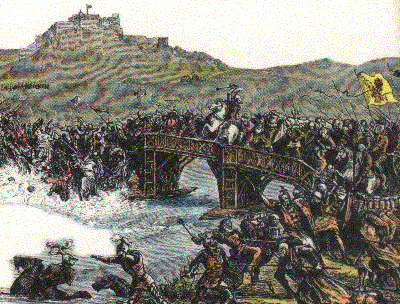
Battle of Stirling Bridge 1297
FREEDOM IS BEST I TELL THEE TRUE
OF ALL THINGS TO BE WON
THEN NEVER LIVE WITHIN THE
BOND OF SLAVERY MY SON

