




|
|
|
|
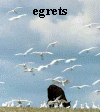
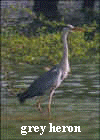
These are long-legged wading birds. They have long slender necks. Their bills are slender, long, pointed and sharp. They are found in lakes, swamps, and estuaries. Cattle Egrets and Pond Herons can be seen in fields all over the place, in lawns and football fields too. The Moorhens breed in large numbers in Carambolim. They live in colonies, or heronries, and nest on trees. The Grey Heron is about 75 cm - 90 cm tall. It is ashy-grey, and has a white crown and neck. It has a long black crest and a black dotted line down the middle of its foreneck. Its beak is long, sharp and pointed. It stands solitary in reedy places. The Purple Heron is slightly smaller than the grey heron. It is bluish grey on top, and has a rufous head and neck. It has distinct linear markings on the face. It eats fish, frogs, snakes. It nests in trees and reed beds. It nests along with its own species, and both the male and female share duties. The Pond Heron is about the size of a village hen. It is an earthy brown when standing, but in flight, the wings, rump and tail are bright white. It is usually solitary, and stands hunched, waiting patiently for food to arrive. Then it extends its neck and jabs at its quarry. It eats frogs, insects, fish. It can be seen in habited areas, and the ones I have observed have been on lawns and fields. It nests from November to January in South India. The Cattle Egret is white and has a yellow beak. It is about 50 cm tall. It has an orangish-beige head and back during breeding. It roosts in large numbers in its favourite tree, and its nesting season is from November to March. It eats chiefly insects, as well as frogs, lizards. and banyan pods.
|