























West Oz's Bear Club

AU/NZ CyBear Club

The place for bear data

Oz.Org IRC chat channel
|
|

Management in One

Quick Messager

Excellent humour

Good font source

XiRCON IRC Client

The official link button

 |
| The
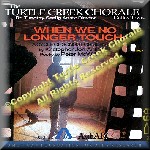
Turtle Creek Chorale are resoundingly moving in this excellent
work that provides a thought provoking look at death and the mourning
process.
The piece is performed by one of the most talented male choruses in the world. They give an unique insight into the process of grieving, celebrating, accepting and denial. A moving piece that, when coupled with the documentary about the group's continuous painful journey of grieving, shows depth of character, love and triumph. |
| When
I was first introduced to the TCC through
two members of the chorale who are now living in the UK, I was
excited by the dynamics of their voices.
This dynamic quality seems to be embalmed into their productions, no matter the subject matter, the seriousness, or the light-heartedness of it. |
|
| "When We No Longer Touch" proves to me that this group can tackle a subject that is so close to their hearts in a strong, compassionate, and professional manner. Many others would fail when their emotions are tied so closely to a performance, but the TCC find strength in the ability to show their continuous process of mourning. | |
| Kristopher Jon Anthony has combined traditional requiem aspects with the excellent understanding that is captured by Peter McWilliams' poetry. Latin and English combine together to produce thought provoking attacks, counters, and lulls. | |
 The
prologue to the process sets the scene. The soloist
capturing the initial shock of realisation that the loved one
has gone, turning to the chorale introducing Requiem Aeternam.
This is countered by questioning. What will I do, becomes what
do I do now? The
prologue to the process sets the scene. The soloist
capturing the initial shock of realisation that the loved one
has gone, turning to the chorale introducing Requiem Aeternam.
This is countered by questioning. What will I do, becomes what
do I do now? |
|
 Denial
comes in the torture of the early days. Wondering why the love
you feel now never seems to be there before. Denial
comes in the torture of the early days. Wondering why the love
you feel now never seems to be there before.
The torture of the early days when the grieving person is still planning to do things with the loved one who is gone, is evoked in the dynamics of contrasting soft, almost spoken words, with strong sections of denial. |
|
 Isolation
from the rest of the world is shown in the fact that you encase
in a hard shell your life. Isolation
from the rest of the world is shown in the fact that you encase
in a hard shell your life.
When a memory occurs that reminds us of the time we had, it breaks the surface, and we fall back into the process. Exaudi Orationem Meam - hear my prayer, captures the feeling of isolation, with a spiritual tone those feelings. A soloist, sometimes unaccompanied, describing the feelings of this time. |
|
 Anger
is excellently portrayed by the Dies Irae.
A classical piece of Latin used in requiems throughout the ages. Anger
is excellently portrayed by the Dies Irae.
A classical piece of Latin used in requiems throughout the ages.
It is introduced by solo questioning of their own insanity. The confusion, whirlwind feelings of anger are typified by the racing introduction to the Dies Irae. The chorale soaring up and down the scales with the highs and lows of anger. |
|
 Bargaining
occurs as the grieving person becomes more used tot he fact that
the loved one has gone. We all question why they had to go. "I
know it was time for us to part, but today?" This
question summarises the bargaining process excellently.
Quid sum miser tunc dicturus? There is not much
to be said beyond this. Bargaining
occurs as the grieving person becomes more used tot he fact that
the loved one has gone. We all question why they had to go. "I
know it was time for us to part, but today?" This
question summarises the bargaining process excellently.
Quid sum miser tunc dicturus? There is not much
to be said beyond this. |
|
 Depression
is formulated by the realisation that you are missing them. Being
torn away from the loved one leads to periods of being "down".
These are often accompanied by tears. Depression
is formulated by the realisation that you are missing them. Being
torn away from the loved one leads to periods of being "down".
These are often accompanied by tears.
The Lacrimosa embodies the feeling of depression in an envelope of emotion that we can feel and understand. |
|
 The
acceptance of the loved one's departing is an
emotional period of the mourning time. Agnus Dei - Lamb
of God - asking for strength from "above". The
acceptance of the loved one's departing is an
emotional period of the mourning time. Agnus Dei - Lamb
of God - asking for strength from "above".
The chorale and soloist bring a soothing feeling that it is perfectly alright to miss the person who is no longer there. "I shall miss loving you" contains the thoughts of times that you spent with the loved one. Remembering the times that you missed them being there, for a hug, for a call, the times they left the home, and the returning from their journeys. This piece never ceases to have me in tears of joy and pain as I personally remember the ones who have gone, who I loved. Eventually there is a time that can be captured by the phrase "I shall miss missing you." |
|
 The
Hope of continuing on with life is typified by the Requiem
Aeternam Donna Eis - grant the loved one eternal rest
from this place. Allow me to continue on. The
Hope of continuing on with life is typified by the Requiem
Aeternam Donna Eis - grant the loved one eternal rest
from this place. Allow me to continue on.
The realisation that through all the times of pain and sadness, the simplicity of a single thought that makes the mourner's spirit lift, is that they have loved. |
|
| I thank
the chorale for a performance that typifies the process of mourning
so well. They have captured the thoughts, feelings, and times
of mourning in a dramatic piece of music.
When Princess Dianna died in September 1997, it was this piece that assisted me to remember her life. I wept when I realised that even though I did not know her personally, I knew her. Thankyou TCC.
|

 ©
Copyright 2000 to Adrian Gould, all rights reserved. All images are original
works unless otherwise noted. Where copyright or original artist is unknown,
their copyright is implied.
©
Copyright 2000 to Adrian Gould, all rights reserved. All images are original
works unless otherwise noted. Where copyright or original artist is unknown,
their copyright is implied.