
Goguryeo's relationship with China
About Goguryo

Politics-Goguryeo's relationship with China


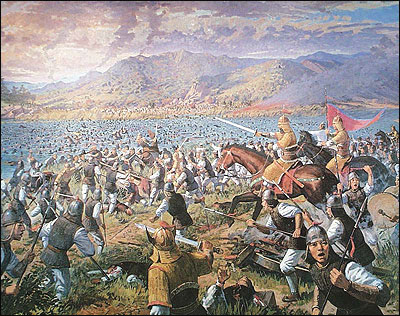
The tributary relationship that Sui and Tang dynasties demanded of Goguryeo, was of a different nature from previous practices. As unified dynasties in Middle China they tried to wield absolute power over the surrounding states. They formally demanded Goguryeo to become a tributary state in fact. When Goguryeo refused this demand, the two dynasties constantly attempted to subdue Goguryeo by use of force to realize a Sino-centric order in the Middle Kingdom. This is the background of the series of conflicts between Goguryeo and the Sui and Tang dynasties.


Chinese scholars argue that Goguryeo was a provincial regime of various dynasties in "Middle China," and try to incorporate the history of Goguryeo into that of China.

Their rational is based on the tributary relationship between the Chinese dynasties and Goguryeo at the time in which Goguryeo paid tributes and received investitures from the Chinese dynasties.


Their argument derives from various historic materials and Chinese documents, which basically treat Goguryeo as a vassal state under the philosophy of "Middle-Kingdom," and describe Goguryeo's diplomatic relations with China in terms of a tribute-investiture system. A superficial reading of Chinese accounts of this system would make Goguryeo a clear case of suzerain-vassal relationship. Let's examine the Chinese argument in more detail.


The Chinese argue that Goguryeo started out in the Chinese domain because it was founded in Xuantu Commandery, one of the Four Han Commanderies of China. Goguryeo, in other words, since the founding, always belonged to Han Dynasty China. Furthermore, the Chinese scholars dismiss the many conflicts that took place between Goguryeo and Chinese dynasties simply on account of their brief durations. They would either ignore or negatively interpret the documents about Goguryeo's invasions of Xuantu and Liaodong Commanderies.


The tribute-investiture system became universal during China's "Southern and Northern Dynasties" period. For this reason, the Chinese historians also treat this period as one in which the practice of investiture was strengthened. They maintain that Goguryeo was subject to Chinese investitures well beyond the fourth century, and that the kings of Goguryeo ruled their people in their capacity as officers of the dynasties in Middle China. The Chinese further insist that there had been no major conflicts between Goguryeo and the Chinese dynasties during this period, thanks to the enlightened policies of friendship and exchange pursued by the Chinese dynasties. With regard to the wars between Goguryeo and Sui (A.D. 581-618) and Tang (A.D. 618-907), the Chinese emphasize that the Chinese expeditions were justified because Goguryeo violated the suzerain-vassal relationship.


The Chinese argument that Goguryeo was a provincial regime of Chinese dynasties is based simply on the tributary relationship. In order to refute this argument, a clear explanation of the historical reality of this system should suffice. It is well known that the tributary system originally was a political order between the Chinese emperor and peripheral provinces. The system subsequently evolved into a diplomatic practice between China and other states.


First, the relationship between Goguryeo and Chinese Xuantu Commandery (during Eastern Han Dynasty A.D. 25-220) was not feudatory as the Chinese insist. On the contrary, Goguryeo was established and saw progress in the process of confrontation against Xuantu.


In short, Goguryeo's relations with Chinese provinces were not peaceful but tension-ridden and confrontational, resulting in a series of conflicts. A clear example of this confrontational situation is the invasion of Goguryeo in AD 244-245 by Kuan-qiu Jian (?-AD 255), a Wei Dynasty (AD 220-266) general.


Second, let's review the Period of Southern and Northern Dynasties in Chinese history, which saw an expansion of the tribute system. The Chinese insist that the system was strengthened and expanded during this period. The reality, however, was that the Chinese power was experiencing break-ups during this period and its grip over the peripheral states was weakening. So, the tributary practice became more of a diplomatic formality between China and the neighboring states, not a prerequisite for dependency. The expansion of tribute-investiture arrangements during this period, in other words, was a phenomenon that appeared as a result of difficulties of the waning Chinese dynasties in maintaining control over the neighboring states.


For example, the number of contacts and frequency between Goguryeo and Northern Wei were so high that no other case could come even close. The contacts between Toyokhon in western China and Northern Wei were the second highest and showed a relatively higher density than other states. Superficially, these frequent contacts seem to represent a faithful practice of the tributary relationship. The reality, however, was exactly the opposite. Goguryeo and Toyokhon were among the strongest of the states surrounding Northern Wei, and so these two states were able to assert their political independence more strongly than any other state in Wei's periphery.


The Northern Chinese dynasties used to recognize Goguryeo's independence through the investiture of titles. But, there is factual evidence that show Northern Wei's affirmation of Goguryeo's independent sphere of power: In many cases the investitures Wei offered to Goguryeo were the highest ever in history; Among Wei's investitures conferred on Goguryeo, many were the highest titles authorizing the exercise of exclusive responsibilities for external relations over the Eastern states; Furthermore, Wei did not offer any investiture to any other state or political entity in the Northeastern region.


Most importantly, the tributary relationship was simply a diplomatic formality that was practiced among all East Asian states at the time. It is, therefore, logically inconsistent to single out Goguryeo and treat it as China's provincial regime simply on the basis of tributary relationship. The tributary relationship between the Chinese dynasties and Goguryeo was no different from those practiced between China and Baekje, Silla and old Japan. If Goguryeo were treated as one of Chinese provincial regimes on account of such a nominal formality, then, logically Baekje, Silla and old Japan should also be treated as such.


Another notable fact is that even though Goguryeo was a tributary state of China, it did embrace a number of states and political forces within its own sphere of influence and maintained a self-reliant world-view. In other words, Goguryeo had set up its own sphere of influence and instituted a tributary relationship of its own with Silla and Baekje.


Consequently, it is difficult to believe that Goguryeo voluntarily complied with China's tributary system and behaved as a vassal state serving the various dynasties in Middle China.


Meanwhile, the tributary relationship that Sui and Tang dynasties demanded of Goguryeo, was of a different nature from previous practices. As unified dynasties in Middle China they tried to wield absolute power over the surrounding states. They formally demanded Goguryeo to become a tributary state in fact. When Goguryeo refused this demand, the two dynasties constantly attempted to subdue Goguryeo by use of force to realize a Sino-centric order in the Middle Kingdom. This is the background of the series of conflicts between Goguryeo and the Sui and Tang dynasties.


This analysis demonstrated that the logic behind Chinese argument to claim the history of Goguryeo as part of its own on account of tributary relationship is based on a highly vulnerable ground because it lacks the evidence-based analysis of historical materials, which should be the basic approach to interpretations of history. Indeed, the real historical facts concerning tributary relationship do provide a basis that will confirm the self-reliant world Goguryeo had built in East Asia.


Written by Im Ki-hwan who is a professor of history at Hanshin University.
http://www.prkorea.com


Issues | About Goguryo | China's Policy | Korea's Position

Home | About Me | Bibliography | E-mail
Hosted by www.Geocities.ws

1