

Barry Allen
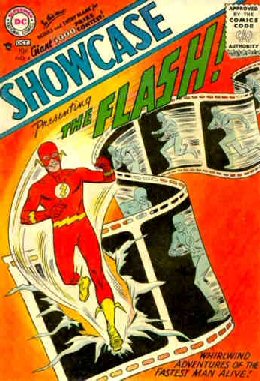 DC's Silver Age of comics has most often been tied in with the reintroduction of the super hero The Flash in Showcase #4 in 1958. Comic books based on super-heros has been sagging for several years, and with the exception of standard Superman and Batman, it seemed that the genre was on its way into fad history. However, seeing the opportunity to revisit classic ideas, the publishing company decided to "revamp" some of it's classic heroes to see what success might be had.
The reintroduction of the Flash came with several changes, and several similarities to the Golden Age's Jay Garrick. The Flash was still a mild-mannered scientist, who's real-life persona seemed to be chronically late. He was then transformed while working in his laboratory and managed to keep his secret-identity from those closest to him. While Jay was only a scientist, Barry Allen worked as a forensic scientist for a police department. It was while working in his police lab that a bolt of lightning crashed through a window and struck Barry, forcing him into a shelf full of chemicals. This chemical bath endoed mild-mannered Barry Allen with the gift of super-speed and the ability to fight for justice outside the sterile environment of his lab.
The changes and similarities seemed to be enough, though. The Flash was an instant hit, starring in several more issues of Showcase before being given his own series. As a further tribut to it's Golden Age star, DC began number Barry Allen's series The Flash, with number 105, right whtere Jay Garrick's Flash Comics had ended more then a decade before.
 Barry's Personal life was centered around his relationship with Iris West, his fiancee and eventually, his wife. Strong and somewhat independent, Iris was always frustrated with how her fiancee never seemed to be able to get anywhere on time. Iris had a nephew who was a huge fan of the Flash, named Wally West. Wally the president of his city's Flash Fan Club, and was thrilled to learn that Aunt Iris's boyfriend could arrange a meeting with the Scarlet Speedster. Bored with the boring police scientist and anxious to meet his idol, Wally was only half-listening to Barry as he recounted the accident which gave the Flash his powers. In the middle of the story, however, the unthinkable happened when the same accident reoccurred, granting Wally the same super powers it gave Barry. And thus, in The Flash #110 "Kid Flash" was born.
Eventaully, Iris and Barry were married, and the Flash began considering whether it was time to share his secret with Iris. Perhaps she would be a bit more understanding of his chronic tardiness if she knew that he was fighting crime as the Flash. Barry knew he somehow had to tell Iris his secret life as the Flash, but he wrestles with the how and when for quite sometime. In a rather amusing and awkward issue, he finally reveals to her who he is, only to find out Iris has known since they were married, because Barry talked outloud in his sleep.
 Once well established, The Flash provided a spring board for other DC characters. Seeing the sucess of the revamped Flash, DC began reimagining several of their classic characters: Green Lantern, The Spectre, Dr. Fate, the Atom, Hawkman, and others. Seeing the growing popularity of all their super-heroes, DC deicded to let loose, and team their most popular heroes together. Thus, The Justice League of America was born. Again a tribute to a Golden Age idea, the Justice League was a nod to the classic Justice Society of America from years before.
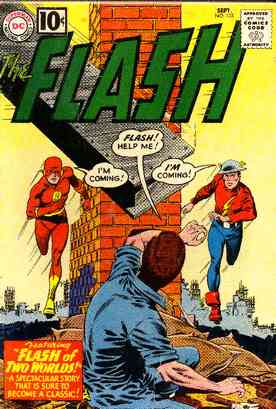
With all these reintroductions and reimaginings, it was only logical for both fans and writers alike to wonder: what would happen if the new characters met their classic counterparts? Once again, DC used the Flash to explore new territory to examine exactly what it might be like for contemporary heroes to meet the Golden Age versions of themselves. In The F lash #123, DC opened up the concept of Earth-1 and Earth-2, two planets in two separate dimensions, one that was home to all of the Golden Age versions of their superheroes, another one with all of the contemporary versions.
This concept fueled the DC Universe for decades, for more information on it, see the page on the History of the DC Universe. Eventually, Barry's character became the epitome of a hero: an excellent father-figure to Kid Flash, the perfect husband, an example of clean living and an upstanding role-model. However, perfection does not inspire interesting storylines. To keep a comic from growing stale, DC had learned there must be constant conflict, or eventually Barry Allen would have the same fate as Jay Garrick. And so, in The Flash #276, Iris Allen was murdered Flash's archnemsis, Dr. Zoom the Reverse Flash.
This of course devastated Barry, who briefly suffered a mental breakdown and was unable to tell friend from foe. Eventually, though, he regained his clarity and, through the help and support of his friends, was able to resume his life, both personally and professionally. However, his world was turned upside-down.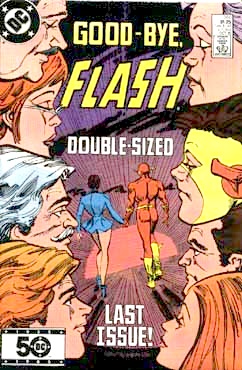 He was eventually able to love again, and Barry began seeing a woman by the name of Fiona Webb. They dated seriously and eventually were engaged. Dr. Zoom once again surfaced and made an attempt to kill Fiona, but at the last minute Flash was able to grab Zoom, accidentally killing him.
Thus began the Trial of the Flash. Flash was tried for murder in the criminal justice system, but in true comicbook form, time anomalies and futuristic science were able to not only reunite Barry and Iris, his one true love, but also allow him to be seen as a vindicated hero in the eyes of the world. Still devastated by the recent events of his life, Flash left our time to be with his love, Iris, in the 30th century. His regular series ended with issue #350. Iris and Barry lived together outside of out time until Barry was once again called on to protect and serve, this time on a grander scale. In Crisis on Infinite Earths (See History of the DC Universe) Barry was called on by the executives at DC to resolve a multiversal crisis which had its roots in his "discovery" of Earth-2. The crisis saved the lives of countless millions, combining alternate dimensions into a streamlined single DC Universe, but at the cost of his own. He died a hero, and in his life and death, inspired many others to be a hero as well.