

 history of the DC Universe
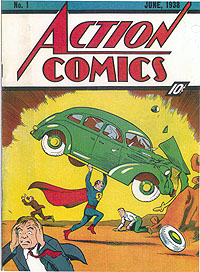
DC has existed in one form or another for many years. By far, it's biggest success has been of course, the iconic Superman, shown here in his first appearance in Action Comics #1. The famous Krpytonian will turn 67 this year, and still doesn't look a day over 30. Over the years, DC has had to reimagine and reinvent each character to adjust with changing times and changing societal demands. Originally, Superman, the Flash, and Batman only had to worry about bank robbers and kidnappers. Now, psychotic mass murderers and terrorists have taken their place.
In the late 30s/early 40s, comics depicted American zeal and hope during the war in Europe. This "Golden Age" spawned many of the most memorable comic book characters: Superman, Batman, Wonderwoman, the Flash, Green Lantern, the Atom, and many others. In their comics, they fought for "Truth, Justice, and the American Way." In the real world, they fought for American idealism. However, once the war with fascism ended, a new one started in it's place: the Cold War. Gone were the days when bad guys were obvious. The new war was fought with spies, lies, and secrets. The war against domestic communism was waged even against our classic heroes. Those with secret-identities were look upon with suspicion, both in the pages of the books and in real life. Waning sales caused DC to cancel most of their regular series, and 50s looked like they might be the end of superheroes.
Dawn of the Silver Age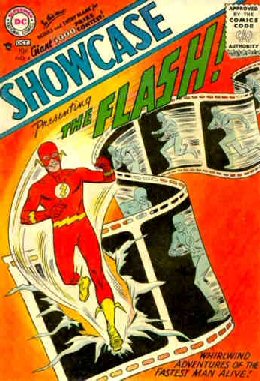
As sales waned, executives looked for a way to boost sales. Remembering past glories, they new at one time the American public enjoyed and even identified with those classic characters. Deciding to try a new spin, the began reimagining the classic superheroes and giving them new looks, abilities, or personalities. The Silver Age had begun. Deciding to try and stay within the limits of growing conservatism, they made many of the "new" heroes simply an outstretch of law enforcement. Batman had a close relationship with Police Commissioner Gordon, the Flash's alter ego was a police scientist, even Green Lantern became a member of the interstellar Green Lantern Corps. Morals standards in the books were dictated by the Comics Code Authority, which regulated everything from the depiction of women to exactly which crimes the criminals were allowed to commit.
Also at this time was the growing interest in Science Fiction writings. While superhero comics had waned during the 50s, science fiction books such as Flash Gordon and Adam Strange had grown in popularity. This spurred DC to take their characters in new directions. As was already mentioned, Green Lantern became a member of an interstellar police force. They then had the Flash begin traveling between dimensions and through time.
In The Flash #123, Barry Allen was able to use his super-speed to vibrate between dimensions. This landed him in what was termed "Earth-2." This dimension contained all the physical details of the current DC Universe, with the exception being that it had all the classic Golden Age versions of the heroes. What DC thought would be an interesting storyline in the following decades turned into the proverbial can of worms. Writers were given the ability to disregard whatever the current situation of a particular hero was. They could put them in whole new scenarios and simply say the story was from an alternate dimension of earth. Batman could marry Catwoman, Superman and Lois could marry and retire, and nobody would have to worry about continuity.
Except for the reader, of course.
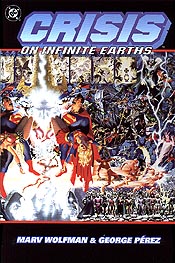 Faithful subscribers wanted to be able to know when they picked up an issue, was this the same Batman whose daughter was Huntress? Was this Superboy from Krypton or from Earth-2? Questions continued mounting until DC realized a crisis was at hand. This crisis was given a name in 1985, a Crisis on Infinite Earths. In this miniseries set out to clean house and reboot DC continuity. It eliminated DC's multi-dimensional universe setup, combining all storylines into a single timestream. Jay Garrick and Barry Allen both existed on the same Earth, in neighboring cities. Superman and Lois Lane never married. Any plots that could not be streamlined were discarded as though they never happened. Supergirl died. And to save what heroes and universes were lift, Barry Allen died in a timestream vortex, preventing it from encompassing the rest of the universe.
Since COIE, DC has had a few other events to try and "brush up" continuity problems caused with time travel and interdimensional visits, but for the most part, the heroes today are living in the same world they did in the mid-80s. We'll see what tomorrow brings.