|
|
||||||
|
About Batik and Processing |
|||||||
  
    
|
The first time the batik was used as the royals clothes on Java at the several centuries ago, furthermore batik become everyday clothes for Javanese community. Although the batik identical with the Javanese traditional dress, but batik has been the national dress for Indonesian community, moreover batik famed on overseas. The making use of batik had no longer the traditional dress only but it follow the fashion developments all for men and women. Moreover batik have been used for interior decoration, home furnishing, etc. The diverse of batiks divided in two groups,
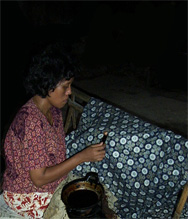
The Classical Batik The classical batik, has the high value and having high art savoir vivre by the difficult process of making and for weeks at a time. The traditional batik has the basic patterns with various motifs such as kawung, parang, nitik, truntum, ceplok, tambal, etc. Basic material for batik is the white cotton best quality or silk. Material batik use silk was going to result the clear and life colors. The Classical Batik Processing Almost everyone has seen a batik at one time or another. Many have even witnessed their manufacture. At least many people think so, if they have visited a batik workshop on a journey through Jogja, with women drawing patterns on a white piece of kain with a canting. This process, by means of which some wax is applied, is, however, only one of numerous operations the kain has to undergo before it becomes proper batik.
Preparation A white cotton or silk kain with a width of some 110 cm and a length of 240 cm receives an initial treatment to render it fit for further processing. This initial treatment involves washing, starching, drying and beating and can take several days.
Pattern Once the material is ready for further processing, the patterns are applied by one ore more motif or draw the pattern straight from the hand. Once the design has been drawn on kain, it is copied in the separate colors. It is also possible to just mark the outlines of the design, thereby making it possible to cover the surface afterward. The copying is done by means of a thin trickle of fluid malam (=wax) from the spout of the canting. These canting exist in different sizes. They can best be compared to small brass teapots the size of a tobacco pipe, with the wooden handle. The thinner the spout, the smaller the flow of wax.
|