|
|
||||
|
About Batik and Processing |
||||
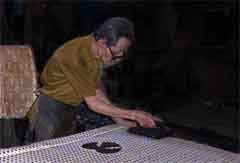
The wax is first heated to render it fluid. It is essential that it has the correct temperature. The batik technique involves application of the same pattern in the same place on both sides of the kain, so that technically there is no difference between the two sides. The parts that are to be dyed brown are initially also covered in wax. As a rule different types of wax are used that can be removed independently from each other. Dyeing The kain is now ready to be submerged in the blue dye. This process is frequently repeated until the desired result has been achieved, sometimes no fewer than 30 times for a top-quality product. Traditionally the dyeing agent was indigo. The remarkable thing about indigo is that its characteristic color does not become apparent until it is left to dry and comes into contact with oxygen. When the kain is still wet, the wax is scraped off the parts of the pattern that are to become brown. Subsequently the parts that have been dyed blue and are to remain blue are also covered in wax. Now the kain is submerged in the brown dye. The traditional brown dye is soga, a special kind of tree bark. For a good result no fewer than 15 days of dyeing with 3 immersions each day maybe necessary. The areas that at first were dyed blue and have now been treated with brown dye as well have by now acquired a black color. This implies that the use of two types of dye has resulted in three colors: blue, brown, and black while some of the kain is still white. Removing the wax After the layers of dye have been applied, the dye is fixed. After that all the wax can be removed, this is done by melting it in hot water, the fluid wax will float on the surface. Subsequently the kain is washed. Applying the batik to silks simply necessitates different techniques, because different waxes and dyes are required to protect the tender silk against possible damage. The batik production process mention above is called batik tulis (tulis = write, draw), handwrite batik. Other type is batik cap (= stamp), stamp batik, this cap was used to stamp the wax onto the kain (see picture below), the stamp tools were made from copper that has the shape of pattern where on it surface had small channel to place liquid wax. The dye process as same as with the batik tulis.
_________________________________________________________________ The well known traditional batik have various size and nomenclature, ie : batik kain panjang the width of 110 cm X length of 240 cm, batik kain sarung (about 105cmX200cm), selendang (45~60cmX200~300cm), iket kepala (90cmX90cm) and kemben (60cmX200cm).
For daily use batiks are marketed as materials: all sorts of different clothing for gents and ladies; or interior decoration for houses, offices or hotels; or pillowcases, bedcovers, bed sheets, or as table cloths, napkins, place mats, bags, etcetera.
|